


Page 2170 - Hematology_ Basic Principles and Practice ( PDFDrive )
P. 2170
Chapter 129  Laboratory Evaluation of Hemostatic and Thrombotic Disorders  1923


                                                           Vessel
                                                            injury


                                             vWF and platelet       ↑TF+VIIa
                                                adhesion
                                                                      IXa         IX
                                             Platelet               X                       Xa
                            Platelet        activation                                    Blood coagulation
                          contribution   ADP        PAR1  PAR4                           protein contribution
                         to hemostasis                               THROMBIN     II       to hemostasis
                                          Epi
                                       Collagen     PAR1*  PAR4*
                                           PAF                      Fibrin                   Fb
                                                 Platelet
                                                aggregation


                                                          Hemostatic
                                                             plug


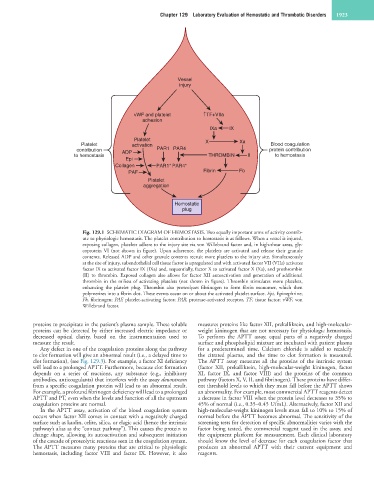
                            Fig. 129.1  SCHEMATIC DIAGRAM OF HEMOSTASIS. Two equally important arms of activity contrib-
                            ute to physiologic hemostasis. The platelet contribution to hemostasis is as follows. When a vessel is injured,
                            exposing collagen, platelets adhere to the injury site via von Willebrand factor and, in high-shear areas, gly-
                            coprotein VI  (not  shown  in  figure).  Upon  adherence,  the  platelets  are  activated  and  release  their  granule
                            contents. Released ADP and other granule contents recruit more platelets to the injury site. Simultaneously
                            at the site of injury, subendothelial cell tissue factor is upregulated and with activated factor VII (VIIa) activates
                            factor IX to activated factor IX (IXa) and, sequentially, factor X to activated factor X (Xa), and prothrombin
                            (II)  to  thrombin.  Exposed  collagen  also  allows  for  factor  XII  autoactivation  and  generation  of  additional
                            thrombin  in  the  milieu  of  activating  platelets  (not  shown  in  figure). Thrombin  stimulates  more  platelets,
                            enhancing  the  platelet  plug. Thrombin  also  proteolyzes  fibrinogen  to  form  fibrin  monomer,  which  then
                            polymerizes into a fibrin clot. These events occur on or about the activated platelet surface. Epi, Epinephrine;
                            Fb, fibrinogen; PAF, platelet-activating factor; PAR, protease-activated receptor, TF, tissue factor; vWF, von
                            Willebrand factor.


            proteins to precipitate in the patient’s plasma sample. These soluble   measures proteins like factor XII, prekallikrein, and high-molecular-
            proteins can be detected by either increased electric impedance or   weight kininogen that are not necessary for physiologic hemostasis.
            decreased  optical  clarity,  based  on  the  instrumentation  used  to   To  perform  the  APTT  assay,  equal  parts  of  a  negatively  charged
            measure the result.                                   surface and phospholipid mixture are incubated with patient plasma
              Any defect in one of the coagulation proteins along the pathway   for  a  predetermined  time.  Calcium  chloride  is  added  to  recalcify
            to clot formation will give an abnormal result (i.e., a delayed time to   the  citrated  plasma,  and  the  time  to  clot  formation  is  measured.
            clot formation), (see Fig. 129.3). For example, a factor XI deficiency   The  APTT  assay  measures  all  the  proteins  of  the  intrinsic  system
            will lead to a prolonged APTT. Furthermore, because clot formation   (factor  XII,  prekallikrein,  high-molecular-weight  kininogen,  factor
            depends  on  a  series  of  reactions,  any  substance  (e.g.,  inhibitory   XI,  factor  IX,  and  factor  VIII)  and  the  proteins  of  the  common
            antibodies, anticoagulants) that interferes with the assay downstream   pathway (factors X, V, II, and fibrinogen). These proteins have differ-
            from a specific coagulation protein will lead to an abnormal result.   ent threshold levels to which they must fall before the APTT shows
            For example, a profound fibrinogen deficiency will lead to a prolonged   an abnormality. For example, most commercial APTT reagents detect
            APTT and PT, even when the levels and function of all the upstream   a decrease in factor VIII when the protein level decreases to 35% to
            coagulation proteins are normal.                      45% of normal (i.e., 0.35–0.45 U/mL). Alternatively, factor XII and
              In the APTT assay, activation of the blood coagulation system   high-molecular-weight kininogen levels must fall to 10% to 15% of
            occurs when factor XII comes in contact with a negatively charged   normal before the APTT becomes abnormal. The sensitivity of the
            surface such as kaolin, celite, silica, or elagic acid (hence the intrinsic   screening tests for detection of specific abnormalities varies with the
            pathway’s alias as the “contact pathway”). This causes the protein to   factor being tested, the commercial reagent used in the assay, and
            change shape, allowing its autoactivation and subsequent initiation   the equipment platform for measurement. Each clinical laboratory
            of the cascade of proteolytic reactions seen in the coagulation system.   should know the level of decrease for each coagulation factor that
            The APTT measures many proteins that are critical to physiologic   produces  an  abnormal  APTT  with  their  current  equipment  and
            hemostasis,  including  factor  VIII  and  factor  IX.  However,  it  also   reagents.

