


Page 2171 - Hematology_ Basic Principles and Practice ( PDFDrive )
P. 2171
1924   Part XII  Hemostasis and Thrombosis


                                          XII                                VII
                                       HK
                                       PK
                                                          Tissue factor
                                         XIIa  XI                            VIIa

                               Amplification
                                                                 Tissue factor/VIIa
                                               XIa      IX
                                                PL, Ca ++                   Initiation
                                                           Ca ++
                                                        IXa       X
                                                                     Ca ++
                                                    PL, Ca ++                Tenase
                                       VIII            VIIIa     Xa
                                                     Prothrombin
                                                                  PL, Ca ++
                                                                             Prothrombinase
                                                                 Va      V
                                                      Thrombin
                                           Fibrinogen             XIII

                                                               Ca ++
                                      Soluble fibrin monomers


                                       Polymerized fibrin clot    XIIIa

                                   Covalently cross-linked fibrin clot
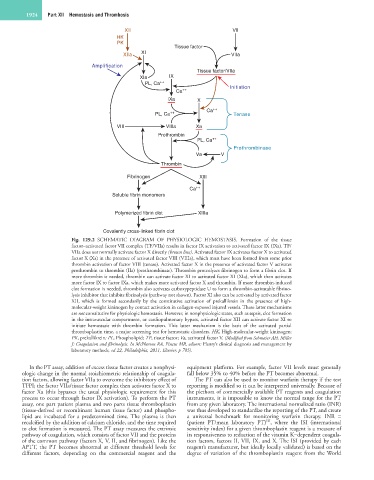
                        Fig.  129.2  SCHEMATIC  DIAGRAM  OF  PHYSIOLOGIC  HEMOSTASIS.  Formation  of  the  tissue
                        factor–activated factor VII complex (TF/VIIa) results in factor IX activation to activated factor IX (IXa). TF/
                        VIIa does not normally activate factor X directly (brown line). Activated factor IX activates factor X to activated
                        factor X (Xa) in the presence of activated factor VIII (VIIIa), which must have been formed from some prior
                        thrombin activation of factor VIII (tenase). Activated factor X in the presence of activated factor V activates
                        prothrombin to thrombin (IIa) (prothrombinase). Thrombin proteolyzes fibrinogen to form a fibrin clot. If
                        more thrombin is needed, thrombin can activate factor XI to activated factor XI (XIa), which then activates
                        more factor IX to factor IXa, which makes more activated factor X and thrombin. If more thrombin-induced
                        clot formation is needed, thrombin also activates carboxypeptidase U to form a thrombin-activatable fibrino-
                        lysis inhibitor that inhibits fibrinolysis (pathway not shown). Factor XI also can be activated by activated factor
                        XII,  which  is  formed  secondarily  by  the  constitutive  activation  of  prekallikrein  in  the  presence  of  high-
                        molecular-weight kininogen by contact activation in collagen-exposed injured vessels. These latter mechanisms
                        are not constitutive for physiologic hemostasis. However, in nonphysiologic states, such as sepsis, clot formation
                        in the intravascular compartment, or cardiopulmonary bypass, activated factor XII can activate factor XI to
                        initiate  hemostasis  with  thrombin  formation.  This  latter  mechanism  is  the  basis  of  the  activated  partial
                        thromboplastin time, a major screening test for hemostatic disorders. HK, High-molecular-weight kininogen;
                        PK, prekallikrein; PL, Phospholipid; TF, tissue factor; Va, activated factor V. (Modified from Schmaier AH, Miller
                        J: Coagulation and fibrinolysis. In McPherson RA, Pincus MR, editors: Henry’s clinical diagnosis and management by
                        laboratory methods, ed 22, Philadelphia, 2011, Elsevier, p 785).

           In the PT assay, addition of excess tissue factor creates a nonphysi-  equipment platform. For example, factor VII levels must generally
        ologic change in the normal stoichiometric relationship of coagula-  fall below 35% to 40% before the PT becomes abnormal.
        tion factors, allowing factor VIIa to overcome the inhibitory effect of   The PT can also be used to monitor warfarin therapy if the test
        TFPI; the factor VIIa/tissue factor complex then activates factor X to   reporting is modified so it can be interpreted universally. Because of
        factor Xa (this bypasses the usual physiologic requirement for this   the plethora of commercially available PT reagents and coagulation
        process to occur through factor IX activation). To perform the PT   instruments, it is impossible to know the normal range for the PT
        assay, one part patient plasma and two parts tissue thromboplastin   from any given laboratory. The international normalized ratio (INR)
        (tissue-derived or recombinant human tissue factor) and phospho-  was thus developed to standardize the reporting of the PT, and create
        lipid  are  incubated  for  a  predetermined  time. The  plasma  is  then   a  universal  benchmark  for  monitoring  warfarin  therapy.  INR  =
                                                                                        ISI
        recalcified by the addition of calcium chloride, and the time required   (patient  PT/mean  laboratory  PT) ,  where  the  ISI  (international
        to clot formation is measured. The PT assay measures the extrinsic   sensitivity index) for a given thromboplastin reagent is a measure of
        pathway of coagulation, which consists of factor VII and the proteins   its responsiveness to reduction of the vitamin K−dependent coagula-
        of the common pathway (factors X, V, II, and fibrinogen). Like the   tion factors, factors II, VII, IX, and X. The ISI (provided by each
        APTT,  the  PT  becomes  abnormal  at  different  threshold  levels  for   reagent’s manufacturer, but ideally locally validated) is based on the
        different  factors,  depending  on  the  commercial  reagent  and  the   degree of variation of the thromboplastin reagent from the World

