


Page 2172 - Hematology_ Basic Principles and Practice ( PDFDrive )
P. 2172
Chapter 129  Laboratory Evaluation of Hemostatic and Thrombotic Disorders  1925


               Surface                               Tissue       TCT, as indicated by values outside the 95% confidence interval for
              activation                             factor       the time to clot of a population of 20 or more normal donors, sug-
                                                                  gests  reduced  fibrinogen  levels  (usually  <100 mg/dL),  abnormal
                                                                  fibrinogen function, or the presence of an inhibitor of the exogenous
                Intrinsic                          Extrinsic      thrombin (e.g., heparin or a direct thrombin inhibitor). The TCT
                                                                  can also be elevated if there is interference with fibrin polymerization,
                   XII, PK                                        which  can  be  caused  by  elevated  levels  of  fibrinogen  degradation
                       HK                                         products or the presence of a paraprotein. Some drugs, such as val-
                          XI                  VII                 proic acid, also cause elevation of the TCT. 9
                            IX
                              VIII                                EVALUATION OF SPECIFIC COAGULATION
                                                                  PROTEIN DEFECTS
                                 Common
                                                                  When the APTT, PT, or TCT indicate a coagulation protein defect,
                                    X                             the plasma concentration of the coagulation factors should be evalu-
               Activated partial    V         Prothrombin         ated. Factor assays determine the nature and severity of coagulation
                thromboplastin       II       time                protein defects, and can also be used to monitor factor replacement
                         time                                     therapy.  Coagulation  protein  defects  can  take  three  forms:  a  true
                                 Fibrinogen                       protein deficiency; an abnormal protein that cannot participate in its
                                                                  physiologic function(s); or an inhibitor that targets the active site of
                                                                  the protein or enhances its clearance. Inherited protein deficiencies
                                                                  and  abnormalities  can  be  caused  by  deletions,  insertions,  and
                                                 Thrombin         missense/nonsense  mutations  in  individual  genes.  Inhibitors  are
                                                    time          generally immunoglobulins, although abnormally produced endog-
                                                                  enous heparin, fibronectin, or cryoglobulins can also serve as acquired
                                                                  inhibitors to coagulation proteins.
                                                                    If  a  coagulation  protein  defect  is  suspected,  clinical  laboratory
                                   Fibrin                         testing can be done with immunologic, chromogenic or clot-based
                                                                  assays. Clot-based assays for coagulation proteins are functional: they
                                                                  will be abnormal with both true deficiencies and dysfunctional pro-
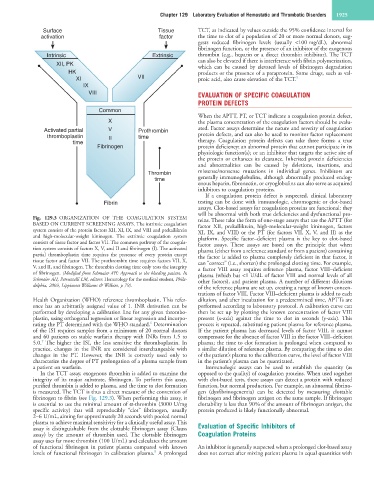
            Fig.  129.3  ORGANIZATION  OF  THE  COAGULATION  SYSTEM   teins. These take the form of one-stage assays that use the APTT (for
            BASED ON CURRENT SCREENING ASSAYS. The intrinsic coagulation   factor  XII,  prekallikrein,  high-molecular-weight  kininogen,  factors
            system consists of the protein factors XII, XI, IX, and VIII and prekallikrein   XI, IX, and VIII) or the PT (for factors VII, X, V, and II) as the
            and  high-molecular-weight  kininogen.  The  extrinsic  coagulation  system   platform.  Specific  factor–deficient  plasma  is  the  key  to  clot-based
            consists of tissue factor and factor VII. The common pathway of the coagula-  factor  assays.  These  assays  are  based  on  the  principle  that  when
            tion system consists of factors X, V, and II and fibrinogen (I). The activated   plasma (either from a reference standard or from a patient) containing
            partial  thromboplastin  time  requires  the  presence  of  every  protein  except   the factor is added to plasma completely deficient in that factor, it
            tissue factor and factor VII. The prothrombin time requires factors VII, X,   can “correct” (i.e., shorten) the prolonged clotting time. For example,
            V, and II, and fibrinogen. The thrombin clotting time only tests the integrity   a  factor VIII  assay  requires  reference  plasma,  factor VIII–deficient
            of fibrinogen. (Modified from Schmaier AH: Approach to the bleeding patient. In   plasma (which has <1 U/dL of factor VIII and normal levels of all
            Schmaier AH, Petruzzelli LM, editors: Hematology for the medical student, Phila-  other factors), and patient plasma. A number of different dilutions
            delphia, 2003, Lippincott Williams & Wilkins, p 79).  of the reference plasma are set up, creating a range of known concen-
                                                                  trations of factor VIII. Factor VIII–deficient plasma is added to each
            Health Organization (WHO) reference thromboplastin. This refer-  dilution, and after incubation for a predetermined time, APTTs are
            ence has an arbitrarily assigned value of 1. INR derivation can be   performed according to laboratory protocol. A calibration curve can
            performed by developing a calibration line for any given thrombo-  then be set up by plotting the known concentration of factor VIII
            plastin, using orthogonal regression or linear regression and incorpo-  present  (x-axis)  against  the  time  to  clot  in  seconds  (y-axis).  This
                                                  6
            rating the PT determined with the WHO standard.  Determination   process is repeated, substituting patient plasma for reference plasma.
            of the ISI requires samples from a minimum of 20 normal donors   If the patient plasma has decreased levels of factor VIII, it cannot
            and 60 patients on stable warfarin therapy with INRs from 1.5 to   compensate for the absence of factor VIII in the factor VIII–deficient
               7
            5.0.  The  higher  the  ISI,  the  less  sensitive  the  thromboplastin.  In   plasma; the time to clot formation is prolonged when compared to
            practice,  changes  in  the  INR  are  considered  interchangeable  with   a similar dilution of reference plasma. By comparing the time to clot
            changes  in  the  PT.  However,  the  INR  is  correctly  used  only  to   of the patient’s plasma to the calibration curve, the level of factor VIII
            characterize the degree of PT prolongation of a plasma sample from   in the patient’s plasma can be quantitated.
            a patient on warfarin.                                  Immunologic  assays  can  be  used  to  establish  the  quantity  (as
              In the TCT assay, exogenous thrombin is added to examine the   opposed to the quality) of coagulation proteins. When used together
            integrity  of  its  major  substrate,  fibrinogen. To  perform  this  assay,   with clot-based tests, these assays can detect a protein with reduced
            purified thrombin is added to plasma, and the time to clot formation   function, but normal production. For example, an abnormal fibrino-
            is measured. The TCT is thus a direct measure of the conversion of   gen  (dysfibrinogenemia)  can  be  detected  by  measuring  clottable
            fibrinogen to fibrin (see Fig. 129.3). When performing this assay, it   fibrinogen and fibrinogen antigen on the same sample. If fibrinogen
            is essential to use the minimal amount of α-thrombin (3000 U/mg   clottability is less than 90% of the amount of fibrinogen antigen, the
            specific  activity)  that  will  reproducibly  “clot”  fibrinogen,  usually   protein produced is likely functionally abnormal.
            2–6 U/mL, aiming for approximately 20 seconds with pooled normal
            plasma to achieve maximal sensitivity for a clinically useful assay. This
            assay is distinguishable from the clottable fibrinogen assay (Clauss   Evaluation of Specific Inhibitors of
            assay)  by  the  amount  of  thrombin  used. The  clottable  fibrinogen   Coagulation Proteins
            assay uses far more thrombin (100 U/mL) and calculates the amount
            of  functional  fibrinogen  in  patient  plasma  compared  with  known   An inhibitor is generally suspected when a prolonged clot-based assay
                                                    8
            levels of functional fibrinogen in calibration plasma.  A prolonged   does not correct after mixing patient plasma in equal quantities with

