


Page 2199 - Hematology_ Basic Principles and Practice ( PDFDrive )
P. 2199
1946   Part XII  Hemostasis and Thrombosis


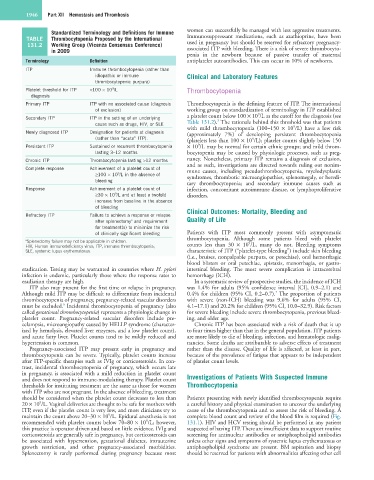
                  Standardized Terminology and Definitions for Immune   women can successfully be managed with less aggressive treatments.
          TABLE   Thrombocytopenia Proposed by the International   Immunosuppressant  medications,  such  as  azathioprine,  have  been
          131.2   Working Group (Vicenza Consensus Conference)    used in pregnancy but should be reserved for refractory pregnancy-
                  in 2009                                     associated ITP with bleeding. There is a risk of severe thrombocyto-
                                                              penia  in  the  newborn  because  of  passive  transfer  of  maternal
         Terminology          Definition                      antiplatelet autoantibodies. This can occur in 10% of newborns.
         ITP                  Immune thrombocytopenia (rather than
                                idiopathic or immune          Clinical and Laboratory Features
                                thrombocytopenic purpura)
                                      9
         Platelet threshold for ITP   <100 × 10 /L            Thrombocytopenia
           diagnosis
         Primary ITP          ITP with no associated cause (diagnosis   Thrombocytopenia is the defining feature of ITP. The international
                                of exclusion)                 working group on standardization of terminology in ITP established
                                                                                     9
         Secondary ITP        ITP in the setting of an underlying   a platelet count below 100 × 10 /L as the cutoff for the diagnosis (see
                                                                        3
                                cause such as drugs, HIV, or SLE  Table 131.2).  The rationale behind this threshold was that patients
                                                                                                 9
                                                              with  mild  thrombocytopenia  (100–150  ×  10 /L)  have  a  low  risk
         Newly diagnosed ITP  Designation for patients at diagnosis   (approximately  7%)  of  developing  persistent  thrombocytopenia
                                (rather than “acute” ITP).    (platelets less than 100 × 10 /L); platelet counts slightly below 150
                                                                                   9
                                                                  9
         Persistent ITP       Sustained or recurrent thrombocytopenia   × 10 /L may be normal for certain ethnic groups; and mild throm-
                                lasting 3–12 months           bocytopenia may be caused by physiologic processes, such as preg-
         Chronic ITP          Thrombocytopenia lasting >12 months  nancy. Nonetheless, primary ITP remains a diagnosis of exclusion,
                                                              and as such, investigations are directed towards ruling out nonim-
         Complete response    Achievement of a platelet count of   mune  causes,  including  pseudothrombocytopenia,  myelodysplastic
                                        9
                                ≥100 × 10 /L in the absence of   syndromes, thrombotic microangiopathies, splenomegaly, or heredi-
                                bleeding
                                                              tary  thrombocytopenia;  and  secondary  immune  causes  such  as
         Response             Achievement of a platelet count of    infection, concomitant autoimmune disease, or lymphoproliferative
                                ≥30 × 10 /L and at least a twofold   disorders.
                                       9
                                increase from baseline in the absence
                                of bleeding
         Refractory ITP       Failure to achieve a response or relapse   Clinical Outcomes: Mortality, Bleeding and
                                            a
                                after splenectomy  and requirement   Quality of Life
                                for treatment(s) to minimize the risk
                                of clinically significant bleeding  Patients  with  ITP  most  commonly  present  with  asymptomatic
                                                              thrombocytopenia.  Although  some  patients  bleed  with  platelet
         a Splenectomy failure may not be applicable in children.                 9
         HIV, Human immunodeficiency virus; ITP, immune thrombocytopenia;    counts  less  than  30  ×  10 /L,  many  do  not.  Bleeding  symptoms
         SLE, systemic lupus erythematosus.                   characteristic of ITP (“platelet-type bleeding”) include skin bleeding
                                                              (i.e., bruises, nonpalpable purpura, or petechiae), oral hemorrhagic
                                                              blood  blisters  or  oral  petechiae,  epistaxis,  menorrhagia,  or  gastro-
        eradication. Testing may be warranted in countries where H. pylori   intestinal  bleeding.  The  most  severe  complication  is  intracerebral
        infection is endemic, particularly those where the response rates to   hemorrhage (ICH).
        eradiation therapy are high.                             In a systematic review of prospective studies, the incidence of ICH
           ITP also may present for the first time or relapse in pregnancy.   was  1.4%  for  adults  (95%  confidence  interval  [CI],  0.9–2.1)  and
                                                                                           7
        Although mild ITP may be difficult to differentiate from incidental   0.4% for children (95% CI, 0.2–0.7).  The proportion of patients
        thrombocytopenia of pregnancy, pregnancy-related vascular disorders   with  severe  (non-ICH)  bleeding  was  9.6%  for  adults  (95%  CI,
                      6
        must be excluded.  Incidental thrombocytopenia of pregnancy (also   4.1–17.1) and 20.2% for children (95% CI, 10.0–32.9). Risk factors
        called gestational thrombocytopenia) represents a physiologic change in   for severe bleeding include severe thrombocytopenia, previous bleed-
        platelet  count.  Pregnancy-related  vascular  disorders  include  pre-  ing, and older age.
        eclampsia, microangiopathy caused by HELLP syndrome (character-  Chronic ITP has been associated with a risk of death that is up
        ized by hemolysis, elevated liver enzymes, and a low platelet count),   to four times higher than that in the general population. ITP patients
        and acute fatty liver. Platelet counts tend to be mildly reduced and   are more likely to die of bleeding, infection, and hematologic malig-
        hypertension is common.                               nancies. Some deaths are attributable to adverse effects of treatment
           Pregnancy-associated  ITP  may  present  early  in  pregnancy  and   rather than the disease. Quality of life is affected, at least in part,
        thrombocytopenia can be severe. Typically, platelet counts increase   because of the prevalence of fatigue that appears to be independent
        after ITP-specific therapies such as IVIg or corticosteroids. In con-  of platelet count levels.
        trast, incidental thrombocytopenia of pregnancy, which occurs late
        in pregnancy, is associated with a mild reduction in platelet count
        and does not respond to immune-modulating therapy. Platelet count   Investigations of Patients With Suspected Immune
        thresholds for instituting treatment are the same as those for women   Thrombocytopenia
        with ITP who are not pregnant. In the absence of bleeding, treatment
        should be considered when the platelet count decreases to less than   Patients presenting with newly identified thrombocytopenia require
              9
        20 × 10 /L. Vaginal deliveries are thought to be safe for mothers with   a careful history and physical examination to uncover the underlying
        ITP, even if the platelet count is very low, and most clinicians try to   cause of the thrombocytopenia and to assess the risk of bleeding. A
                                    9
        maintain the count above 20–30 × 10 /L. Epidural anesthesia is not   complete blood count and review of the blood film is required (Fig.
                                                 9
        recommended with platelet counts below 70–80 × 10 /L; however,   131.1). HIV and HCV testing should be performed in any patient
        this practice is operator driven and based on little evidence. IVIg and   suspected of having ITP. There are insufficient data to support routine
        corticosteroids are generally safe in pregnancy, but corticosteroids can   screening for antinuclear antibodies or antiphospholipid antibodies
        be  associated  with  hypertension,  gestational  diabetes,  intrauterine   unless other signs and symptoms of systemic lupus erythematosus or
        growth  restriction,  and  other  pregnancy-associated  morbidities.   antiphospholipid syndrome are present. BM aspiration and biopsy
        Splenectomy  is  rarely  performed  during  pregnancy  because  most   should be reserved for patients with abnormalities affecting other cell

