


Page 2204 - Hematology_ Basic Principles and Practice ( PDFDrive )
P. 2204
Chapter 131  Diseases of Platelet Number  1951


                                              Diagnosis of Neonatal Alloimmune Thrombocytopenia (NAIT)
                                                 Testing for Human Platelet Antigens (HPA) and Antibodies

                                         Affected Neonate    Exclude other causes  Request samples from
                                                              of thrombocyotpenia   mother and father for
                                       (platelets <100x10 /L)                      laboratory investigation
                                                    9
                                                                Suspect NAIT            of NAIT

                                               Plasma / Serum
                                                              Platelets
                                                                         Leucocytes-DNA


                                                Maternal    Phenotyping and
                                               antiplatelet  target for maternal  Genotyping
                                                antibody    antibody testing


                                                                    Incompatible for
                              Incompatible for   Incompatible for                      Compatible for
                               HPA antigen       HPA-1a antigen      HPA antigen       HPA antigens
                                                                   other than HPA-1a
                                  and                 and                                  and
                                                                        and
                              antibody present   antibody absent                       antibody absent
                                                                    antibody absent

                              NAIT confirmed      NAIT probable      NAIT possible      NAIT unlikely

                               Assess risk of NAIT in future children
                               by amniocyte genotyping
                               when the father is heterozygous

                             As currently practised at the McMaster University Platelet Immunology Reference Laboratory 2017
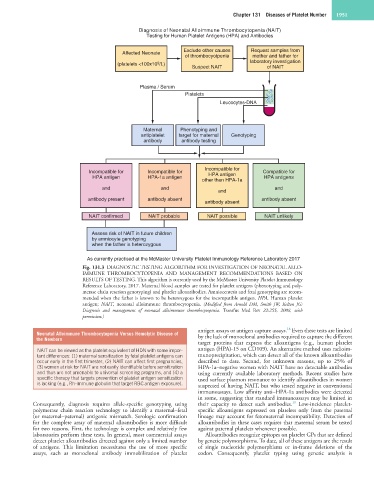
                            Fig. 131.3  DIAGNOSTIC TESTING ALGORITHM FOR INVESTIGATION OF NEONATAL ALLO-
                            IMMUNE  THROMBOCYTOPENIA  AND  MANAGEMENT  RECOMMENDATIONS  BASED  ON
                            RESULTS OF TESTING. This algorithm is currently used by the McMaster University Platelet Immunology
                            Reference Laboratory, 2017. Maternal blood samples are tested for platelet antigens (phenotyping and poly-
                            merase chain reaction genotyping) and platelet alloantibodies. Amniocentesis and fetal genotyping are recom-
                            mended when the father is known to be heterozygous for the incompatible antigen. HPA, Human platelet
                            antigen;  NAIT,  neonatal  alloimmune  thrombocytopenia.  (Modified  from  Arnold  DM,  Smith  JW,  Kelton  JG:
                            Diagnosis  and  management  of  neonatal  alloimmune  thrombocytopenia.  Transfus  Med  Rev  22:255,  2008,  with
                            permission.)

                                                                                               18
                                                                  antigen assays or antigen capture assays.  Even these tests are limited
             Neonatal Alloimmune Thrombocytopenia Versus Hemolytic Disease of
             the Newborn                                          by the lack of monoclonal antibodies required to capture the different
                                                                  target  proteins  that  express  the  alloantigens  (e.g.,  human  platelet
             NAIT can be viewed as the platelet equivalent of HDN with some impor-  antigen (HPA)-15 on CD109). An alternative method uses radioim-
             tant differences: (1) maternal sensitization by fetal platelet antigens can   munoprecipitation, which can detect all of the known alloantibodies
             occur early in the first trimester, (2) NAIT can affect first pregnancies,   described  to  date.  Second,  for  unknown  reasons,  up  to  25%  of
             (3) women at risk for NAIT are not easily identifiable before sensitization   HPA-1a–negative women with NAIT have no detectable antibodies
             and thus are not amenable to universal screening programs, and (4) a   using  currently  available  laboratory  methods.  Recent  studies  have
             specific therapy that targets prevention of platelet antigen sensitization   used surface plasmon resonance to identify alloantibodies in women
             is lacking (e.g., Rh-immune globulin that target RBC antigen exposure).  suspected of having NAIT, but who tested negative in conventional
                                                                  immunoassays. Low affinity anti–HPA-1a antibodies were detected
                                                                  in some, suggesting that standard immunoassays may be limited in
                                                                                                 19
            Consequently,  diagnosis  requires  allele-specific  genotyping  using   their  capacity  to  detect  such  antibodies.   Low-incidence  platelet-
            polymerase  chain  reaction  technology  to  identify  a  maternal–fetal   specific  alloantigens  expressed  on  platelets  only  from  the  paternal
            (or maternal–paternal) antigenic mismatch. Serologic confirmation   lineage may account for fetomaternal incompatibility. Detection of
            for  the  complete  array  of  maternal  alloantibodies  is  more  difficult   alloantibodies in these cases requires that maternal serum be tested
            for two reasons. First, the technology is complex and relatively few   against paternal platelets whenever possible.
            laboratories perform these tests. In general, most commercial assays   Alloantibodies recognize epitopes on platelet GPs that are defined
            detect platelet alloantibodies directed against only a limited number   by genetic polymorphisms. To date, all of these antigens are the result
            of  antigens.  This  limitation  necessitates  the  use  of  more  specific   of  single  nucleotide  polymorphisms  or  in-frame  deletions  of  the
            assays,  such  as  monoclonal  antibody  immobilization  of  platelet   codon.  Consequently,  platelet  typing  using  genetic  analysis  is

