


Page 2223 - Hematology_ Basic Principles and Practice ( PDFDrive )
P. 2223
1970   Part XII  Hemostasis and Thrombosis


                            60                 54.9
                                                                             After cardiac surgery
                            50
                                                                             After orthopedic surgery
                                            38.4
                            40
                          Patients (%)  30  25.5        26.7                Potentially abnormal
                                    31.6
                            20
                                                          13.0              on or after day 5
                            10                                     4.3                  3.8
                                                                     0.4     1.4
                             0
                                    1          2          3          4         5          >6
                        A                             Days of postoperative nadir

                           300                                  300
                         Platelet count (× 10 9 /L)  200  Day 2 nadir  200  Hemodilution  Day 3 nadir


                           100
                                                                100
                             0    Hemodilution                    0
                               0     1    2     3     4    5        0     1    2     3     4    5
                        B           Days after cardiac surgery  C        Days after cardiac surgery
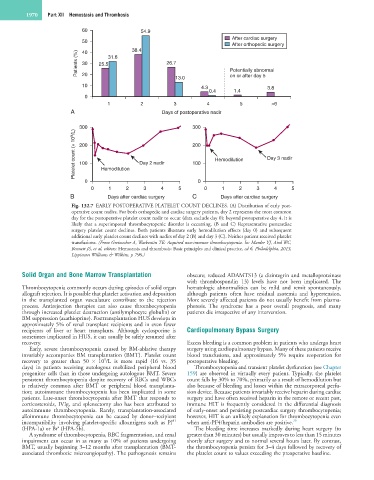
                        Fig. 132.7  EARLY POSTOPERATIVE PLATELET COUNT DECLINES. (A) Distribution of early post-
                        operative count nadirs. For both orthopedic and cardiac surgery patients, day 2 represents the most common
                        day for the postoperative platelet count nadir to occur (data exclude day 0); beyond postoperative day 4, it is
                        likely  that  a  superimposed  thrombocytopenic  disorder  is  occurring.  (B  and  C)  Representative  postcardiac
                        surgery  platelet  count  declines.  Both  patients  illustrate  early  hemodilution  effects  (day  0)  and  subsequent
                        additional early platelet count declines with nadirs of day 2 (B) and day 3 (C). Neither patient received platelet
                        transfusions. (From Greinacher A, Warkentin TE: Acquired non-immune thrombocytopenia. In: Marder VJ, Aird WC,
                        Bennett JS, et al, editors: Hemostasis and thrombosis: Basic principles and clinical practice, ed 6. Philadelphia, 2013,
                        Lippincott Williams & Wilkins, p 796.)


        Solid Organ and Bone Marrow Transplantation           obscure; reduced ADAMTS13 (a disintegrin and metalloproteinase
                                                              with  thrombospondin  13)  levels  have  not  been  implicated.  The
        Thrombocytopenia commonly occurs during episodes of solid organ   hematologic  abnormalities  can  be  mild  and  remit  spontaneously,
        allograft rejection. It is possible that platelet activation and deposition   although  patients  often  have  residual  azotemia  and  hypertension.
        in  the  transplanted  organ  vasculature  contribute  to  the  rejection   More severely affected patients do not usually benefit from plasma-
        process.  Antirejection  therapies  can  also  cause  thrombocytopenia   pheresis.  The  syndrome  has  a  poor  overall  prognosis,  and  many
        through increased platelet destruction (antilymphocyte globulin) or   patients die irrespective of any intervention.
        BM suppression (azathioprine). Posttransplantation HUS develops in
        approximately 5% of renal transplant recipients and in even fewer
        recipients  of  liver  or  heart  transplants.  Although  cyclosporine  is   Cardiopulmonary Bypass Surgery
        sometimes implicated in HUS, it can usually be safely resumed after
        recovery.                                             Excess bleeding is a common problem in patients who undergo heart
           Early,  severe  thrombocytopenia  caused  by  BM-ablative  therapy   surgery using cardiopulmonary bypass. Many of these patients receive
        invariably accompanies BM transplantation (BMT). Platelet count   blood  transfusions,  and  approximately  5%  require  reoperation  for
                                   9
        recovery  to  greater  than  50  ×  10 /L  is  more  rapid  (16  vs.  35   postoperative bleeding.
        days)  in  patients  receiving  autologous  mobilized  peripheral  blood   Thrombocytopenia and transient platelet dysfunction (see Chapter
        progenitor cells than in those undergoing autologous BMT. Severe   159)  are  observed  in  virtually  every  patient. Typically,  the  platelet
        persistent thrombocytopenia despite recovery of RBCs and WBCs   count falls by 30% to 70%, primarily as a result of hemodilution but
        is  relatively  common  after  BMT  or  peripheral  blood  transplanta-  also because of bleeding and losses within the extracorporeal perfu-
        tion; autoimmune thrombocytopenia has been implicated in some   sion device. Because patients invariably receive heparin during cardiac
        patients. Late-onset thrombocytopenia after BMT that responds to   surgery and have often received heparin in the remote or recent past,
        corticosteroids,  IVIg,  and  splenectomy  also  has  been  attributed  to   immune HIT is frequently considered in the differential diagnosis
        autoimmune  thrombocytopenia.  Rarely,  transplantation-associated   of early-onset and persisting postcardiac surgery thrombocytopenia;
        alloimmune  thrombocytopenia  can  be  caused  by  donor–recipient   however, HIT is an unlikely explanation for thrombocytopenia even
                                                         A1
        incompatibility  involving  platelet-specific  alloantigens  such  as  Pl    when anti-PF4/heparin antibodies are positive. 29
                    a
        (HPA-1a) or Br  (HPA-5b).                                The  bleeding  time  increases  markedly  during  heart  surgery  (to
           A syndrome of thrombocytopenia, RBC fragmentation, and renal   greater than 30 minutes) but usually improves to less than 15 minutes
        impairment  can  occur  in  as  many  as  10%  of  patients  undergoing   shortly after surgery and to normal several hours later. By contrast,
        BMT, usually beginning 3–12 months after transplantation (BMT-  the thrombocytopenia persists for 3–4 days followed by recovery of
        associated thrombotic microangiopathy). The pathogenesis remains   the platelet count to values exceeding the preoperative baseline.

