


Page 2228 - Hematology_ Basic Principles and Practice ( PDFDrive )
P. 2228
Chapter 133  Heparin-Induced Thrombocytopenia  1975


                           Endothelial
                              cell    Heparan    B-lymphocyte
                                      sulfate                             Heparin
                                                                                      Resting
                                                                                      platelet


                                                                                        GpIIb/IIIa
                                           HIT
                                        antibody
                                                                                           PF4
                                                                                           tetramer

                                                                                       Fc receptor


                            Endothelial cell activation  Monocyte  Microparticles         Fibrinogen


                                                           Thrombin      Activated platelet

                                  Tissue
                                   factor
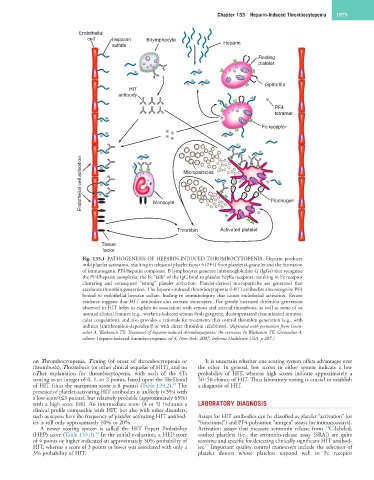
                            Fig. 133.1  PATHOGENESIS OF HEPARIN-INDUCED THROMBOCYTOPENIA. Heparin produces
                            mild platelet activation, resulting in release of platelet factor 4 (PF4) from platelet α-granules and the formation
                            of immunogenic PF4/heparin complexes. B lymphocytes generate immunoglobulins G (IgGs) that recognize
                            the PF4/heparin complexes; the Fc “tails” of the IgG bind to platelet FcγIIa receptors, resulting in Fc receptor
                            clustering  and  consequent  “strong”  platelet  activation.  Platelet-derived  microparticles  are  generated  that
                            accelerate thrombin generation. The heparin-induced thrombocytopenia (HIT) antibodies also recognize PF4
                            bound  to  endothelial  heparan  sulfate,  leading to  immunoinjury that causes  endothelial activation. Recent
                            evidence suggests that HIT antibodies also activate monocytes. The greatly increased thrombin generation
                            observed in HIT helps to explain its association with venous and arterial thrombosis, as well as some of its
                            unusual clinical features (e.g., warfarin-induced venous limb gangrene, decompensated disseminated intravas-
                            cular coagulation), and also provides a rationale for treatments that control thrombin generation (e.g., with
                            indirect [antithrombin-dependent] or with direct thrombin inhibitors). (Reprinted with permission from Grein-
                            acher A, Warkentin TE: Treatment of heparin-induced thrombocytopenia: An overview. In Warkentin TE, Greinacher A,
                            editors: Heparin-induced thrombocytopenia, ed 4, New York, 2007, Informa Healthcare USA, p 287.)


            on  Thrombocytopenia,  Timing  (of  onset  of  thrombocytopenia  or   It is uncertain whether one scoring system offers advantages over
            thrombosis), Thrombosis (or other clinical sequelae of HIT), and no   the  other.  In  general,  low  scores  in  either  system  indicate  a  low
            oTher  explanation  for  thrombocytopenia,  with  each  of  the  4Ts   probability  of  HIT,  whereas  high  scores  indicate  approximately  a
            scoring as an integer of 0, 1, or 2 points, based upon the likelihood   50 : 50 chance of HIT. Thus laboratory testing is crucial to establish
                                                          23
            of HIT (thus the maximum score is 8 points) (Table 133.2).  The   a diagnosis of HIT.
            presence of platelet-activating HIT antibodies is unlikely (<3%) with
            a low score (≤3 points), but relatively probable (approximately 65%)
            with a high score (≥6). An intermediate score (4 or 5) indicates a   LABORATORY DIAGNOSIS
            clinical profile compatible with HIT, but also with other disorders,
            such as sepsis; here the frequency of platelet-activating HIT antibod-  Assays for HIT antibodies can be classified as platelet “activation” (or
            ies is still only approximately 10% to 20%.           “functional”) and PF4-polyanion “antigen” assays (or immunoassays).
                                                                                                            14
              A  newer  scoring  system  is  called  the  HIT  Expert  Probability   Activation  assays  that  measure  serotonin  release  from  C-labeled,
                                24
            (HEP) score (Table 133.3).  In the initial evaluation, a HEP score   washed  platelets  (i.e.,  the  serotonin-release  assay  [SRA])  are  quite
            of 4 points or higher indicated an approximately 50% probability of   sensitive and specific for detecting clinically significant HIT antibod-
                                                                    25
            HIT, whereas a score of 3 points or lower was associated with only a   ies.  Important quality control maneuvers include the selection of
            3% probability of HIT.                                platelet  donors  whose  platelets  respond  well  to  Fc  receptor

