


Page 2221 - Hematology_ Basic Principles and Practice ( PDFDrive )
P. 2221
1968   Part XII  Hemostasis and Thrombosis


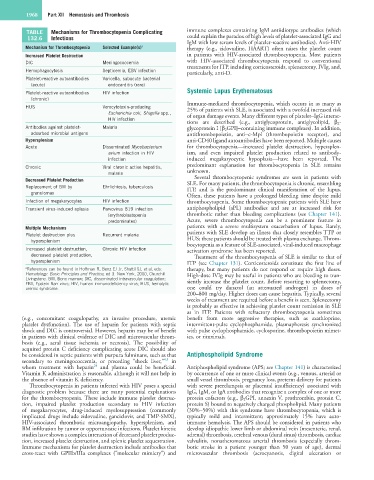
          TABLE   Mechanisms for Thrombocytopenia Complicating   immune complexes containing IgM antiidiotype antibodies (which
          132.6   Infections                                  could explain the paradox of high levels of platelet-associated IgG and
                                                              IgM with low serum levels of platelet-reactive antibodies). Anti-HIV
         Mechanism for Thrombocytopenia  Selected Example(s) a  therapy  (e.g.,  zidovudine,  HAART)  often  raises  the  platelet  count
         Increased Platelet Destruction                       in  patients  with  HIV-associated  thrombocytopenia.  Most  patients
         DIC                       Meningococcemia            with  HIV-associated  thrombocytopenia  respond  to  conventional
                                                              treatments for ITP, including corticosteroids, splenectomy, IVIg, and,
         Hemophagocytosis          Septicemia, EBV infection  particularly, anti-D.
         Platelet-reactive autoantibodies   Varicella, subacute bacterial
           (acute)                  endocarditis (rare)
         Platelet-reactive autoantibodies   HIV infection     Systemic Lupus Erythematosus
           (chronic)
                                                              Immune-mediated thrombocytopenia, which occurs in as many as
         HUS                       Verocytotoxin-producing    25% of patients with SLE, is associated with a twofold increased risk
                                    Escherichia coli, Shigella spp.,   of organ damage events. Many different types of platelet–IgG interac-
                                    HIV infection
                                                              tions  are  described  (e.g.,  antiglycoprotein,  antiglycolipid,  β 2-
         Antibodies against platelet-  Malaria                glycoprotein I [β 2 GPI]–containing immune complexes). In addition,
           adsorbed microbial antigens                        antithrombopoietin,  anti–c-Mpl  (thrombopoietin  receptor),  and
         Hypersplenism                                        anti-CD40 ligand autoantibodies have been reported. Multiple causes
         Acute                     Disseminated Mycobacterium   for  thrombocytopenia—increased  platelet  destruction,  hypersplen-
                                    avium infection in HIV    ism,  and  even  impaired  platelet  production  related  to  antibody-
                                    infection                 induced  megakaryocytic  hypoplasia—have  been  reported.  The
         Chronic                   Viral chronic active hepatitis,   predominant  explanation  for  thrombocytopenia  in  SLE  remains
                                    malaria                   unknown.
                                                                 Several  thrombocytopenic  syndromes  are  seen  in  patients  with
         Decreased Platelet Production                        SLE. For many patients, the thrombocytopenia is chronic, resembling
         Replacement of BM by      Ehrlichiosis, tuberculosis  ITP,  and  is  the  predominant  clinical  manifestation  of  the  lupus.
           granulomas
                                                              Often, these patients have a prolonged bleeding time despite mild
         Infection of megakaryocytes  HIV infection           thrombocytopenia. Some thrombocytopenic patients with SLE have
         Transient virus-induced aplasia  Parvovirus B19 infection   antiphospholipid  (aPL)  antibodies  and  are  at  increased  risk  for
                                    (erythroblastopenia       thrombotic rather than bleeding complications (see Chapter 141).
                                    predominates)             Acute,  severe  thrombocytopenia  can  be  a  prominent  feature  in
         Multiple Mechanisms                                  patients  with  a  severe  multisystem  exacerbation  of  lupus.  Rarely,
         Platelet destruction plus   Recurrent malaria        patients with SLE develop an illness that closely resembles TTP or
           hypersplenism                                      HUS; these patients should be treated with plasma exchange. Throm-
                                                              bocytopenia as a feature of SLE-associated, viral-induced macrophage
         Increased platelet destruction,   Chronic HIV infection  activation syndrome has been reported.
           decreased platelet production,                        Treatment of the thrombocytopenia of SLE is similar to that of
           hypersplenism                                      ITP  (see  Chapter  131).  Corticosteroids  constitute  the  first  line  of
         a References can be found in Hoffman R, Benz EJ Jr, Shattil SJ, et al, eds:   therapy,  but  many  patients  do  not  respond  or  require  high  doses.
         Hematology: Basic Principles and Practice, ed 3. New York, 2000, Churchill   High-dose IVIg may be useful in patients who are bleeding to tran-
         Livingstone. BM, Bone marrow; DIC, disseminated intravascular coagulation;   siently increase the platelet count. Before resorting to splenectomy,
         EBV, Epstein-Barr virus; HIV, human immunodeficiency virus; HUS, hemolytic
         uremic syndrome.                                     one  could  try  danazol  (an  attenuated  androgen)  in  doses  of
                                                              200–800 mg/day. Higher doses can cause hepatitis. Typically, several
                                                              weeks of treatment are required before a benefit is seen. Splenectomy
                                                              is probably as effective in achieving platelet count remission in SLE
                                                              as  in  ITP.  Patients  with  refractory  thrombocytopenia  sometimes
        (e.g.,  concomitant  coagulopathy,  an  invasive  procedure,  uremic   benefit  from  more  aggressive  therapies,  such  as  azathioprine,
        platelet  dysfunction).  The  use  of  heparin  for  patients  with  septic   intermittent-pulse  cyclophosphamide,  plasmapheresis  synchronized
        shock and DIC is controversial. However, heparin may be of benefit   with pulse cyclophosphamide, cyclosporine, thrombopoietin mimet-
        in patients with clinical evidence of DIC and microvascular throm-  ics, or rituximab.
        bosis  (e.g.,  acral  tissue  ischemia  or  necrosis).  The  possibility  of
        acquired protein C deficiency complicating acute DIC should also
        be considered in septic patients with purpura fulminans, such as that   Antiphospholipid Syndrome
                                                       4,5
        secondary  to  meningococcemia,  or  preceding  “shock  liver,”   in
                                24
        whom  treatment  with  heparin   and  plasma  could  be  beneficial.   Antiphospholipid syndrome (APS; see Chapter 141) is characterized
        Vitamin K administration is reasonable, although it will not help in   by occurrence of one or more clinical events (e.g., venous, arterial or
        the absence of vitamin K deficiency.                  small vessel thrombosis, pregnancy loss, preterm delivery for patients
           Thrombocytopenia in patients infected with HIV poses a special   with severe preeclampsia or placental insufficiency) associated with
        diagnostic  problem  because  there  are  many  potential  explanations   IgG, IgM, or IgA antibodies that recognize a complex of one or more
        for the thrombocytopenia. These include immune platelet destruc-  protein cofactors (e.g., β 2 GPI, annexin V, prothrombin, protein C,
        tion,  impaired  platelet  production  secondary  to  HIV  infection   protein S) bound to negatively charged phospholipid. Many patients
        of  megakaryocytes,  drug-induced  myelosuppression  (commonly   (30%–50%) with this syndrome have thrombocytopenia, which is
        implicated drugs include zidovudine, ganciclovir, and TMP-SMX),   typically  mild  and  intermittent;  approximately  15%  have  auto-
        HIV-associated  thrombotic  microangiopathy,  hypersplenism,  and   immune hemolysis. The APS should be considered in patients who
        BM infiltration by tumor or opportunistic infections. Platelet kinetic   develop idiopathic lower limb or abdominal vein (mesenteric, renal,
        studies have shown a complex interaction of decreased platelet produc-  adrenal) thrombosis, cerebral venous (dural sinus) thrombosis, cardiac
        tion, increased platelet destruction, and splenic platelet sequestration.   valvulitis,  nonatheromatous  arterial  thrombosis  (especially  throm-
        Immune mechanisms for platelet destruction include antibodies that   botic  stroke  in  a  patient  younger  than  50  years  of  age),  dermal
        cross-react  with  GPIIb/IIIa  complexes  (“molecular  mimicry”)  and   microvascular  thrombosis  (acrocyanosis,  digital  ulceration  or

