


Page 2218 - Hematology_ Basic Principles and Practice ( PDFDrive )
P. 2218
Chapter 132  Thrombocytopenia Caused by Platelet Destruction, Hypersplenism, or Hemodilution  1965


                                          Trauma (burn)-
                                           associated
                                            thrombo-  Postoperative  Resolution of Mirtazapine-induced
                                      1800  cytopenia thrombocytosis thrombocytosis thrombocytopenia
                                      1600
                                                                       MIRTAZAPINE:
                                      1400                             tetracyclic antidepressant of the
                                                                       piperazine-azapine group
                                      1200
                                     Platelet count × 10 9 /L  800      Abrupt unexpected
                                      1000


                                                                         platelet count fall
                                       600
                                       400
                                                                          High-dose IVIG
                                       200

                                         0                                     Platelet count nadir
                                               Debridement          Mirtazapine  (12 × 10 /L)
                                                                                     9
                                          –20   –15   –10    –5    0     5     10    15    20
                                                         Days after starting mirtazapine
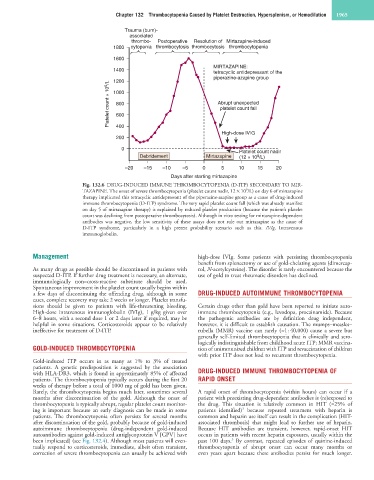
                            Fig. 132.6  DRUG-INDUCED IMMUNE THROMBOCYTOPENIA (D-ITP) SECONDARY TO MIR-
                                                                                 9
                            TAZAPINE. The onset of severe thrombocytopenia (platelet count nadir, 12 × 10 /L) on day 6 of mirtazapine
                            therapy implicated this tetracyclic antidepressant of the piperazine-azapine group as a cause of drug-induced
                            immune thrombocytopenia (D-ITP) syndrome. The very rapid platelet count fall (which was already manifest
                            on day 5 of mirtazapine therapy) is explained by reduced platelet production (because the patient’s platelet
                            count was declining from postoperative thrombocytosis). Although in vitro testing for mirtazapine-dependent
                            antibodies  was  negative,  the  low  sensitivity  of  these  assays  does  not  rule  out  mirtazapine  as  the  cause  of
                            D-ITP  syndrome,  particularly  in  a  high  pretest  probability  scenario  such  as  this.  IVIg,  Intravenous
                            immunoglobulin.


            Management                                            high-dose  IVIg.  Some  patients  with  persisting  thrombocytopenia
                                                                  benefit from splenectomy or use of gold-chelating agents (dimercap-
            As many drugs as possible should be discontinued in patients with   rol, N-acetylcysteine). The disorder is rarely encountered because the
            suspected D-ITP. If further drug treatment is necessary, an alternate,   use of gold to treat rheumatic disorders has declined.
            immunologically  non–cross-reactive  substitute  should  be  used.
            Spontaneous improvement in the platelet count usually begins within
            a few days of discontinuing the offending drug, although in some   DRUG-INDUCED AUTOIMMUNE THROMBOCYTOPENIA
            cases, complete recovery may take 2 weeks or longer. Platelet transfu-
            sions  should  be  given  to  patients  with  life-threatening  bleeding.   Certain drugs other than gold have been reported to initiate auto-
            High-dose  intravenous  immunoglobulin  (IVIg),  1 g/kg  given  over   immune thrombocytopenia (e.g., levodopa, procainamide). Because
            6–8 hours, with a second dose 1 or 2 days later if required, may be   the  pathogenic  antibodies  are  by  definition  drug  independent,
            helpful  in  some  situations.  Corticosteroids  appear  to  be  relatively   however, it is difficult to establish causation. The mumps–measles–
            ineffective for treatment of D-ITP.                   rubella (MMR) vaccine can rarely (≈1 : 40,000) cause a severe but
                                                                  generally  self-limited  thrombocytopenia  that  is  clinically  and  sero-
                                                                  logically indistinguishable from childhood acute ITP; MMR vaccina-
            GOLD-INDUCED THROMBOCYTOPENIA                         tion of unimmunized children with ITP and revaccination of children
                                                                  with prior ITP does not lead to recurrent thrombocytopenia.
            Gold-induced  ITP  occurs  in  as  many  as  1%  to  3%  of  treated
            patients.  A  genetic  predisposition  is  suggested  by  the  association
            with HLA-DR3, which is found in approximately 85% of affected   DRUG-INDUCED IMMUNE THROMBOCYTOPENIA OF
            patients. The thrombocytopenia typically occurs during the first 20   RAPID ONSET
            weeks of therapy before a total of 1000 mg of gold has been given.
            Rarely, the thrombocytopenia begins much later, sometimes several   A  rapid  onset  of  thrombocytopenia  (within  hours)  can  occur  if  a
            months  after  discontinuation  of  the  gold.  Although  the  onset  of   patient with preexisting drug-dependent antibodies is (re)exposed to
            thrombocytopenia is typically abrupt, regular platelet count monitor-  the  drug.  This  situation  is  relatively  common  in  HIT  (≈25%  of
                                                                                3
            ing  is  important  because  an  early  diagnosis  can  be  made  in  some   patients  identified)   because  repeated  treatment  with  heparin  is
            patients.  The  thrombocytopenia  often  persists  for  several  months   common and heparin use itself can result in the complication (HIT-
            after discontinuation of the gold, probably because of gold-induced   associated  thrombosis)  that  might  lead  to  further  use  of  heparin.
            autoimmune  thrombocytopenia  (drug-independent  gold-induced   Because  HIT  antibodies  are  transient,  however,  rapid-onset  HIT
            autoantibodies against gold-induced antiglycoprotein V [GPV] have   occurs in patients with recent heparin exposures, usually within the
                                                                             3
            been implicated) (see Fig. 132.4). Although most patients will even-  past  100  days.   By  contrast,  repeated  episodes  of  quinine-induced
            tually respond to corticosteroids, immediate, albeit often transient,   thrombocytopenia  of  abrupt  onset  can  occur  many  months  or
            correction of severe thrombocytopenia can usually be achieved with   even  years  apart  because  these  antibodies  persist  for  much  longer.

