


Page 2242 - Hematology_ Basic Principles and Practice ( PDFDrive )
P. 2242
Chapter 134  Thrombotic Thrombocytopenic Purpura and the Hemolytic Uremic Syndromes  1989


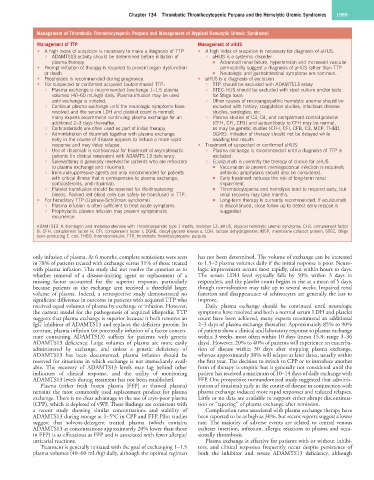
             Management of Thrombotic Thrombocytopenic Purpura and Management of Atypical Hemolytic Uremic Syndrome)
             Management of TTP                                    Management of aHUS
             •  A high index of suspicion is necessary to make a diagnosis of TTP.  •  A high index of suspicion is necessary for diagnosis of aHUS.
                ○  ADAMTS13 activity should be determined before initiation of   ○  aHUS is a systemic disorder
                  plasma therapy.                                      ■  Advanced renal failure, hypertension and increased vascular
             •  Prompt initiation of therapy is required to prevent organ dysfunction   permeability suggest a diagnosis of aHUS rather than TTP
                or death.                                              ■  Neurologic and gastrointestinal symptoms are common.
             •  Prophylaxis is recommended during pregnancy.      •  aHUS is a diagnosis of exclusion
             •  For suspected or confirmed acquired (autoimmune) TTP:  ○  TTP should be excluded with ADAMTS13 assay
                ○  Plasma exchange is recommended (exchange 1–1.5 plasma   ○  STEC-HUS should be excluded with stool culture and/or tests
                  volumes [40–60 mL/kg]) daily. Plasma infusion may be used   for Shiga toxin
                  until exchange is initiated.                      ○  Other causes of microangiopathic hemolytic anemia should be
                ○  Continue plasma exchange until the neurologic symptoms have   excluded with history, coagulation studies, infectious disease
                  resolved and the serum LDH and platelet count is normal;   studies, serologies, etc.
                  many experts recommend continuing plasma exchange for an   ○  Plasma studies of C3, C4, and complement control proteins
                  additional 2–3 days thereafter.                      (CFH, CFI, CFB) and autoantibody to CFH may be normal,
                ○  Corticosteroids are often used as part of initial therapy  as may be genetic studies (CFH, CFI, CFB, C3, MCP, THBD,
                ○  Administration of rituximab together with plasma exchange   DGKE). Initiation of therapy should not be delayed while
                  early in the course of disease appears to induce a more rapid   awaiting test results.
                  response and may delay relapse.                 •  Treatment of suspected or confirmed aHUS:
                ○  Use of rituximab is controversial for treatment of asymptomatic   ○  Plasma exchange is recommended until a diagnosis of TTP is
                  patients (in clinical remission) with ADAMTS 13 deficiency.  excluded.
                ○  Splenectomy is generally reserved for patients who are refractory   ○  Eculizumab is currently the therapy of choice for aHUS
                  to plasma exchange and rituximab.                    ■  Vaccination to prevent meningococcal infection is required;
                ○  Immunosuppressive agents are only recommended for patients   antibiotic prophylaxis should also be considered.
                  with critical illness that is unresponsive to plasma exchange,   ■  Early treatment reduces the risk of long-term renal
                  corticosteroids, and rituximab.                        impairment.
                ○  Platelet transfusion should be reserved for life-threatening   ■  Thrombocytopenia and hemolysis tend to respond early, but
                  bleeds. Packed red blood cells can safely be transfused in TTP.  renal recovery may take months.
             •  For hereditary TTP (Upshaw-Schülman syndrome)          ■  Long-term therapy is currently recommended. If eculizumab
                ○  Plasma infusion is often sufficient to treat acute symptoms.  is discontinued, close follow up to detect early relapse is
                ○  Prophylactic plasma infusion may prevent symptomatic   suggested.
                  recurrence.
             ADAMTS13, A disintegrin and metalloproteinase with Thrombospondin type 1 motifs, member 13; aHUS, atypical hemolytic uremic syndrome; CFB, complement factor
             B; CFH, complement factor H; CFI, complement factor I; DGKE, diacyl glycerol kinase ε; LDH, lactate dehydrogenase; MCP, membrane cofactor protein; STEC, Shiga
             toxin-producing E. coli; THBD, thrombomodulin; TTP, thrombotic thrombocytopenic purpura.


            only infusion of plasma. At 6 months, complete remissions were seen   has not been determined. The volume of exchange can be increased
            in 78% of patients treated with exchange versus 31% of those treated   to 1.5–2 plasma volumes daily if the initial response is poor. Neuro-
            with plasma infusion. This study did not resolve the question as to   logic improvement occurs most rapidly, often within hours to days.
            whether  removal  of  a  disease-inciting  agent  or  replacement  of  a   The  serum  LDH  level  typically  falls  by  50%  within  3  days  in
            missing  factor  accounted  for  the  superior  response,  particularly   responders, and the platelet count begins to rise at a mean of 5 days,
            because  patients  in  the  exchange  arm  received  a  threefold  larger   though normalization may take up to several weeks. Impaired renal
            volume  of  plasma.  Indeed,  a  retrospective  study  demonstrated  no   function and disappearance of schistocytes are generally the last to
            significant difference in outcome in patients with acquired TTP who   improve.
            received equal volumes of plasma by exchange or infusion. However,   Daily  plasma  exchange  should  be  continued  until  neurologic
            the current model for the pathogenesis of acquired idiopathic TTP   symptoms have resolved and both a normal serum LDH and platelet
            suggests that plasma exchange is superior because it both removes an   count have been achieved; many experts recommend an additional
            IgG inhibitor of ADAMTS13 and replaces the deficient protein. In   2–3 days of plasma exchange thereafter. Approximately 85% to 90%
            contrast, plasma infusion (or potentially infusion of a factor concen-  of patients show a clinical and laboratory response to plasma exchange
            trate  containing  ADAMTS13)  suffices  for  patients  with  genetic   within 3 weeks, most often within 10 days (mean 15.8; range 3–36
            ADAMTS13  deficiency.  Large  volumes  of  plasma  are  more  easily   days). However, 20% to 40% of patients will experience an exacerba-
            administered  by  exchange,  and  unless  a  genetic  deficiency  of   tion  of  disease  within  30  days  after  stopping  plasma  exchange,
            ADAMTS13  has  been  documented,  plasma  infusion  should  be   whereas approximately 30% will relapse at later dates, usually within
            reserved for situations in which exchange is not immediately avail-  the first year. The decision to switch to CPP or to introduce another
            able.  The  recovery  of  ADAMTS13  levels  may  lag  behind  other   form of therapy is empiric but is generally not considered until the
            indicators  of  clinical  response,  and  the  utility  of  monitoring   patient has received a minimum of 10–14 days of daily exchange with
            ADAMTS13 levels during treatment has not been established.  FFP. One prospective nonrandomized study suggested that adminis-
              Plasma  (either  fresh  frozen  plasma  [FFP]  or  thawed  plasma)   tration of rituximab early in the course of disease in conjunction with
            remains the most commonly used replacement product for plasma   plasma exchange induced more rapid responses and reduced relapses.
            exchange. There is no clear advantage to the use of cryo-poor plasma   Little or no data are available to support either abrupt discontinua-
            (CPP), which is depleted of vWF. These findings are consistent with   tion or “tapering” of plasma exchange after remission.
            a  recent  study  showing  similar  concentrations  and  stability  of   Complication rates associated with plasma exchange therapy have
            ADAMTS13 during storage at 1–5°C in CPP and FFP. Pilot studies   been reported to be as high as 30%, but recent reports suggest a lower
            suggest  that  solvent-detergent  treated  plasma  (which  contains   rate. The  majority  of  adverse  events  are  related  to  central  venous
            ADAMTS13 at concentrations approximately 20% lower than those   catheter insertion, infection, allergic reactions to plasma and occa-
            in FFP) is as efficacious as FFP and is associated with fewer allergic/  sionally thrombosis.
            urticarial reactions.                                   Plasma exchange is effective for patients with or without inhibi-
              Treatment is generally initiated with the goal of exchanging 1–1.5   tors,  and  clinical  responses  frequently  occur  despite  persistence  of
            plasma volumes (40–60 mL/kg) daily, although the optimal regimen   both  the  inhibitor  and  severe  ADAMTS13  deficiency,  although

