


Page 2267 - Hematology_ Basic Principles and Practice ( PDFDrive )
P. 2267
2014   Part XII  Hemostasis and Thrombosis


        generally lower, with 1 IU/kg increasing the FIX level by 0.8%. With   inhibitors. Determining the factor level at trough every several days
        the  newer  modified  extended  half-life  FIX  concentrates,  recoveries   ensures that the patient is achieving a hemostatic level of replacement.
        appear to be variable, perhaps because of differences in their extra-  An alternative method for maintaining hemostasis is by continu-
        vascular  distribution.  Children  exhibit  lower  recoveries  of  clotting   ous clotting factor infusion. A lower dose of factor is required with
        factor.  FVIII  concentrates  have  much  shorter  half-lives  (approxi-  this form of treatment, and the peaks and troughs of repeated bolus
        mately  8–12  hours)  than  FIX  concentrates  (approximately  18–24   administration are avoided. In general, a FVIII infusion rate of 2 to
        hours). There are large interindividual variations in clotting factor   3 U/kg/h is sufficient once the FVIII level is increased to 100% with
        half-life because the half-life is affected by a number of variables. In   a bolus infusion of 50 U/kg. There has been concern about inhibitor
        the case of FVIII, it appears to be affected by the patient’s endogenous   development  with  continuous  infusion  therapy,  particularly  in
        VWF level, which in turn is related to the patient’s ABO blood group.   patients with mild/moderate hemophilia A but there is no conclusive
        Both FVIII and FIX half-lives are also affected by patient age; half-  evidence  that  continuous  infusion  poses  a  risk  for  inhibitor
        lives generally increase with age.                    development.
           Recent cohort studies and a randomized open label study have   The above recommendations are based on the use of conventional
        challenged  the  assumption  that  the  rate  of  inhibitor  develop-  half-life FVIII and FIX concentrates; different recommendations are
        ment  is  similar  with  all  plasma  derived  and  recombinant  FVIII   needed for extended half-life FVIII and FIX and continuous infusion
        concentrates. 20–22  The Sippet (Study on Inhibitors in Plasma-Product   of these products is unlikely to be necessary to maintain hemostasis
        Exposed Toddlers) study showed a 1.87-fold higher rate of inhibitor   in patients undergoing surgery.
        development with recombinant FVIII versus plasma derived FVIII
        while  the  Rodin  study  showed  a  1.6-fold  higher  rate  of  inhibitor
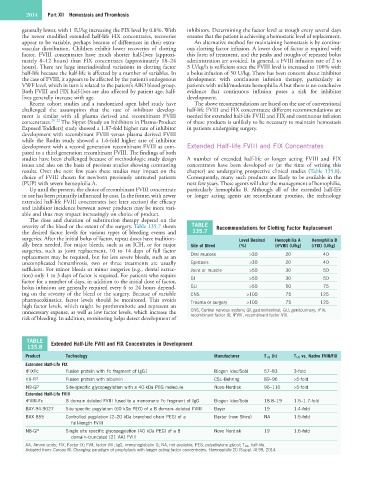
        development with a second generation recombinant FVIII as com-  Extended Half-life FVIII and FIX Concentrates
        pared to a third generation recombinant FVIII. The findings of both
        studies have been challenged because of methodologic study design   A  number  of  extended  half-life  or  longer  acting  FVIII  and  FIX
        issues and also on the basis of previous studies showing contrasting   concentrates  have  been  developed  or  (at  the  time  of  writing  this
        results.  Over  the  next  few  years  these  studies  may  impact  on  the   chapter)  are  undergoing  prospective  clinical  studies  (Table  135.8).
        choice  of  FVIII  chosen  for  newborn  previously  untreated  patients   Consequently, many such products are likely to be available in the
        (PUP) with severe hemophilia A.                       next few years. These agents will alter the management of hemophilia,
           Up until the present, the choice of recombinant FVIII concentrate   particularly  hemophilia  B.  Although  all  of  the  extended  half-life
        to use has been primarily influenced by cost. In the future, with newer   or  longer  acting  agents  are  recombinant  proteins,  the  technology
        extended half-life FVIII concentrates (see later section) the efficacy
        and inhibitor incidence between newer products may be more vari-
        able and thus may impact increasingly on choice of product.
           The  dose  and  duration  of  substitution  therapy  depend  on  the
        severity of the bleed or the extent of the surgery. Table 135.7 shows   TABLE   Recommendations for Clotting Factor Replacement
        the  desired  factor  levels  for  various  types  of  bleeding  events  and   135.7
        surgeries. After the initial bolus of factor, repeat doses have tradition-  Level Desired   Hemophilia A   Hemophilia B
        ally been needed. For major bleeds, such as an ICH, or for major   Site of Bleed  (%)  (rFVIII) (U/kg)  (rFIX) (U/kg)
        surgeries,  such  as  joint  replacement,  10  to  14  days  of  full  factor
        replacement may be required, but for less severe bleeds, such as an   Oral mucosa  >30  20         40
        uncomplicated  hemarthrosis,  two  or  three  treatments  are  usually   Epistaxis  >30  20        40
        sufficient. For minor bleeds or minor surgeries (e.g., dental extrac-  Joint or muscle  >50  30    50
        tion) only 1 to 3 days of factor is required. For patients who require   GI  >50      30           50
        factor for a number of days, in addition to the initial dose of factor,
        bolus infusions are generally required every 6 to 24 hours depend-  GU     >50        50           75
        ing on the severity of the bleed or the surgery. Because of variable   CNS  >100      75          125
        pharmacokinetics,  factor  levels  should  be  monitored.  This  avoids   Trauma or surgery  >100  75  125
        high factor levels, which might be prothrombotic and represent an
        unnecessary expense, as well as low factor levels, which increase the   CNS, Central nervous system; GI, gastrointestinal; GU, genitourinary; rFIX,
                                                               recombinant factor IX; rFVIII, recombinant factor VIII.
        risk of bleeding. In addition, monitoring helps detect development of


          TABLE   Extended Half-Life FVIII and FIX Concentrates in Development
          135.8
         Product       Technology                                      Manufacturer    T 1/2  (h)  T 1/2  vs. Native FVIII/FIX
         Extended Half-Life FIX
         rFIXFc        Fusion protein with Fc fragment of IgG1         Biogen Idec/Sobi  57–83   3-fold
         rIX-FP        Fusion protein with albumin                     CSL-Behring     89–96     >5-fold
         N9-GP         Site-specific glycopegylation with a 40-kDa PEG molecule  Novo-Nordisk  96–110  >5-fold
         Extended Half-Life FVIII
         rFVIII-Fc     B domain deleted FVIII fused to a monomeric Fc fragment of IgG  Biogen Idec/Sobi  18.8–19  1.5–1.7-fold
         BAY-94-9027   Site specific pegylation (60 kDa PEG) of a B domain–deleted FVIII  Bayer  19  1.4-fold
         BAX 855       Controlled pegylation (2–20 kDa branched chain PEG) of a   Baxter (now Shire)  NA  1.5-fold
                        full-length FVIII
         N8-GP         Single site specific glycopegylation (40 kDa PEG) of a B   Novo Nordisk  19  1.6-fold
                        domain–truncated (21 AA) FVIII
         AA, Amino acids; FIX, Factor IX; FVII, factor VIII; IgG, immunoglobulin G; NA, not available; PEG, polyethylene glycol; T 1/2, half-life.
         Adapted from: Carcao M. Changing paradigm of prophylaxis with longer acting factor concentrates. Haemophilia 20 (Suppl. 4):99, 2014.

