


Page 2262 - Hematology_ Basic Principles and Practice ( PDFDrive )
P. 2262
Chapter 135  Hemophilia A and B  2009


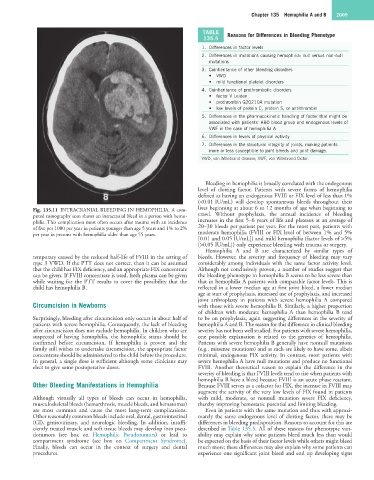
                                                                   TABLE   Reasons for Differences in Bleeding Phenotype
                                                                    135.5
                                                                   1.  Differences in factor levels
                                                                   2.  Differences in mutations causing hemophilia: null versus non-null
                                                                     mutations
                                                                   3.  Coinheritance of other bleeding disorders
                                                                     •  VWD
                                                                     •  mild functional platelet disorders
                                                                   4.  Coinheritance of prothrombotic disorders
                                                                     •  factor V Leiden
                                                                     •  prothrombin G20210A mutation
                                                                     •  low levels of protein C, protein S, or antithrombin
                                                                   5.  Differences in the pharmacokinetic handling of factor that might be
                                                                     associated with patients’ ABO blood group and endogenous levels of
                                                                     VWF in the case of hemophilia A
                                                                   6.  Differences in levels of physical activity
                                                                   7.  Differences in the structural integrity of joints, making patients
                                                                     more or less susceptible to joint bleeds and joint damage.
                                                                   VWD, von Willebrand disease; VWF, von Willebrand factor.


                                                                    Bleeding in hemophilia is broadly correlated with the endogenous
                                                                  level  of  clotting  factor.  Patients  with  severe  forms  of  hemophilia
                                                                  defined as having an endogenous FVIII or FIX level of less than 1%
                                                                  (<0.01 IU/mL)  will  develop  spontaneous  bleeds  throughout  their
            Fig. 135.11  INTRACRANIAL BLEEDING IN HEMOPHILIA. A com-  lives beginning at about 6 to 12 months of age when beginning to
            puted tomography scan shows an intracranial bleed in a person with hemo-  crawl.  Without  prophylaxis,  the  annual  incidence  of  bleeding
            philia. This complication most often occurs after trauma with an incidence   increases in the first 5–6 years of life and plateaus at an average of
            of five per 1000 per year in patients younger than age 5 years and 1% to 2%   20–30 bleeds per patient per year. For the most part, patients with
            per year in persons with hemophilia older than age 55 years.   moderate hemophilia (FVIII or FIX level of between 1% and 5%
                                                                  [0.01 and 0.05 IU/mL]) and mild hemophilia (factor levels of >5%
                                                                  [>0.05 IU/mL]) only experience bleeding with trauma or surgery.
                                                                    Hemophilia  A  and  B  are  characterized  by  similar  types  of
            temporary caused by the reduced half-life of FVIII in the setting of   bleeds.  However,  the  severity  and  frequency  of  bleeding  may  vary
            type 3 VWD. If the PTT does not correct, then it can be assumed   considerably  among  individuals  with  the  same  factor  activity  level.
            that the child has FIX deficiency, and an appropriate FIX concentrate   Although not conclusively proven, a number of studies suggest that
            can be given. If FVIII concentrate is used, fresh plasma can be given   the bleeding phenotype in hemophilia B seems to be less severe than
            while waiting for the PTT results to cover the possibility that the   that in hemophilia A patients with comparable factor levels. This is
            child has hemophilia B.                               reflected in a lower median age at first joint bleed, a lower median
                                                                  age at start of prophylaxis, increased use of prophylaxis, and increased
                                                                  joint  arthroplasty  in  patients  with  severe  hemophilia  A  compared
            Circumcision in Newborns                              with those with severe hemophilia B. Similarly, a higher proportion
                                                                  of  children  with  moderate  hemophilia  A  than  hemophilia  B  tend
            Surprisingly, bleeding after circumcision only occurs in about half of   to be on prophylaxis, again suggesting differences in the severity of
            patients with severe hemophilia. Consequently, the lack of bleeding   hemophilia A and B. The reason for this difference in clinical bleeding
            after circumcision does not exclude hemophilia. In children who are   severity has not been well studied. For patients with severe hemophilia,
            suspected  of  having  hemophilia,  the  hemophilic  status  should  be   one  possible  explanation  is  related  to  the  genetics  of  hemophilia.
            confirmed  before  circumcision.  If  hemophilia  is  proven  and  the   Patients with severe hemophilia B generally have nonnull mutations
            family still wishes to undertake circumcision, the appropriate factor   (e.g., missense mutations) and as such are likely to have some, albeit
            concentrate should be administered to the child before the procedure.   minimal,  endogenous  FIX  activity.  In  contrast,  most  patients  with
            In general, a single dose is sufficient although some clinicians may   severe hemophilia A have null mutations and produce no functional
            elect to give some postoperative doses.               FVIII.  Another  theoretical  reason  to  explain  the  difference  in  the
                                                                  severity of bleeding is that FVIII levels tend to rise when patients with
                                                                  hemophilia B have a bleed because FVIII is an acute phase reactant.
            Other Bleeding Manifestations in Hemophilia           Because FVIII serves as a cofactor for FIX, the increase in FVIII may
                                                                  augment the activity of the very low levels of FIX found in patients
            Although  virtually  all  types  of  bleeds  can  occur  in  hemophilia,   with  mild,  moderate,  or  nonnull  mutation  severe  FIX  deficiency,
            musculoskeletal bleeds (hemarthrosis, muscle bleeds, and hematomas)   thereby improving hemostatic potential and limiting bleeding.
            are  most  common  and  cause  the  most  long-term  complications.   Even in patients with the same mutation and thus with approxi-
            Other reasonably common bleeds include oral, dental, gastrointestinal   mately the same endogenous level of clotting factor, there may be
            (GI),  genitourinary,  and  neurologic  bleeding.  In  addition,  insuffi-  differences in bleeding predisposition. Reasons to account for this are
            ciently treated muscle and soft tissue bleeds may develop into pseu-  described in Table 135.5. All of these reasons for phenotypic vari-
            dotumors  (see  box  on  Hemophilic  Pseudotumors)  or  lead  to   ability may explain why some patients bleed much less than would
            compartment  syndrome  (see  box  on  Compartment  Syndrome).   be expected on the basis of their factor levels while others might bleed
            Finally,  bleeds  can  occur  in  the  context  of  surgery  and  dental   much more; these differences may also explain why some patients can
            procedures.                                           experience one significant joint bleed and end up developing signs

