


Page 227 - Hematology_ Basic Principles and Practice ( PDFDrive )
P. 227
Chapter 17  Control of Cell Division  179


                                                                     ACP/C CDC20


                                              Cyclin B
                                               CDK1
                            SCF Cyclin F
                                                      Metaphase
                                                                 Anaphase                      ACP/C CDH1
                                             Prophase
                                                                            Telophase


                                                  FOXM1
                                                  B–MYB       Mitosis
                               Cyclin A
                                CDK1                                        Dream      G 0
                                                      G 2             G 1
                                                                              RB

                                                               S
                                                                                          Cyclin D
                                                                                          CDK4/6

                                                             E2F1–3


                                             Cyclin A                         Cyclin E
                                              CDK2                            CDK2

                                                                                    SCF SKP2

                                                         SCF FBXW7
                                                        SCF betaTRCP
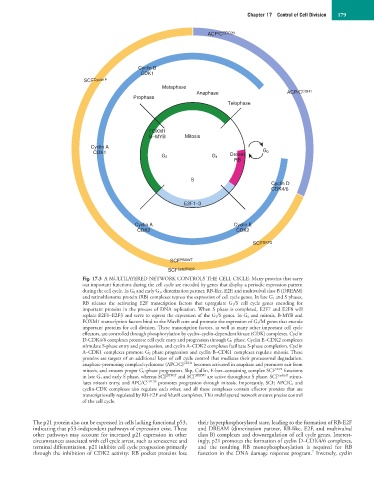
                            Fig. 17.3  A MULTILAYERED NETWORK CONTROLS THE CELL CYCLE. Many proteins that carry
                            out important functions during the cell cycle are encoded by genes that display a periodic expression pattern
                            during the cell cycle. In G 0 and early G 1, dimerization partner, RB-like, E2F, and multivulval class B (DREAM)
                            and retinoblastoma protein (RB) complexes repress the expression of cell cycle genes. In late G 1 and S phases,
                            RB  releases  the  activating  E2F  transcription  factors  that  upregulate  G 1/S  cell  cycle  genes  encoding  for
                            important proteins in the process of DNA replication. When S phase is completed, E2F7 and E2F8 will
                            replace E2F1–E2F3 and serve to repress the expression of the G 1/S genes. In G 2 and mitosis, B-MYB and
                            FOXM1 transcription factors bind to the MuvB core and promote the expression of G 2/M genes that encode
                            important proteins for cell division. These transcription factors, as well as many other important cell cycle
                            effectors, are controlled through phosphorylation by cyclin–cyclin-dependent kinase (CDK) complexes. Cyclin
                            D-CDK4/6 complexes promote cell cycle entry and progression through G 1 phase. Cyclin E–CDK2 complexes
                            stimulate S-phase entry and progression, and cyclin A–CDK2 complexes facilitate S-phase completion. Cyclin
                            A–CDK1 complexes promote G 2 phase progression and cyclin B–CDK1 complexes regulate mitosis. These
                            proteins are targets of an additional layer of cell cycle control that mediates their proteasomal degradation.
                            anaphase-promoting complex/cyclosome (APC/C) CDH1  becomes activated in anaphase and promotes exit from
                            mitosis, and ensures proper G 1-phase progression. Skp, Cullin, F-box–containing complex SCF SKP2  functions
                            in late G 1 and early S phase, whereas SCF βTRCP  and SCF FBXW7  are active throughout S phase. SCF cyclin F  stimu-
                            lates mitosis entry, and APC/C CDC20  promotes progression through mitosis. Importantly, SCF, APC/C, and
                            cyclin-CDK complexes also regulate each other, and all these complexes contain effector proteins that are
                            transcriptionally regulated by RB-E2F and MuvB complexes. This multilayered network ensures precise control
                            of the cell cycle.


            The p21 protein also can be expressed in cells lacking functional p53,   their hyperphosphorylated state, leading to the formation of RB-E2F
            indicating that p53-independent pathways of expression exist. These   and DREAM (dimerization partner, RB-like, E2F, and multivulval
            other pathways may account for increased p21 expression in other   class B) complexes and downregulation of cell cycle genes. Interest-
            circumstances associated with cell cycle arrest, such as senescence and   ingly, p21 promotes the formation of cyclin D–CDK4/6 complexes,
            terminal differentiation. p21 inhibits cell cycle progression primarily   and  the  resulting  RB  monophosphorylation  is  required  for  RB
                                                                                                       7
            through the inhibition of CDK2 activity: RB pocket proteins lose   function in the DNA damage response program.  Inversely, cyclin

