


Page 228 - Hematology_ Basic Principles and Practice ( PDFDrive )
P. 228
180    Part II  Cellular Basis of Hematology


        D-CDK4/6  can  sequester  p21,  preventing  inactivation  of  CDK2-  is its upregulation in aging tissues and in response to oncogene activa-
        containing complexes.                                 tion.  For  example,  in  response  to  continuously  high  RAS  or  E2F
           In  marked  contrast  with  the  transcriptional  regulation  of  p21,   activity, CDKN2A is transcriptionally induced, leading to cell cycle
        regulation  of  p27  (KIP1,  CDKN1B)  occurs  posttranscriptionally,   arrest and senescence.
        such that mRNA levels remain largely constant, whereas levels of the
        protein change. p27 protein levels are maximal during quiescence and
        early G 1, and p27 protein binds and inhibits cyclin E–CDK2 com-  TRANSCRIPTIONAL REGULATION: MYC,
        plexes.  The  progressive  decrease  in  p27  protein  levels  during  G 1   RB-E2F, DREAM, AND MMB-FOXM1
        allows for activation of cyclin E–CDK2 complexes that are required
        for the transition into S phase. Notably, to the end of G 1 phase, active   Cell cycle entry and progression require specific genes to be expressed
        cyclin E–CDK2 complexes phosphorylate p27, causing its ubiquitin-  at certain times. When cell proliferation is triggered by growth condi-
        mediated  degradation  and  leading  to  a  dramatic  decline  in  p27   tions and cells leave quiescence, mitogen signaling leads to the activa-
                                                                                           10
        protein  levels.  In  accordance  with  the  ability  of  p21  and  p27  to   tion of the MYC transcription factor.  MYC has the capability to
        inhibit cyclin-CDK activity and cell cycling, p21 and p27 are candi-  drive cell proliferation because it activates cyclin D and CDK4/6, and
        date tumor suppressor genes, but silencing or loss of these genes is   it also plays an important role in cell growth because it upregulates
        very uncommon in cancers. Unlike its ubiquitous siblings, p57 has a   ribosomal RNA and proteins, leading to increased ribosome biogen-
        tissue-specific expression pattern during embryogenesis, and in the   esis and translation. Indeed, experiments showed that when MYC is
        adult,  and  it  is  the  only  CDK  inhibitor  required  for  embryonic   missing,  cell  growth  and  proliferation  slow  down  and  cells  arrest
        development.                                          primarily in G 1 phase. MYC activity ensures that cells reach a certain
           Striking  diversity  in  the  pattern  of  expression  of  INK4  genes   size before entering S phase and progressing through the cell cycle.
        suggests that this family of CDK inhibitors might have cell type–  The two main cell cycle events—DNA synthesis and mitosis—
        specific or tissue-specific functions. The two founding members, p16   take  place  after  the  cell  passes  the  G 1/S  restriction  point  and  is
        and p15, were cloned as tumor suppressor genes, and the p18 and   committed to cell cycle progression. Entry into S phase requires the
        p19 proteins were subsequently cloned on the basis of homology to   expression of genes required for DNA replication. These genes are
        p16 and p15. INK4 CDK inhibitors block CDK4 and CDK6, and   distinct  from  the  ones  required  for  entry  into  mitosis.  In  general,
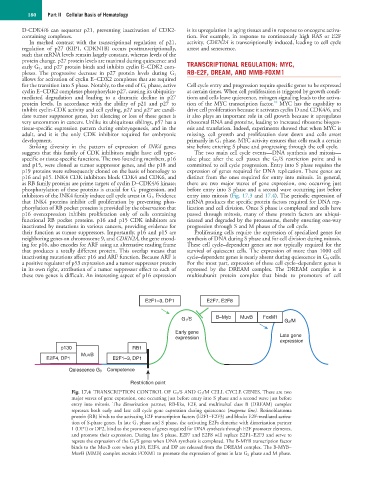
        as RB family proteins are prime targets of cyclin D–CDK4/6 kinase;   there  are  two  major  waves  of  gene  expression,  one  occurring  just
        phosphorylation of these proteins is crucial for G 1  progression, and   before entry into S phase and a second wave occurring just before
        inhibitors of the INK4 family induce cell cycle arrest in G 1 . Evidence   entry into mitosis (Fig. 17.3 and 17.4). The periodic expression of
        that  INK4  proteins  inhibit  cell  proliferation  by  preventing  phos-  mRNA produces the specific protein factors required for DNA rep-
        phorylation of RB pocket proteins is provided by the observation that   lication and cell division. Once S phase is completed and cells have
        p16  overexpression  inhibits  proliferation  only  of  cells  containing   passed  through  mitosis,  many  of  these  protein  factors  are  ubiqui-
        functional  RB  pocket  proteins.  p16  and  p15  CDK  inhibitors  are   tinated and degraded by the proteasome, thereby ensuring one-way
        inactivated by mutations in various cancers, providing evidence for   progression through S and M phases of the cell cycle.
        their function as tumor suppressors. Importantly, p16 and p15 are   Proliferating cells require the expression of specialized genes for
        neighboring genes on chromosome 9, and CDKN2A, the gene encod-  synthesis of DNA during S phase and for cell division during mitosis.
        ing for p16, also encodes for ARF using an alternative reading frame   These cell cycle–dependent genes are not typically required for the
        that  produces  a  totally  different  protein. This  overlap  means  that   survival  of  quiescent  cells. The  expression  of  more  than  1000  cell
        inactivating mutations affect p16 and ARF function. Because ARF is   cycle–dependent genes is nearly absent during quiescence in G 0  cells.
        a positive regulator of p53 expression and a tumor suppressor protein   For the most part, expression of these cell cycle–dependent genes is
        in its own right, attribution of a tumor suppressor effect to each of   repressed  by  the  DREAM  complex.  The  DREAM  complex  is  a
        these two genes is difficult. An interesting aspect of p16 expression   multisubunit  protein  complex  that  binds  to  promoters  of  cell


                                                E2F1–3, DP1          E2F7, E2F8

                                                            G 1 /S      B–Myb   MuvB   FoxM1  G 2 /M

                                                          Early gene
                                                          expression                         Late gene
                                                                                             expression
                     p130                   RB1
                            MuvB
                E2F4, DP1             E2F1–3, DP1
                        Quiescence G 0  Competence
                                            Restriction point
                        Fig. 17.4  TRANSCRIPTION CONTROL OF G 1 /S AND G 2 /M CELL CYCLE GENES. There are two
                        major waves of gene expression, one occurring just before entry into S phase and a second wave just before
                        entry  into  mitosis.  The  dimerization  partner,  RB-like,  E2F,  and  multivulval  class  B  (DREAM)  complex
                        represses  both  early  and  late  cell  cycle  gene  expression  during  quiescence  (magenta  line).  Retinoblastoma
                        protein (RB) binds to the activating E2F transcription factors (E2F1–E2F3) and blocks E2F-mediated activa-
                        tion of S-phase genes. In late G 1  phase and S phase, the activating E2Fs dimerize with dimerization partner
                        1 (DP1) or DP2, bind to the promoters of genes required for DNA synthesis through E2F promoter elements,
                        and promote their expression. During late S phase, E2F7 and E2F8 will replace E2F1–E2F3 and serve to
                        repress the expression of the G 1 /S genes when DNA synthesis is completed. The B-MYB transcription factor
                        binds to the MuvB core when p130, E2F4, and DP are released from the DREAM complex. The B-MYB–
                        MuvB (MMB) complex recruits FOXM1 to promote the expression of genes in late G 2 phase and M phase.

