


Page 225 - Hematology_ Basic Principles and Practice ( PDFDrive )
P. 225
Chapter 17  Control of Cell Division  177


                     Metaphase                                                  RTK (TCR, BCR, CSF1R, MPL)
                                Anaphase
           Prophase
                                          Telophase
                                                                                     SOS, GRB, SHC
                            Mitosis
                                                                                   KRAS, HRAS, NRAS


                                                      Quiescence                     RAF1, RAFA, RAFB
                                                          G 0
                G 2                        G 1
                                                                           MEK1, MEK2  MAP2K1, MAP2K2


                              S
                                                                            ERK, MAPK   MAPK1, MAPK3

                                                 Restriction point
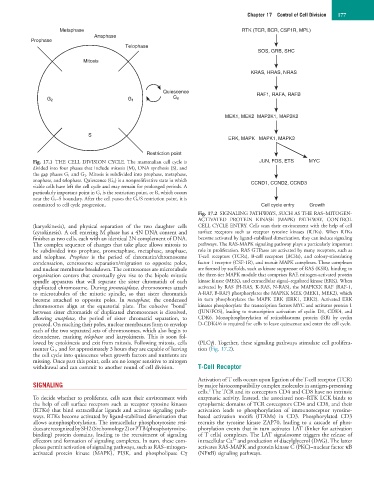
            Fig.  17.1  THE CELL DIVISION CYCLE. The mammalian cell cycle is          JUN, FOS, ETS   MYC
            divided into four phases that include mitosis (M), DNA synthesis (S), and
            the gap phases G 1 and G 2. Mitosis is subdivided into prophase, metaphase,
            anaphase, and telophase. Quiescence (G 0) is a nonproliferative state in which   CCND1, CCND2, CCND3
            viable cells have left the cell cycle and may remain for prolonged periods. A
            particularly important point in G 1 is the restriction point, or R, which occurs
            near the G 1–S boundary. After the cell passes the G 1/S restriction point, it is
            committed to cell cycle progression.                                      Cell cycle entry  Growth
                                                                  Fig. 17.2  SIGNALING PATHWAYS, SUCH AS THE RAS–MITOGEN-
                                                                  ACTIVATED  PROTEIN  KINASE  (MAPK)  PATHWAY,  CONTROL
            (karyokinesis),  and  physical  separation  of  the  two  daughter  cells   CELL CYCLE ENTRY. Cells scan their environment with the help of cell
            (cytokinesis). A cell entering M phase has a 4N DNA content and   surface  receptors  such  as  receptor  tyrosine  kinases  (RTKs).  When  RTKs
            finishes as two cells, each with an identical 2N complement of DNA.   become activated by ligand-stabilized dimerization, they can induce signaling
            The complex sequence of changes that take place allows mitosis to   pathways. The RAS-MAPK signaling pathway plays a particularly important
            be  subdivided  into  prophase,  prometaphase,  metaphase,  anaphase,   role in proliferation. RAS GTPases are activated by many receptors, such as
            and  telophase.  Prophase  is  the  period  of  chromatin/chromosome   T-cell  receptors  (TCRs),  B-cell  receptors  (BCRs),  and  colony-stimulating
            condensation,  centrosome  separation/migration  to  opposite  poles,   factor 1 receptor (CSF-1R), and recruit MAPK complexes. These complexes
            and nuclear membrane breakdown. The centrosomes are microtubule   are formed by scaffolds, such as kinase suppressor of RAS (KSR), binding to
            organization centers that eventually give rise to the bipole mitotic   the three-tier MAPK module that comprises RAF, mitogen-activated protein
            spindle  apparatus  that  will  separate  the  sister  chromatids  of  each   kinase kinase (MEK), and extracellular signal–regulated kinase (ERK). When
            duplicated chromosome. During prometaphase, chromosomes attach   activated by RAS (H-RAS, K-RAS, N-RAS), the MAPKKK RAF (RAF-1,
            to  microtubules  of  the  mitotic  spindle,  so  that  sister  chromatids   A-RAF, B-RAF) phosphorylates the MAPKK MEK (MEK1, MEK2), which
            become  attached  to  opposite  poles.  In  metaphase,  the  condensed   in  turn  phosphorylates  the  MAPK  ERK  (ERK1,  ERK2).  Activated  ERK
            chromosomes  align  at  the  equatorial  plate.  The  cohesive  “bond”   kinases phosphorylate the transcription factors MYC and activator protein 1
            between sister chromatids of duplicated chromosomes is dissolved,   (JUN/FOS), leading to transcription activation of cyclin D1, CDK4, and
            allowing  anaphase,  the  period  of  sister  chromatid  separation,  to   CDK6.  Monophosphorylation  of  retinoblastoma  protein  (RB)  by  cyclin
            proceed. On reaching their poles, nuclear membranes form to envelop   D-CDK4/6 is required for cells to leave quiescence and enter the cell cycle.
            each of the two separated sets of chromosomes, which also begin to
            decondense,  marking  telophase  and  karyokinesis. This  is  soon  fol-
            lowed by cytokinesis and exit from mitosis. Following mitosis, cells   (PLCγ). Together, these signaling pathways stimulate cell prolifera-
            reenter G 1 , and for approximately 3 hours they are capable of leaving   tion (Fig. 17.2).
            the cell cycle into quiescence when growth factors and nutrients are
            missing. Once past this point, cells are no longer sensitive to mitogen
            withdrawal and can commit to another round of cell division.  T-Cell Receptor

                                                                  Activation of T cells occurs upon ligation of the T-cell receptor (TCR)
            SIGNALING                                             by major histocompatibility complex molecules in antigen-presenting
                                                                     2
                                                                  cells.  The TCR and its coreceptors CD4 and CD8 have no intrinsic
            To decide whether to proliferate, cells scan their environment with   enzymatic activity. Instead, the associated non–RTK LCK binds to
            the  help  of  cell  surface  receptors  such  as  receptor  tyrosine  kinases   cytoplasmic domains of TCR coreceptors CD4 and CD8, and their
            (RTKs) that bind extracellular ligands and activate signaling path-  activation  leads  to  phosphorylation  of  immunoreceptor  tyrosine-
            ways. RTKs become activated by ligand-stabilized dimerization that   based  activation  motifs  (ITAMs)  in  CD3.  Phosphorylated  CD3
            allows autophosphorylation. The intracellular phosphotyrosine resi-  recruits  the  tyrosine  kinase  ZAP70,  leading  to  a  cascade  of  phos-
            dues are recognized by SH2 (Src homology 2) or PTB (phosphotyrosine-  phorylation events that in turn activates LAT (linker for activation
            binding)  protein  domains,  leading  to  the  recruitment  of  signaling   of T cells) complexes. The LAT signalosome triggers the release of
                                                                             2+
            effectors and formation of signaling complexes. In turn, these com-  intracellular Ca  and production of diacylglycerol (DAG). The latter
            plexes permit activation of signaling pathways, such as RAS–mitogen-  activates RAS-MAPK and protein kinase C (PKC)–nuclear factor κB
            activated  protein  kinase  (MAPK),  PI3K,  and  phospholipase  Cγ   (NFκB) signaling pathways.

