


Page 2279 - Hematology_ Basic Principles and Practice ( PDFDrive )
P. 2279
2026   Part XII  Hemostasis and Thrombosis


                                                              Amino acids 2303-2332
                                                              inhibit binding to FIX 55


                                                              Amino acids 2248-2312
                                                              inhibit binding to vWF 143


                          Amino acids 351-365
                          inhibit binding                     Amino acids 2181-2243
                                                                             144
                          to FX 140,141                       inhibit binding to VWF


                                               Amino acids 1804-1819
                                               inhibit binding to FIX 63


                          A1     a1    A2     a2          B         a3   A3     C1        C2


                                                              Amino acids 2170-2327
                                                              inhibit binding to PL
                                                              and VWF 54


                                Amino acids 484-508           Amino acids 2218-2307
                                inhibit binding to FIXa 59    slow release from VWF 56


                                                               Amino acids 2253-2270
                                                               inhibit binding to FX
                                                               and cleavage by FX 142

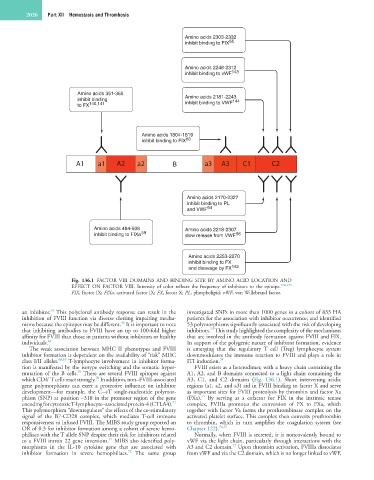
                        Fig.  136.1  FACTOR  VIII  DOMAINS  AND  BINDING  SITE  BY  AMINO  ACID  LOCATION  AND
                        EFFECT  ON  FACTOR  VIII.  Intensity  of  color  reflects  the  frequency  of  inhibitors  to  the  epitope. 170–174
                        FIX, Factor IX; FIXa, activated factor IX; FX, factor X; PL, phospholipid; vWF, von Willebrand factor.


                  65
        an inhibitor.  This polyclonal antibody response can result in the   investigated SNPs in more than 1000 genes in a cohort of 833 HA
        inhibition of FVIII function via diverse clotting impairing mecha-  patients for the association with inhibitor occurrence, and identified
                                         66
        nisms because the epitopes may be different.  It is important to note   53 polymorphisms significantly associated with the risk of developing
                                                                      73
        that inhibiting antibodies to FVIII have an up to 100-fold higher   inhibitors.  This study highlighted the complexity of the mechanisms
        affinity for FVIII than those in patients without inhibitors or healthy   that are involved in the antibody formation against FVIII and FIX.
        individuals. 67                                       In support of the polygenic nature of inhibitor formation, evidence
           The  weak  association  between  MHC  II  phenotypes  and  FVIII   is  emerging  that  the  regulatory  T  cell  (Treg)  lymphocyte  system
        inhibitor formation is dependent on the availability of “risk” MHC   downmodulates the immune reaction to FVIII and plays a role in
        class I/II alleles. 68,69  T-lymphocyte involvement in inhibitor forma-  ITI induction. 74
        tion is manifested by the isotype switching and the somatic hyper-  FVIII exists as a heterodimer, with a heavy chain containing the
                          70
        mutation of the B cells.  There are several FVIII epitopes against   A1, A2, and B domains connected to a light chain containing the
                 +
                                70
        which CD4  T cells react strongly.  In addition, non–FVIII-associated   A3,  C1,  and  C2  domains  (Fig.  136.1).  Short  intervening  acidic
        gene  polymorphisms  can  exert  a  protective  influence  on  inhibitor   regions (a1, a2, and a3) aid in FVIII binding to factor X and serve
        development—for  example,  the  C→T  single-nucleotide  polymor-  as important sites for FVIII proteolysis by thrombin and factor Xa
                                                                   75
        phism (SNP) at position –318 in the promoter region of the gene   (FXa).   By  serving  as  a  cofactor  for  FIX  in  the  intrinsic  tenase
                                                         71
        encoding for cytotoxic T-lymphocyte–associated protein-4 (CTLA4).    complex,  FVIIIa  promotes  the  conversion  of  FX  to  FXa,  which
        This polymorphism “downregulates” the effects of the co-stimulatory   together with factor Va forms the prothrombinase complex on the
        signal  of  the  B7-CD28  complex,  which  mediates  T-cell  immune   activated platelet surface. This complex then converts prothrombin
        responsiveness to infused FVIII. The MIBS study group reported an   to  thrombin,  which  in  turn  amplifies  the  coagulation  system  (see
        OR of 0.3 for inhibitor formation among a cohort of severe hemo-  Chapter 122). 76,77
        philiacs with the T allele SNP despite their risk for inhibitors related   Normally, when FVIII is secreted, it is noncovalently bound to
                                     71
        to a FVIII intron 22 gene inversions.  MIBS also identified poly-  vWF via the light chain, particularly through interactions with the
                                                                             77
        morphisms  in  the  IL-10  cytokine  gene  that  are  associated  with   A3 and C2 domain.  Upon thrombin activation, FVIIIa dissociates
                                           72
        inhibitor  formation  in  severe  hemophiliacs.   The  same  group   from vWF and via the C2 domain, which is no longer linked to vWF,

