


Page 2280 - Hematology_ Basic Principles and Practice ( PDFDrive )
P. 2280
Chapter 136  Inhibitors in Hemophilias  2027

                                                      78
            binds to platelet membrane-associated phosphatidylserine.  Neutral-  100
            izing alloantibody inhibitors can interrupt this complex process (see
            Fig. 136.1) by (a) preventing FVIII interaction with vWF, thereby   75
            significantly  decreasing  its  circulating  half-life,  (b)  hampering  the
            release  of  FVIIIa  from  vWF  following  thrombin  activation,  (c)
            increasing the time available for FVIII inactivation, and/or (d) pre-  50
            venting C2 domains from binding to the phospholipid layer. 79–83
              Other FVIII alloantibody inhibitors interact with the A2 domain,
            predominantly  at  the  Arg4844–Ile5085  epitope  and  interrupt  Corrected percent residual factor VIII
            FVIIIa–FIXa  interactions,  thereby  impairing  intrinsic  tenase  activ-  25
              84
            ity.  Regions outside the A2 and C2 domains are minor epitopes for
            FVIII  inhibitors;  however,  those  binding  to  the  A3  domain  also
                                      84
            blocks the FVIIIa–FIXa interaction.  In most hemophilia A patients,
            alloantibodies recognize multiple epitopes in both the A2 and C2
            domains, in contrast to autoantibodies to FVIII, which target either   10
                                      84
            the C2 or A2 domain but not both.  Although antibodies that target   0  0.5      1         1.5         2
            B domain epitopes have been reported, these do not exert any neu-
            tralizing activity.                                                    Bethesda units per mL plasma
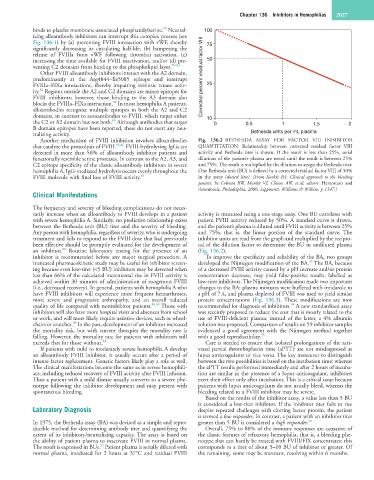
              Another mechanism of FVIII inhibition involves alloantibodies   Fig.  136.2  BETHESDA  ASSAY  FOR  FACTOR  VIII  INHIBITOR
            that catalyze the proteolysis of FVIII. 85,86  FVIII-hydrolyzing IgGs are   QUANTITATION.  Relationship  between  corrected  residual  factor  VIII
            detected in more than 50% of alloantibody inhibitor patients and   activity  and  Bethesda  titer  is  shown.  If  the  result  is  less  than  25%,  serial
            functionally resemble serine proteases. In contrast to the A2, A3, and   dilutions of the patient’s plasma are tested until the result is between 25%
            C2 epitope specificity of the classic alloantibody inhibitors in severe   and 75%. The result is multiplied by the dilution to assign the Bethesda titer.
            hemophilia A, IgG-mediated hydrolysis occurs evenly throughout the   One Bethesda unit (BU) is defined by a corrected residual factor VIII of 50%
            FVIII molecule with final loss of FVIII activity. 87  in  the  assay  (dotted  line).  (From  Konkle  BA:  Clinical  approach  to  the  bleeding
                                                                  patient.  In  Colman  RW,  Marder  VJ,  Clowes  AW,  et al,  editors:  Hemostasis  and
                                                                  thrombosis, Philadelphia, 2006, Lippincott, Williams & Wilkins, p 1147.)
            Clinical Manifestations

            The frequency and severity of bleeding complications do not neces-
            sarily increase when an alloantibody to FVIII develops in a patient   activity is measured using a one-stage assay. One BU correlates with
            with severe hemophilia A. Similarly, no predictive relationship exists   patient FVIII activity reduced by 50%. A standard curve is drawn,
            between the Bethesda unit (BU) titer and the severity of bleeding.   and the patient’s plasma is diluted until FVIII activity is between 25%
            Any person with hemophilia, regardless of severity, who is undergoing   and  75%,  that  is,  the  linear  portion  of  the  standard  curve.  The
            treatment and fails to respond to the FVIII dose that had previously   inhibitor units are read from the graph and multiplied by the recipro-
            been effective should be promptly evaluated for the development of   cal of the dilution factor to determine the BU in undiluted plasma
                     88
            an  inhibitor.   Routine  laboratory  testing  for  the  presence  of  an   (Fig. 136.2).
            inhibitor  is  recommended  before  any  major  surgical  procedure.  A   To improve the specificity and reliability of the BA, two groups
                                                                                                      93
            truncated pharmacokinetic study may be useful for inhibitor screen-  developed the Nijmegen modification of the BA.  The BA, because
            ing because even low-titer (<5 BU) inhibitors may be detected when   of a decreased FVIII activity caused by a pH increase and/or protein
            less than 66% of the calculated incremental rise in FVIII activity is   concentration  decrease,  may  yield  false-positive  results,  labelled  as
            achieved within 30 minutes of administration of exogenous FVIII   low-titer inhibitors. The Nijmegen modification made two important
            (i.e., decreased recovery). In general, patients with hemophilia A who   changes to the BA: plasma mixtures were buffered with imidazole to
            have FVIII inhibitors will experience more frequent hemarthroses,   a pH of 7.4, and plasma depleted of FVIII was used to yield similar
            more  severe  and  progressive  arthropathy,  and  an  overall  reduced   protein  concentrations  (Fig.  136.3).  These  modifications  are  now
                                                                                                94
            quality of life compared with noninhibitor patients. 89,90  Those with   recommended for diagnosis of inhibitors.  A new standardized assay
            inhibitors will also have more hospital visits and absences from school   was recently proposed to reduce the cost that is mostly related to the
            or work, and will more likely require assistive devices, such as wheel-  use of FVIII-deficient plasma; instead of the latter, a 4% albumin
                         90
            chairs or crutches.  In the past, development of an inhibitor increased   solution was proposed. Comparison of results on 59 inhibitor samples
            the mortality risk, but with current therapies the mortality rate is   evidenced  a  good  agreement  with  the  Nijmegen  method  together
            falling. However, the mortality rate for patients with inhibitors still   with a good reproducibility. 95
            exceeds that for those without. 91                      Care is needed to ensure that isolated prolongations of the acti-
              If patients with mild to moderately severe hemophilia A develop   vated partial thromboplastin time (aPTT) are not misdiagnosed as
            an alloantibody FVIII inhibitor, it usually occurs after a period of   lupus anticoagulants or vice versa. The key maneuver to distinguish
            intense factor replacement. Genetic factors likely play a role as well.   between the two possibilities is based on the incubation time: whereas
            The clinical manifestations become the same as in severe hemophili-  the aPTT results performed immediately and after 2 hours of incuba-
            acs, including reduced recovery of FVIII activity after FVIII infusion.   tion are similar in the presence of a lupus anticoagulant, inhibitors
            Thus a patient with a mild disease usually converts to a severe phe-  exert their effect only after incubation. This is a critical issue because
            notype following the inhibitor development and may present with   patients with lupus anticoagulants do not usually bleed, whereas the
            spontaneous bleeding.                                 bleeding related to a FVIII inhibitor may be severe.
                                                                    Based on the results of the inhibitor assay, a value less than 5 BU
                                                                  is considered a low-titer inhibitor. If the inhibitor titer fails to rise
            Laboratory Diagnosis                                  despite repeated challenges with clotting factor protein, the patient
                                                                  is termed a low responder. In contrast, a patient with an inhibitor titer
            In 1975, the Bethesda assay (BA) was devised as a simple and repro-  greater than 5 BU is considered a high responder. 94
            ducible method for determining antibody titer and quantifying the   Overall, 75% to 80% of the immune responses are causative of
            extent of its inhibitory/neutralizing capacity. The assay is based on   the classic features of refractory hemophilia, that is, a bleeding phe-
            the ability of patient plasma to inactivate FVIII in normal plasma.   notype that can hardly be treated with FVIII/FIX concentrates: this
                                  92
            The result is expressed in BUs.  Patient plasma is serially diluted with   corresponds to a titer of about 5–10 BU of inhibitor or greater. Of
            normal plasma, incubated for 2 hours at 37°C and residual FVIII   the remaining, some may be transient, resolving within 6 months.

