


Page 2282 - Hematology_ Basic Principles and Practice ( PDFDrive )
P. 2282
Chapter 136  Inhibitors in Hemophilias  2029


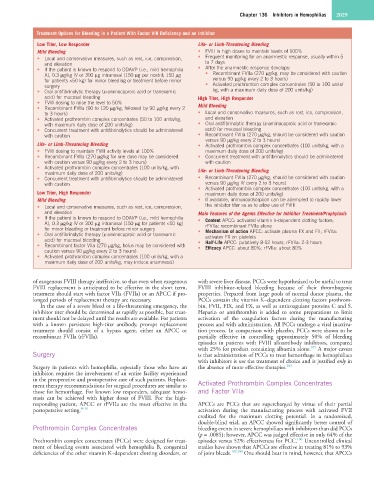
             Treatment Options for Bleeding in a Patient With Factor VIII Deficiency and an Inhibitor
             Low Titer, Low Responder                             Life- or Limb-Threatening Bleeding
             Mild Bleeding                                        •  FVIII in high doses to maintain levels of 100%
             •  Local and conservative measures, such as rest, ice, compression,   •  Frequent monitoring for an anamnestic response, usually within 5
                and elevation                                       to 7 days
             •  If the patient is known to respond to DDAVP (i.e., mild hemophilia   •  After the anamnestic response develops:
                A), 0.3 µg/kg IV or 300 µg intranasal (150 µg per nostril; 150 µg   •  Recombinant FVIIa (270 µg/kg, may be considered with caution
                for patients <50 kg) for minor bleeding or treatment before minor   versus 90 µg/kg every 2 to 3 hours)
                surgery                                             •  Activated prothrombin complex concentrates (50 to 100 units/
             •  Oral antifibrinolytic therapy (ε-aminocaproic acid or tranexamic   kg, with a maximum daily dose of 200 units/kg)
                acid) for mucosal bleeding                        High Titer, High Responder
             •  FVIII dosing to raise the level to 50%            Mild Bleeding
             •  Recombinant FVIIa (90 to 120 µg/kg, followed by 90 µg/kg every 2
                to 3 hours)                                       •  Local and conservative measures, such as rest, ice, compression,
             •  Activated prothrombin complex concentrates (50 to 100 units/kg,   and elevation
                with maximum daily dose of 200 units/kg)          •  Oral antifibrinolytic therapy (ε-aminocaproic acid or tranexamic
             •  Concurrent treatment with antifibrinolytics should be administered   acid) for mucosal bleeding
                with caution                                      •  Recombinant FVIIa (270 µg/kg, should be considered with caution
                                                                    versus 90 µg/kg every 2 to 3 hours)
             Life- or Limb-Threatening Bleeding                   •  Activated prothrombin complex concentrates (100 units/kg, with a
             •  FVIII dosing to maintain FVIII activity levels at 100%  maximum daily dose of 200 units/kg)
             •  Recombinant FVIIa (270 µg/kg for one dose may be considered   •  Concurrent treatment with antifibrinolytics should be administered
                with caution versus 90 µg/kg every 2 to 3 hours)    with caution
             •  Activated prothrombin complex concentrates (100 units/kg, with   Life- or Limb-Threatening Bleeding
                maximum daily dose of 200 units/kg)
             •  Concurrent treatment with antifibrinolytics should be administered   •  Recombinant FVIIa (270 µg/kg, should be considered with caution
                with caution                                        versus 90 µg/kg IV every 2 to 3 hours)
                                                                  •  Activated prothrombin complex concentrates (100 units/kg, with a
             Low Titer, High Responder                              maximum daily dose of 200 units/kg)
             Mild Bleeding                                        •  If available, immunoadsorption can be attempted to rapidly lower
             •  Local and conservative measures, such as rest, ice, compression,   the inhibitor titer so as to allow use of FVIII
                and elevation                                     Main Features of the Agents Effective for Inhibitor Treatment/Prophylaxis
             •  If the patient is known to respond to DDAVP (i.e., mild hemophilia   •  Content APCC: activated vitamin k-dependent clotting factors;
                A), 0.3 µg/kg IV or 300 µg intranasal (150 µg for patients <50 kg)   rFVIIa: recombinant FVIIa alone
                for minor bleeding or treatment before minor surgery  •  Mechanism of action APCC: activate plasma FX and FII; rFVIIa:
             •  Oral antifibrinolytic therapy (ε-aminocaproic acid or tranexamic   activates FX on platelets
                acid) for mucosal bleeding                        •  Half-Life APCC: putatively 8-12 hours; rFVIIa: 2-3 hours
             •  Recombinant factor VIIa (270 µg/kg, bolus may be considered with   •  Efficacy APCC: about 80%; rFVIIa: about 80%
                caution versus 90 µg/kg every 2 to 3 hours)
             •  Activated prothrombin complex concentrates (100 units/kg, with a
                maximum daily dose of 200 units/kg, may induce anamnesis)


            of exogenous FVIII therapy ineffective, so that even when exogenous   with severe liver disease. PCCs were hypothesized to be useful to treat
            FVIII replacement is anticipated to be effective in the short term,   FVIII  inhibitor-related  bleeding  because  of  their  thrombogenic
            treatment should start with factor VIIa (FVIIa) or an APCC if pro-  properties. Prepared from large pools of normal donor plasma, the
            longed periods of replacement therapy are necessary.  PCCs contain the vitamin K–dependent clotting factors prothrom-
              In the case of a severe bleed or a life-threatening emergency, the   bin, FVII, FIX, and FX, as well as anticoagulant proteins C and S.
            inhibitor titer should be determined as rapidly as possible, but treat-  Heparin  or  antithrombin  is  added  to  some  preparations  to  limit
            ment should not be delayed until the results are available. For patients   activation  of  the  coagulation  factors  during  the  manufacturing
            with  a  known  persistent  high-titer  antibody,  prompt  replacement   process and with administration. All PCCs undergo a viral inactiva-
            treatment  should  consist  of  a  bypass  agent,  either  an  APCC  or   tion process. In comparison with placebo, PCCs were shown to be
            recombinant FVIIa (rFVIIa).                           partially  effective  in  controlling  approximately  50%  of  bleeding
                                                                  episodes  in  patients  with  FVIII  alloantibody  inhibitors,  compared
                                                                                                       105
                                                                  with 25% for product containing albumin alone.  A major caveat
            Surgery                                               is that administration of PCCs to treat hemorrhage in hemophiliacs
                                                                  with inhibitors is not the treatment of choice and is justified only in
            Surgery in patients with hemophilia, especially those who have an   the absence of more effective therapies. 105
            inhibitor, requires the involvement of an entire facility experienced
            in the preoperative and postoperative care of such patients. Replace-
            ment therapy recommendations for surgical procedures are similar to   Activated Prothrombin Complex Concentrates
            those for hemorrhage. For known low responders, adequate hemo-  and Factor VIIa
            stasis  can  be  achieved  with  higher  doses  of  FVIII.  For  the  high-
            responding patient, APCC or rFVIIa are the most effective in the   APCCs  are  PCCs  that  are  supercharged  by  virtue  of  their  partial
            postoperative setting. 8–10                           activation  during  the  manufacturing  process  with  activated  FVII
                                                                  credited  for  the  maximum  clotting  potential.  In  a  randomized,
                                                                  double-blind trial, an APCC showed significantly better control of
            Prothrombin Complex Concentrates                      bleeding events in severe hemophiliacs with inhibitors than did PCCs
                                                                  (p = .0085); however, APCC was judged effective in only 64% of the
                                                                                                  106
            Prothrombin complex concentrates (PCCs) were designed for treat-  episodes versus 52% effectiveness for PCC.  Uncontrolled clinical
            ment  of  bleeding  events  associated  with  hemophilia  B,  congenital   studies have shown that APCCs are effective in treating 81% to 93%
            deficiencies of the other vitamin K–dependent clotting disorders, or   of joint bleeds. 107,108  One should bear in mind, however, that APCCs

