


Page 2293 - Hematology_ Basic Principles and Practice ( PDFDrive )
P. 2293
Chapter 137  Rare Coagulation Factor Deficiencies  2035

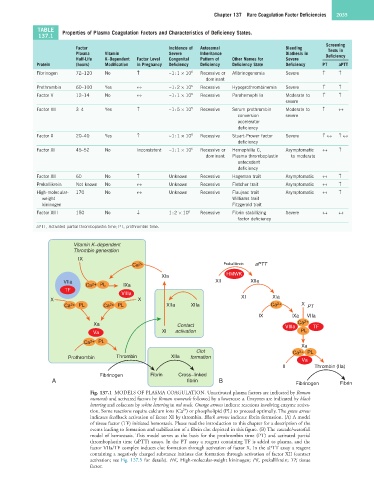
             TABLE   Properties of Plasma Coagulation Factors and Characteristics of Deficiency States.
              137.1
                                                                                                            Screening
                          Factor                        Incidence of   Autosomal              Bleeding      Tests in
                          Plasma   Vitamin              Severe     Inheritance                Diathesis in   Deficiency
                          Half-Life   K–Dependent   Factor Level   Congenital   Pattern of   Other Names for   Severe
             Protein      (hours)  Modification  in Pregnancy  Deficiency  Deficiency  Deficiency State  Deficiency  PT  aPTT
             Fibrinogen   72–120   No         ↑         ~1 : 1 × 10 6  Recessive or   Afibrinogenemia  Severe  ↑  ↑
                                                                    dominant
             Prothrombin  60–100   Yes        ↔         ~1 : 2 × 10 6  Recessive  Hypoprothrombinemia  Severe  ↑  ↑
             Factor V     12–14    No         ↔         ~1 : 1 × 10 6  Recessive  Parahemophilia  Moderate to  ↑  ↑
                                                                                              severe
             Factor VII   3–4      Yes        ↑         ~1 : 5 × 10 5  Recessive  Serum prothrombin   Moderate to  ↑  ↔
                                                                               conversion     severe
                                                                               accelerator
                                                                               deficiency
             Factor X     20–40    Yes        ↑         ~1 : 1 × 10 6  Recessive  Stuart-Prower factor   Severe  ↑ ↔  ↑ ↔
                                                                               deficiency
             Factor XI    45–52    No         Inconsistent  ~1 : 1 × 10 6  Recessive or   Hemophilia C,  Asymptomatic   ↔  ↑
                                                                    dominant  Plasma thromboplastin   to moderate
                                                                               antecedent
                                                                               deficiency
             Factor XII   60       No         ↑         Unknown    Recessive  Hageman trait   Asymptomatic  ↔   ↑
             Prekallikrein  Not known  No     ↔         Unknown    Recessive  Fletcher trait  Asymptomatic  ↔   ↑
             High-molecular-  170  No         ↔         Unknown    Recessive  Flaujeac trait  Asymptomatic  ↔   ↑
               weight                                                        Williams trait
               kininogen                                                     Fitzgerald trait
             Factor XIII  150      No         ↓         1 : 2 × 10 6  Recessive  Fibrin stabilizing   Severe  ↔  ↔
                                                                               factor deficiency
             aPTT, Activated partial thromboplastin time; PT, prothrombin time.

                         Vitamin K−dependent
                         Thrombin generation
                           IX
                                            Ca 2+                         Prekallikrein  aPTT
                                                                           HMWK
                                                      XIa
                      VIIa                                              XII        XIIa
                             Ca 2+ PL    IXa
                      TF
                                         VIIIa
                  X                           X                                 XI        XIa
                      Ca 2+ PL     Ca 2+ PL            XIIa    XIIa                       Ca 2+     X  PT
                                                                                      IX        IXa  VIIa
                                Xa                         Contact                            VIIIa  Ca 2+  TF
                               Va                     XI  activation                               PL
                            Ca 2+ PL
                                                                                                    Xa
                                                                 Clot                            Ca 2+ PL
                       Prothrombin     Thrombin          XIIa  formation                            Va
                                                                                             II         Thrombin (IIa)
                                  Fibrinogen      Fibrin   Cross−linked
                  A                                           fibrin     B
                                                                                                  Fibrinogen    Fibrin
                               Fig. 137.1  MODELS OF PLASMA COAGULATION. Unactivated plasma factors are indicated by Roman
                               numerals and activated factors by Roman numerals followed by a lowercase a. Enzymes are indicated by black
                               lettering and cofactors by white lettering in red ovals. Orange arrows indicate reactions involving enzyme activa-
                                                             2+
                               tion. Some reactions require calcium ions (Ca ) or phospholipid (PL) to proceed optimally. The green arrow
                               indicates feedback activation of factor XI by thrombin. Black arrows indicate fibrin formation. (A) A model
                               of tissue factor (TF) initiated hemostasis. Please read the introduction to this chapter for a description of the
                               events leading to formation and stabilization of a fibrin clot depicted in this figure. (B) The cascade/waterfall
                               model  of  hemostasis. This  model  serves  as  the  basis  for  the  prothrombin  time  (PT)  and  activated  partial
                               thromboplastin time (aPTT) assays. In the PT assay a reagent containing TF is added to plasma, and the
                               factor VIIa/TF complex induces clot formation through activation of factor X. In the aPTT assay a reagent
                               containing a negatively charged substance initiates clot formation through activation of factor XII (contact
                               activation; see Fig. 137.5 for details). HK, High-molecular-weight kininogen; PK, prekallikrein; TF, tissue
                               factor.

