


Page 2296 - Hematology_ Basic Principles and Practice ( PDFDrive )
P. 2296
2038   Part XII  Hemostasis and Thrombosis


                             β                                                             γ
                                                                             α
                                                            FPA
                                                            ss      RGDS
                                                                                   γ
                                                  RGDF                       ss   α PI
                                                           FPB
                                                            s s
                                                            s s
                               D-domain                   E-domain
                                            ss

                                            α
                             γ                                                             β
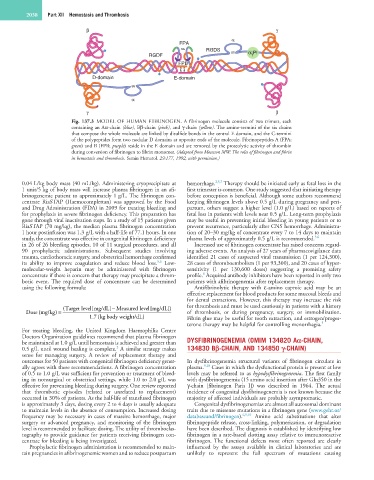
                        Fig.  137.3  MODEL OF HUMAN FIBRINOGEN. A fibrinogen molecule consists of two trimers, each
                        containing an Aα-chain (blue), Bβ-chain (pink), and γ-chain (yellow). The amino-termini of the six chains
                        that compose the whole molecule are linked by disulfide bonds in the central E domain, and the C-termini
                        of the polypeptides form two nodular D domains at opposite ends of the molecule. Fibrinopeptides A (FPA;
                        green) and B (FPB; purple) reside in the E domain and are removed by the proteolytic activity of thrombin
                        during conversion of fibrinogen to fibrin monomer. (Adapted from Mosesson MW: The roles of fibrinogen and fibrin
                        in hemostasis and thrombosis. Semin Hematol. 29:177, 1992, with permission.)


        0.04 L/kg body mass (40 mL/kg). Administering cryoprecipitate at   hemorrhage. 2,5,7  Therapy should be initiated early as fetal loss in the
        1 unit/5 kg of body mass will increase plasma fibrinogen in an afi-  first trimester is common. One study suggested that initiating therapy
        brinogenemic patient to approximately 1 g/L. The fibrinogen con-  before conception is beneficial. Although some authors recommend
        centrate  RiaSTAP  (Haemocomplettan)  was  approved  by  the  Food   keeping fibrinogen levels above 0.5 g/L during pregnancy and peri-
        and Drug Administration (FDA) in 2009 for treating bleeding and   partum, others suggest a higher level (1.0 g/L) based on reports of
        for prophylaxis in severe fibrinogen deficiency. This preparation has   fetal loss in patients with levels near 0.5 g/L. Long-term prophylaxis
        gone through viral inactivation steps. In a study of 15 patients given   may be useful in preventing initial bleeding in young patients or to
        RiaSTAP (70 mg/kg), the median plasma fibrinogen concentration   prevent recurrence, particularly after CNS hemorrhage. Administra-
        1 hour postinfusion was 1.3 g/L with a half-life of 77.1 hours. In one   tion of 20–30 mg/kg of concentrate every 7 to 14 days to maintain
        study, the concentrate was effective in congenital fibrinogen deficiency   plasma levels of approximately 0.5 g/L is recommended. 5,6
        in 26 of 26 bleeding episodes, 10 of 11 surgical procedures, and all   Increased use of fibrinogen concentrate has raised concerns regard-
        90  prophylactic  administrations.  Subsequent  studies  involving   ing adverse events. An analysis of 27 years of pharmacovigilance data
        trauma, cardiothoracic surgery, and obstetrical hemorrhage confirmed   identified 21 cases of suspected viral transmission (1 per 124,300),
                                                    5,6
        its  ability  to  improve  coagulation  and  reduce  blood  loss.   Low-  28 cases of thromboembolism (1 per 93,300), and 20 cases of hyper-
        molecular-weight  heparin  may  be  administered  with  fibrinogen   sensitivity  (1  per  130,600  doses)  suggesting  a  promising  safety
                                                                   8
        concentrate if there is concern that therapy may precipitate a throm-  profile.  Acquired antibody inhibitors have been reported in only two
        botic  event. The  required  dose  of  concentrate  can  be  determined   patients with afibrinogenemia after replacement therapy.
        using the following formula:                             Antifibrinolytic  therapy  with  ε-amino  caproic  acid  may  be  an
                                                              effective replacement for blood products for some mucosal bleeds and
                                                              for dental extractions. However, this therapy may increase the risk
                                                  [
                               [
                      ( Target level mg/dL]−  Measured level mg/dL])  for thrombosis and must be used cautiously in patients with a history
          Dose mg/kg) =                                       of  thrombosis,  or  during  pregnancy,  surgery,  or  immobilization.
              (
                                 (
                               . 1 7 (kg body weight/dL )     Fibrin glue may be useful for tooth extraction, and estrogen/proges-
                                                              terone therapy may be helpful for controlling menorrhagia. 5
        For  treating  bleeding,  the  United  Kingdom  Haemophilia  Centre
        Doctors Organization guidelines recommend that plasma fibrinogen
        be maintained at 1.0 g/L until hemostasis is achieved and greater than   DYSFIBRINOGENEMIA (OMIM 134820 Aα-CHAIN,
                                       2
        0.5 g/L until wound healing is complete.  A similar strategy makes   134830 Bβ-CHAIN, AND 134850 γ-CHAIN)
        sense  for  managing  surgery.  A  review  of  replacement  therapy  and
        outcomes for 50 patients with congenital fibrinogen deficiency gener-  In  dysfibrinogenemia  structural  variants  of  fibrinogen  circulate  in
        ally agrees with these recommendations. A fibrinogen concentration   plasma. 9,10  Cases in which the dysfunctional protein is present at low
        of 0.5 to 1.0 g/L was sufficient for prevention or treatment of bleed-  levels may be referred to as hypodysfibrinogenemia. The first family
        ing in nonsurgical or obstetrical settings, while 1.0 to 2.0 g/L was   with dysfibrinogenemia (15 amino acid insertion after Gln350 in the
        effective for preventing bleeding during surgery. One review reported   γ-chain  [fibrinogen  Paris  I])  was  described  in  1964.  The  actual
        that  thrombotic  episodes  (related  or  unrelated  to  replacement)   incidence of congenital dysfibrinogenemia is not known because the
        occurred in 30% of patients. As the half-life of transfused fibrinogen   majority of affected individuals are probably asymptomatic.
        is approximately 3 days, dosing every 2 to 4 days is usually adequate   Congenital dysfibrinogenemias are almost all autosomal dominant
        to maintain levels in the absence of consumption. Increased dosing   traits due to missense mutations in a fibrinogen gene (www.geht.or/
        frequency may be necessary in cases of massive hemorrhage, major   databaseand/fibrinogen). 6,9,10   Amino  acid  substitutions  that  alter
        surgery  or  advanced  pregnancy,  and  monitoring  of  the  fibrinogen   fibrinopeptide release, cross-linking, polymerization, or degradation
        level is recommended to facilitate dosing. The utility of thromboelas-  have been described. The diagnosis is established by identifying low
        tography to provide guidance for patients receiving fibrinogen con-  fibrinogen in a rate-based clotting assay relative to immunoreactive
        centrate for bleeding is being investigated.          fibrinogen. The  functional  defects  most  often  reported  are  clearly
           Prophylactic fibrinogen administration is recommended to main-  influenced  by  the  assays  available  in  clinical  laboratories  and  are
        tain pregnancies in afibrinogenemic women and to reduce postpartum   unlikely  to  represent  the  full  spectrum  of  mutations  causing

