


Page 2294 - Hematology_ Basic Principles and Practice ( PDFDrive )
P. 2294
2036   Part XII  Hemostasis and Thrombosis


        gene mutations such as Gly284Arg (fibrinogen Brescia), Arg375Trp   (54% and 72%, respectively), but were less frequent (25%) in another
                                                                  6
        (fibrinogen  Aguadilla),  or  Thr314Pro  (fibrinogen  Al  DuPont)  are   study.   Hemarthrosis-related  arthropathy  appears  to  be  less  pro-
        associated with accumulation of the mutant γ-polypeptide in hepa-  nounced than in hemophilia A or B. Intracranial bleeding occurs in
        tocytes, leading to hepatic dysfunction and cirrhosis similar to the   up to 10% of patients, and is a major cause of death, providing a
                                                                                   6
        process associated with α 1-antitrypsin deficiency (endoplasmic reticu-  justification for prophylaxis.  Afibrinogenemic patients are prone to
        lum [ER] storage disease).                            spontaneous rupture of the spleen. Hypofibrinogenemic patients are
           Acquired hypofibrinogenemia occurs in disseminated intravascu-  usually asymptomatic, but may have excessive bleeding with trauma
        lar  coagulation  (DIC)  and  primary  fibrinolysis  (see  Chapter  139).   or surgery, particularly if the fibrinogen level is below 0.5 g/L. In the
        Fibrinogen levels are usually normal or increased in liver disease, but   absence of factor replacement, pregnancy loss is common in afibrino-
                                                                                                      2,7
        levels less than 1 g/L may be seen in cirrhosis with hepatic failure or   genemic women, usually occurring in the first trimester.  Fibrinogen-
        fulminant hepatic necrosis, and indicate a poor prognosis. Patients   deficient mice also have difficulty sustaining pregnancy, confirming
        receiving  L-asparaginase for hematologic malignancies may develop   the  importance  of  maternal  fibrinogen  to  fetal  viability.  Pre-  and
                                                                                      7
        severe  hypofibrinogenemia  (<0.2 g/L),  while  other  coagulation   postpartum bleeding is common,  and intraabdominal bleeding from
        factors are normal or only slightly reduced.          ruptured corpus luteal cysts has been reported.
           Hemorrhagic symptoms in fibrinogen deficiency are most signifi-  Curiously, arterial and venous thromboses occur in afibrinogen-
                                             5,6
        cant  when  the  plasma  level  is  less  than  0.5 g/L.   Data  from  the   emic patients, and there may actually be an increased risk of myocar-
        EN-RBD  database  indicate  spontaneous  bleeds  rarely  occur  when   dial infarction. While some events are likely precipitated by known
        levels are over 0.7 g/L, while bleeding even with surgery is unusual   risk factors or by factor replacement, no identifiable cause is evident
        with levels over 1.0 g/L. Most (85%) afibrinogenemic patients bleed   in  most  instances.  Fibrinogen  and  fibrin  downregulate  thrombin
                                            6
        from their umbilical cord and mucosal surfaces.  Menorrhagia and   activity, providing a possible explanation for these events.
                                                          6
        bleeding from the skin, GI tract and genitourinary tract are common.    Assays such as the PT, aPTT, and thrombin time will be infinitely
        Hemarthroses and muscle hematomas were common in one series   prolonged in afibrinogenemia. In hypofibrinogenemia, the thrombin
                                                              time is often prolonged, but the PT and aPTT are insensitive to low
                                                              fibrinogen and may be normal. Results for the template bleeding time
           40                        36  28     32            and standard platelet aggregometry are usually abnormal. However,
                                                              the aperture closure times in the PFA-100 platelet function screen
          % of all rare factor deficiencies  20  8  8  8  15  8 10  23  is most commonly used for measuring fibrinogen, based on determin-
                                                              are usually normal, as this test depends on von Willebrand factor and
                                                              not fibrinogen to support platelet function. The von Clauss method
           30
                                                              ing the time to clot formation after addition of thrombin to plasma.
                                                              The assay is not reliable at low fibrinogen levels (<10 mg/dL) and
                                                              may give falsely low readings with fibrinogen variants that polymerize
                                                              slowly (dysfibrinogenemia), if high levels of substances that interfere
                                                              with fibrin polymerization (paraproteins, fibrin degradation products)
           10
                                                              borns, liver disease). Thus it is important to demonstrate the absence
                                                              of immune-reactive fibrinogen to confirm a diagnosis of afibrinogen-
            0        2  2    7  2                     5  7    are present, or if the sialic acid content of fibrinogen is high (new-
                                                              emia.  In  hypofibrinogenemia  functional  and  antigenic  fibrinogen
                Fib   FII  FV FV VIII FVII  FX   FXI  FXIII   levels are proportionately decreased. A disproportionately low func-
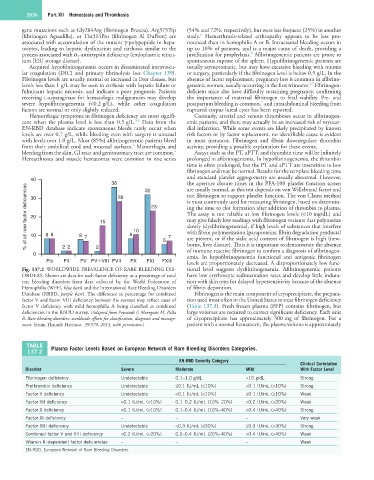
        Fig. 137.2  WORLDWIDE PREVALENCE OF RARE BLEEDING DIS-  tional  level  suggests  dysfibrinogenemia.  Afibrinogenemic  patients
        ORDERS. Shown are data for each factor deficiency as a percentage of total   have low erythrocyte sedimentation rates and develop little indura-
        rare  bleeding  disorders  from  data  collected  by  the  World  Federation  of   tion with skin tests for delayed hypersensitivity because of the absence
        Hemophilia (WFH, blue bars) and the International Rare Bleeding Disorders   of fibrin deposition.
        Database (RBBD, purple bars). The difference in percentage for combined   Fibrinogen is the main component of cryoprecipitate, the prepara-
        factor V and factor VIII deficiency between the surveys may reflect cases of   tion used most often in the United States to treat fibrinogen deficiency
        factor  V  deficiency  with  mild  hemophilia  A  being  classified  as  combined   (Table 137.3). Fresh frozen plasma (FFP) contains fibrinogen, but
        deficiencies in the RBDD survey. (Adapted from Peyvandi F, Menegatti M, Palla   large volumes are required to correct significant deficiency. Each unit
        R: Rare bleeding disorders: worldwide efforts for classification, diagnosis and manage-  of  cryoprecipitate  has  approximately  300 mg  of  fibrinogen.  For  a
        ment. Semin Thromb Haemost. 39:579, 2013, with permission.)  patient with a normal hematocrit, the plasma volume is approximately


          TABLE   Plasma Factor Levels Based on European Network of Rare Bleeding Disorders Categories.
          137.2
                                                            EN-RBD Severity Category
                                                                                                   Clinical Correlation
         Disorder                        Severe           Moderate               Mild              With Factor Level
         Fibrinogen deficiency           Undetectable     0.1–1.0 g/dL           >10 g/dL          Strong
         Prothrombin deficiency          Undetectable     ≤0.1 IU/mL (≤10%)      >0.1 IU/mL (>10%)  Strong
         Factor V deficiency             Undetectable     <0.1 IU/mL (<10%)      ≥0.1 IU/mL (≥10%)  Weak
         Factor VII deficiency           <0.1 IU/mL (<10%)  0.1–0.2 IU/mL (10%–20%)  >0.2 IU/mL (>20%)  Weak
         Factor X deficiency             <0.1 IU/mL (<10%)  0.1–0.4 IU/mL (10%–40%)  >0.4 IU/mL (>40%)  Strong
         Factor XI deficiency            –                –                      –                 Very weak
         Factor XIII deficiency          Undetectable     <0.3 IU/mL (≤30%)      ≥0.3 IU/mL (>30%)  Strong
         Combined factor V and VIII deficiency  <0.2 IU/mL (<20%)  0.2–0.4 IU/mL (20%–40%)  >0.4 IU/mL (>40%)  Weak
         Vitamin K–dependent factor deficiencies  –       –                      –                 Weak
         EN-RBD, European Network of Rare Bleeding Disorders.

