


Page 2336 - Hematology_ Basic Principles and Practice ( PDFDrive )
P. 2336
2078   Part XII  Hemostasis and Thrombosis


                          Protein C Pathway                     TABLE
                                                                140.4   Types of Inherited Protein C Deficiency
                                                               Type                 Antigen                Activity
                            Thrombin generation
            COAGULATION         inhibited                      I                    Low                    Low
                                                               II                   Normal                 Low
         Thrombin
         generation

                 II                         A     Va     Vi      APC has a half-life in the circulation of about 15 minutes, whereas
          Thrombin             Protein C    P     Va L   Vi   thrombin has a half-life of about 10 seconds. APC is inhibited by
          inactivation         activation   C                 protein  C  inhibitor  and  α 1-proteinase  inhibitor  (α 1-antitrypsin),
                                           PS                 both  of  which  are  relatively  slow  inhibitors.  Only  the  activity  of
                          IIa                                 protein  C  inhibitor  is  enhanced  by  heparin,  but  both  inhibitors
                               PC
                           TM     EPCR                        appear to contribute to APC inhibition in vivo.
                                                                 Protein C deficiency can be inherited or acquired. Like antithrom-
                                                              bin  deficiency,  protein  C  deficiency  is  inherited  in  an  autosomal-
                                                              dominant  fashion  and  has  a  proven  association  with  venous
                                                                       5
                                                              thrombosis.  Based on studies in healthy blood donors, heterozygous
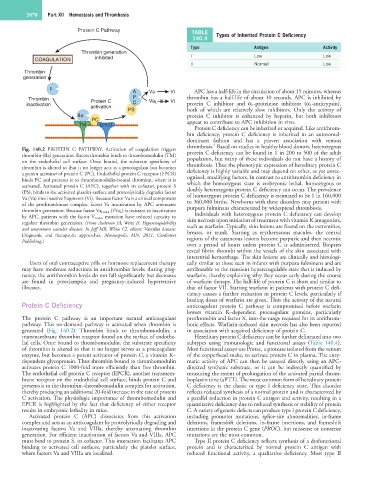
        Fig.  140.2  PROTEIN  C  PATHWAY.  Activation  of  coagulation  triggers   protein C deficiency can be found in 1 in 200 to 500 of the adult
        thrombin (IIa) generation. Excess thrombin binds to thrombomodulin (TM)   population, but many of these individuals do not have a history of
        on  the  endothelial  cell  surface.  Once  bound,  the  substrate  specificity  of   thrombosis. Thus the phenotypic expression of hereditary protein C
        thrombin is altered so that it no longer acts as a procoagulant but becomes   deficiency is highly variable and may depend on other, as yet unrec-
        a potent activator of protein C (PC). Endothelial protein C receptor (EPCR)   ognized, modifying factors. In contrast to antithrombin deficiency in
        binds PC and presents it to thrombomodulin-bound thrombin, where it is   which  the  homozygous  state  is  embryonic  lethal,  homozygous  or
        activated. Activated protein C (APC), together with its cofactor, protein S   doubly heterozygous protein C deficiency can occur. The prevalence
        (PS), binds to the activated platelet-surface and proteolytically degrades factor   of homozygous protein C deficiency is estimated to be 1 in 160,000
        Va (Va) into inactive fragments (Vi). Because factor Va is a critical component   to 360,000 births. Newborns with these disorders may present with
        of the prothrombinase complex, factor Va inactivation by APC attenuates   purpura fulminans characterized by widespread thrombosis.
        thrombin generation. Because factor Va Leiden  (FVa L ) is resistant to inactivation   Individuals with heterozygous protein C deficiency can develop
        by APC, patients with the factor V Leiden  mutation have reduced capacity to   skin necrosis upon initiation of treatment with vitamin K antagonists,
        regulate thrombin generation. (From Anderson JA, Weitz JI: Hypercoagulability   such as warfarin. Typically, skin lesions are found on the extremities,
        and uncommon vascular diseases. In Jaff MR, White CJ, editors: Vascular disease:   breasts,  or  trunk.  Starting  as  erythematous  macules,  the  central
        Diagnostic  and  therapeutic  approaches,  Minneapolis,  MN,  2011,  Cardiotext   regions of the cutaneous lesions become purpuric and then necrotic
        Publishing.)
                                                              over  a  period  of  hours  unless  protein  C  is  administered.  Biopsies
                                                              reveal fibrin thrombi within the vessels of the skin associated with
                                                              interstitial hemorrhage. The skin lesions are clinically and histologi-
           Users of oral contraceptive pills or hormone replacement therapy   cally similar to those seen in infants with purpura fulminans and are
        may have moderate reductions in antithrombin levels; during preg-  attributable to the transient hypercoagulable state that is induced by
        nancy, the antithrombin levels do not fall significantly but decreases   warfarin, thereby explaining why they occur early during the course
        are  found  in  preeclampsia  and  pregnancy-induced  hypertensive   of warfarin therapy. The half-life of protein C is short and similar to
        illnesses.                                            that of factor VII. Starting warfarin in patients with protein C defi-
                                                              ciency causes a further reduction in protein C levels, particularly if
                                                              loading doses of warfarin are given. Thus the activity of the natural
        Protein C Deficiency                                  anticoagulant  protein  C  pathway  is  compromised  before  warfarin
                                                              lowers  vitamin  K–dependent  procoagulant  proteins,  particularly
        The  protein  C  pathway  is  an  important  natural  anticoagulant   prothrombin and factor X, into the range required for its antithrom-
        pathway. This  on-demand  pathway  is  activated  when  thrombin  is   botic effects. Warfarin-induced skin necrosis has also been reported
        generated  (Fig.  140.2).  Thrombin  binds  to  thrombomodulin,  a   in association with acquired deficiency of protein C.
        transmembrane thrombin receptor found on the surface of endothe-  Hereditary protein C deficiency can be further delineated into two
        lial cells. Once bound to thrombomodulin, the substrate specificity   subtypes  using  immunologic  and  functional  assays  (Table  140.4).
        of thrombin is altered so that it no longer serves as a procoagulant   Most functional assays use Protac, a protease isolated from the venom
        enzyme, but becomes a potent activator of protein C, a vitamin K–  of the copperhead snake, to activate protein C in plasma. The enzy-
        dependent glycoprotein. Thus thrombin bound to thrombomodulin   matic activity of APC can then be assayed directly using an APC-
        activates protein C 1000-fold more efficiently than free thrombin.   directed  synthetic  substrate,  or  it  can  be  indirectly  quantified  by
        The endothelial cell protein C receptor (EPCR), another transmem-  measuring the extent of prolongation of the activated partial throm-
        brane receptor on the endothelial cell surface, binds protein C and   boplastin time (aPTT). The most common form of hereditary protein
        presents it to the thrombin–thrombomodulin complex for activation,   C deficiency is the classic or type I deficiency state. This disorder
        thereby producing an additional 20-fold increase in the rate of protein   reflects reduced synthesis of a normal protein and is characterized by
        C activation. The physiologic importance of thrombomodulin and   a parallel reduction in protein C antigen and activity, resulting in a
        EPCR  is  highlighted  by  the  fact  that  deficiency  of  either  receptor   quantitative deficiency due to reduced synthesis or stability of protein
        results in embryonic lethality in mice.               C. A variety of genetic defects can produce type I protein C deficiency,
           Activated  protein  C  (APC)  dissociates  from  this  activation   including  promoter  mutations,  splice-site  abnormalities,  in-frame
        complex and acts as an anticoagulant by proteolytically degrading and   deletions,  frameshift  deletions,  in-frame  insertions,  and  frameshift
        inactivating  factors  Va  and  VIIIa,  thereby  attenuating  thrombin   insertions in the protein C gene (PROC), but missense or nonsense
        generation. For efficient inactivation of factors Va and VIIIa, APC   mutations are the most common.
        must bind to protein S, its cofactor. This interaction facilitates APC   Type II protein C deficiency reflects synthesis of a dysfunctional
        binding  to  activated  cell  surfaces,  particularly  the  platelet  surface,   protein  and  is  characterized  by  normal  protein  C  antigen  with
        where factors Va and VIIIa are localized.             reduced  functional  activity,  a  qualitative  deficiency.  Most  type  II

