


Page 2331 - Hematology_ Basic Principles and Practice ( PDFDrive )
P. 2331
Chapter 139  Disseminated Intravascular Coagulation  2073


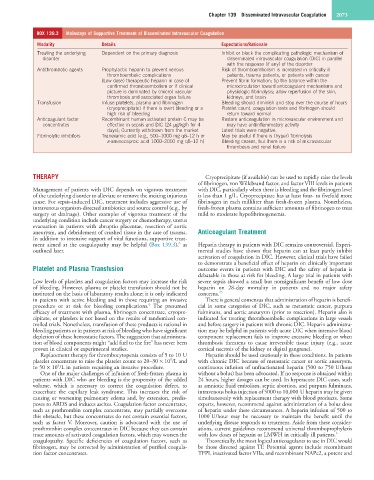
             BOX 139.3  Mainstays of Supportive Treatment of Disseminated Intravascular Coagulation
             Modality             Details                                Expectations/Rationale
             Treating the underlying   Dependent on the primary diagnosis  Inhibit or block the complicating pathologic mechanism of
               disorder                                                    disseminated intravascular coagulation (DIC) in parallel
                                                                           with the response (if any) of the disorder
             Antithrombotic agents  Prophylactic heparin to prevent venous   Risk of thromboembolism is increased in critically ill
                                    thromboembolic complications           patients, trauma patients, or patients with cancer
                                  (Low dose) therapeutic heparin in case of   Prevent fibrin formation; tip the balance within the
                                    confirmed thromboembolism or if clinical   microcirculation toward anticoagulant mechanisms and
                                    picture is dominated by (micro) vascular   physiologic fibrinolysis; allow reperfusion of the skin,
                                    thrombosis and associated organ failure  kidneys, and brain
             Transfusion          Infuse platelets, plasma and fibrinogen   Bleeding should diminish and stop over the course of hours
                                    (cryoprecipitate) if there is overt bleeding or a   Platelet count, coagulation tests and fibrinogen should
                                    high risk of bleeding                  return toward normal
             Anticoagulant factor   Recombinant human activated protein C may be   Restore anticoagulation in microvascular environment and
               concentrates         effective in sepsis and DIC (24 µg/kg/h for 4   may have antiinflammatory activity
                                    days); Currently withdrawn from the market  Latest trials were negative.
             Fibrinolytic inhibitors  Tranexamic acid (e.g., 500–1000 mg q8–12 h or   May be useful if there is (hyper) fibrinolysis
                                    ε-aminocaproic acid 1000–2000 mg q8–12 h)  Bleeding ceases, but there is a risk of microvascular
                                                                           thrombosis and renal failure


            THERAPY                                                 Cryoprecipitate (if available) can be used to rapidly raise the levels
                                                                  of fibrinogen, von Willebrand factor, and factor VIII levels in patients
            Management of patients with DIC depends on vigorous treatment   with DIC, particularly when there is bleeding and the fibrinogen level
            of the underlying disorder to alleviate or remove the inciting injurious   is less than 1 g/L. Cryoprecipitate has at least four- to fivefold more
            cause. For sepsis-induced DIC, treatment includes aggressive use of   fibrinogen in each milliliter than fresh-frozen plasma. Nonetheless,
            intravenous organism-directed antibiotics and source control (e.g., by   fresh-frozen plasma contains sufficient amounts of fibrinogen to treat
            surgery or drainage). Other examples of vigorous treatment of the   mild to moderate hypofibrinogenemia.
            underlying condition include cancer surgery or chemotherapy, uterus
            evacuation  in  patients  with  abruptio  placentae,  resection  of  aortic
            aneurysm, and debridement of crushed tissue in the case of trauma.   Anticoagulant Treatment
            In addition to intensive support of vital functions, supportive treat-
                                                           6
            ment  aimed  at  the  coagulopathy  may  be  helpful  (Box  139.3),   as   Heparin therapy in patients with DIC remains controversial. Experi-
            outlined later.                                       mental studies have shown that heparin can at least partly inhibit
                                                                  activation of coagulation in DIC. However, clinical trials have failed
                                                                  to demonstrate a beneficial effect of heparin on clinically important
            Platelet and Plasma Transfusion                       outcome events in patients with DIC and the safety of heparin is
                                                                  debatable in those at risk for bleeding. A large trial in patients with
            Low levels of platelets and coagulation factors may increase the risk   severe sepsis showed a small but nonsignificant benefit of low dose
            of bleeding. However, plasma or platelet transfusion should not be   heparin  on  28-day  mortality  in  patients  and  no  major  safety
            instituted on the basis of laboratory results alone; it is only indicated   concerns. 25
            in patients with active bleeding and in those requiring an invasive   There is general consensus that administration of heparin is benefi-
                                                  6
            procedure  or  at  risk  for  bleeding  complications.   The  presumed   cial  in  some  categories  of  DIC,  such  as  metastatic  cancer,  purpura
            efficacy of treatment with plasma, fibrinogen concentrate, cryopre-  fulminans, and aortic aneurysm (prior to resection). Heparin also is
            cipitate, or platelets is not based on the results of randomized con-  indicated for treating thromboembolic complications in large vessels
            trolled trials. Nonetheless, transfusion of these products is rational in   and before surgery in patients with chronic DIC. Heparin administra-
            bleeding patients or in patients at risk of bleeding who have significant   tion may be helpful in patients with acute DIC when intensive blood
            depletion of these hemostatic factors. The suggestion that administra-  component replacement fails to improve excessive bleeding or when
            tion of blood components might “add fuel to the fire” has never been   thrombosis  threatens  to  cause  irreversible  tissue  injury  (e.g.,  acute
            proven in clinical or experimental studies.           cortical necrosis of the kidney or digital gangrene).
              Replacement therapy for thrombocytopenia consists of 5 to 10 U   Heparin should be used cautiously in these conditions. In patients
                                                         9
            platelet concentrate to raise the platelet count to 20–30 × 10 /L and   with chronic DIC because of metastatic cancer or aortic aneurysm,
                    9
            to 50 × 10 /L in patients requiring an invasive procedure.  continuous infusion of unfractionated heparin (500 to 750 U/hour
              One of the major challenges of infusion of fresh-frozen plasma in   without a bolus) has been advocated. If no response is obtained within
            patients with DIC who are bleeding is the propensity of the added   24 hours, higher dosages can be used. In hyperacute DIC cases, such
            volume,  which  is  necessary  to  correct  the  coagulation  defect,  to   as amniotic fluid embolism, septic abortion, and purpura fulminans,
            exacerbate  the  capillary  leak  syndrome.  This  increases  the  risk  of   intravenous bolus injection of 5000 to 10,000 U heparin may be given
            causing or worsening pulmonary edema and, by extension, predis-  simultaneously with replacement therapy with blood products. Some
            poses to ARDS and induces ascites. Coagulation factor concentrates,   experts, however, recommend against administration of a bolus dose
            such as prothrombin complex concentrate, may partially overcome   of heparin under these circumstances. A heparin infusion of 500 to
            this obstacle, but these concentrates do not contain essential factors,   1000 U/hour  may  be  necessary  to  maintain  the  benefit  until  the
            such  as  factor  V.  Moreover,  caution  is  advocated  with  the  use  of   underlying disease responds to treatment. Aside from these consider-
            prothrombin complex concentrates in DIC because they can contain   ations, current guidelines recommend universal thromboprophylaxis
            trace amounts of activated coagulation factors, which may worsen the   with low doses of heparin or LMWH in critically ill patients. 6
            coagulopathy.  Specific  deficiencies  of  coagulation  factors,  such  as   Theoretically, the most logical anticoagulants to use in DIC would
            fibrinogen, may be corrected by administration of purified coagula-  be those directed against TF. Potential agents include recombinant
            tion factor concentrates.                             TFPI, inactivated factor VIIa, and recombinant NAPc2, a potent and

