


Page 2337 - Hematology_ Basic Principles and Practice ( PDFDrive )
P. 2337
Chapter 140  Hypercoagulable States  2079


            protein C deficiency states are caused by point mutations. Mutations   TABLE
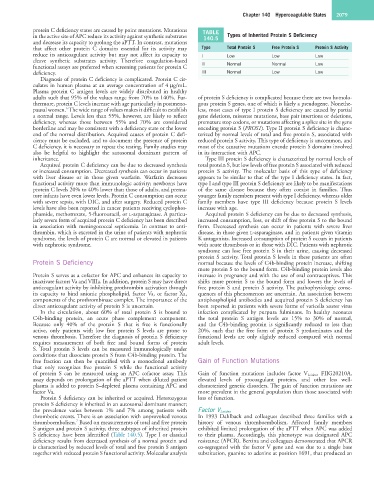
            in the active site of APC reduce its activity against synthetic substrates   140.5  Types of Inherited Protein S Deficiency
            and decrease its capacity to prolong the aPTT. In contrast, mutations
            that  affect  other  protein  C  domains  essential  for  its  activity  may   Type  Total Protein S  Free Protein S  Protein S Activity
            reduce its anticoagulant activity but may not affect its capacity to   I  Low  Low          Low
            cleave  synthetic  substrates  activity.  Therefore  coagulation-based
            functional assays are preferred when screening patients for protein C   II  Normal  Normal  Low
            deficiency.                                            III     Normal         Low           Low
              Diagnosis of protein C deficiency is complicated. Protein C cir-
            culates in human plasma at an average concentration of 4 µg/mL.
            Plasma  protein  C  antigen  levels  are  widely  distributed  in  healthy
            adults such that 95% of the values range from 70% to 140%. Fur-  of protein S deficiency is complicated because there are two homolo-
            thermore, protein C levels increase with age particularly in postmeno-  gous protein S genes, one of which is likely a pseudogene. Nonethe-
                       6
            pausal women.  The wide range of values makes it difficult to establish   less, most cases of type I protein S deficiency are caused by partial
            a normal range. Levels less than 55%, however, are likely to reflect   gene deletions, missense mutations, base pair insertions or deletions,
            deficiency,  whereas  those  between  55%  and  70%  are  considered   premature stop codons, or mutations affecting a splice site in the gene
            borderline and may be consistent with a deficiency state or the lower   encoding protein S (PROS1). Type II protein S deficiency is charac-
            end of the normal distribution. Acquired causes of protein C defi-  terized by normal levels of total and free protein S, associated with
            ciency must be excluded, and to document the presence of protein   reduced protein S activity. This type of deficiency is uncommon, and
            C deficiency, it is necessary to repeat the testing. Family studies may   most of the causative mutations encode protein S domains involved
            also  be  helpful  to  highlight  the  autosomal  dominant  pattern  of   in its interaction with APC.
            inheritance.                                            Type III protein S deficiency is characterized by normal levels of
              Acquired protein C deficiency can be due to decreased synthesis   total protein S, but low levels of free protein S associated with reduced
            or increased consumption. Decreased synthesis can occur in patients   protein  S  activity.  The  molecular  basis  of  this  type  of  deficiency
            with  liver  disease  or  in  those  given  warfarin.  Warfarin  decreases   appears to be similar to that of the type I deficiency states. In fact,
            functional activity more than immunologic activity; newborns have   type I and type III protein S deficiency are likely to be manifestations
            protein C levels 20% to 40% lower than those of adults, and prema-  of  the  same  disease  because  they  often  coexist  in  families.  Thus
            ture infants have even lower levels. Protein C consumption can occur   younger family members present with type I deficiency, whereas older
            with severe sepsis, with DIC, and after surgery. Reduced protein C   family  members  have  type  III  deficiency  because  protein  S  levels
            levels have also been reported in cancer patients receiving cyclophos-  increase with age.
            phamide, methotrexate, 5-fluorouracil, or L-asparaginase. A particu-  Acquired protein S deficiency can be due to decreased synthesis,
            larly severe form of acquired protein C deficiency has been described   increased consumption, loss, or shift of free protein S to the bound
            in  association  with  meningococcal  septicemia.  In  contrast  to  anti-  form.  Decreased  synthesis  can  occur  in  patients  with  severe  liver
            thrombin, which is excreted in the urine of patients with nephrotic   disease, in those given L-asparaginase, and in patients given vitamin
            syndrome, the levels of protein C are normal or elevated in patients   K antagonists. Increased consumption of protein S occurs in patients
            with nephrotic syndrome.                              with acute thrombosis or in those with DIC. Patients with nephrotic
                                                                  syndrome can lose free protein S in their urine, causing decreased
                                                                  protein S activity. Total protein S levels in these patients are often
            Protein S Deficiency                                  normal because the levels of C4b-binding protein increase, shifting
                                                                  more protein S to the bound form. C4b-binding protein levels also
            Protein S serves as a cofactor for APC and enhances its capacity to   increase in pregnancy and with the use of oral contraceptives. This
            inactivate factors Va and VIIIa. In addition, protein S may have direct   shifts  more  protein  S  to  the  bound  form  and  lowers  the  levels  of
            anticoagulant activity by inhibiting prothrombin activation through   free protein S and protein S activity. The pathophysiologic conse-
            its capacity to bind anionic phospholipid, factor Va, or factor Xa,   quences of this phenomenon are uncertain. An association between
            components of the prothrombinase complex. The importance of the   antiphospholipid  antibodies  and  acquired  protein  S  deficiency  has
            direct anticoagulant activity of protein S is uncertain.  been reported in patients with severe forms of varicella zoster virus
              In  the  circulation,  about  60%  of  total  protein  S  is  bound  to   infection  complicated  by  purpura  fulminans.  In  healthy  neonates
            C4b-binding  protein,  an  acute  phase  complement  component.   the  total  protein  S  antigen  levels  are  15%  to  30%  of  normal,
            Because  only  40%  of  the  protein  S  that  is  free  is  functionally   and  the  C4b-binding  protein  is  significantly  reduced  to  less  than
            active,  only  patients  with  low  free  protein  S  levels  are  prone  to   20%,  such  that  the  free  form  of  protein  S  predominates  and  the
            venous thrombosis. Therefore the diagnosis of protein S deficiency   functional  levels  are  only  slightly  reduced  compared  with  normal
            requires  measurement  of  both  free  and  bound  forms  of  protein   adult levels.
            S. Total  protein  S  levels  can  be  measured  immunologically  under
            conditions that dissociate protein S from C4b-binding protein. The
            free  fraction  can  then  be  quantified  with  a  monoclonal  antibody   Gain of Function Mutations
            that  only  recognizes  free  protein  S  while  the  functional  activity
            of  protein  S  can  be  measured  using  an  APC  cofactor  assay. This   Gain  of  function  mutations  includes  factor  V Leiden ,  FIIG20210A,
            assay  depends  on  prolongation  of  the  aPTT  when  diluted  patient   elevated  levels  of  procoagulant  proteins,  and  other  less  well-
            plasma is added to protein S–depleted plasma containing APC and     characterized genetic disorders. The gain of function mutations are
            factor Va.                                            more prevalent in the general population than those associated with
              Protein S deficiency can be inherited or acquired. Heterozygous   loss of function.
            protein S deficiency is inherited in an autosomal dominant manner;
            the  prevalence  varies  between  1%  and  7%  among  patients  with   Factor V Leiden
            thrombotic events. There is an association with unprovoked venous   In  1993  Dahlback  and  colleagues  described  three  families  with  a
                          7
            thromboembolism.  Based on measurements of total and free protein   history  of  venous  thromboembolism.  Affected  family  members
            S antigen and protein S activity, three subtypes of inherited protein   exhibited limited prolongation of the aPTT when APC was added
            S deficiency have been identified (Table 140.5). Type I or classical   to  their  plasma.  Accordingly,  this  phenotype  was  designated  APC
            deficiency results from decreased synthesis of a normal protein and   resistance (APCR). Bertina and colleagues demonstrated that APCR
            is characterized by reduced levels of total and free protein S antigen   co-segregated with the factor V gene and was due to a single base
            together with reduced protein S functional activity. Molecular analysis   substitution, guanine to adenine at position 1691, that produced an

