


Page 2335 - Hematology_ Basic Principles and Practice ( PDFDrive )
P. 2335
Chapter 140  Hypercoagulable States  2077


             TABLE   Classification of Hypercoagulable States      TABLE   Causes of Acquired Antithrombin Deficiency
              140.1                                                 140.3
             Hereditary     Mixed              Acquired                                                    Enhanced
                                                                   Decreased Synthesis  Increased Consumption  Clearance
             Loss of Function
             Antithrombin   Hyperhomocysteinemia  Previous venous   Hepatic cirrhosis  Major surgery       Heparin
               deficiency                        thromboembolism   Severe liver disease  Acute thrombosis  Nephrotic
             Protein C      Obesity            Pregnancy,                                                    syndrome
               deficiency                        puerperium        L-asparaginase    Disseminated intravascular
             Protein S      Cancer                                                    coagulation
               deficiency                      Drug-induced:                         Severe sepsis
                                               Heparin-induced                       Multiple trauma
                                                 thrombocytopenia                    Malignancy
                                               Prothrombin complex                   Prolonged extracorporeal
                                                 concentrates                         circulation
                                               L-asparaginase
                                               Hormonal therapy
             Gain of Function
             Factor V Leiden  Postoperative                       activity in the absence or presence of heparin. In contrast, mutations
                                                                  in  the  heparin-binding  domain  are  associated  with  reduced  anti-
             Prothrombin FII   Myeloproliferative disorders       thrombin activity in the presence of heparin but normal activity in
               G20210A
                                                                  its absence. Unlike other inherited forms of antithrombin deficiency,
             Elevated factor                                      which are embryonic lethal in the homozygous state, mutations in
               VIII, IX, or XI                                    the  heparin-binding  domain  only  have  clinical  consequences  in
                                                                  individuals homozygous for these mutations and do not increase the
                                                                  risk for thrombosis in the heterozygous state.
                                                                    Because of the wide variety of heritable forms of antithrombin
             TABLE   Types of Inherited Antithrombin Deficiency   deficiency, functional antithrombin assays are the preferred method
              140.2                                               for  screening.  Most  functional  assays  use  synthetic  substrates  to
                                         Activity (No   Activity (With   monitor the rates at which added thrombin or factor Xa are inhibited
             Type              Antigen   Heparin)    Heparin)     in  patient  plasma.  However,  the  assays  differ  in  terms  of  whether
                                                                  bovine or human thrombin is used and whether or not heparin is
             I                 Low       Low         Low
                                                                  added. Defects in the heparin-binding domain of antithrombin will
             II (active site defect)  Normal  Low    Low          be  detected  only  in  the  presence  of  heparin.  When  antithrombin
             II (heparin-binding   Normal  Normal    Low          deficiency is identified with functional assays, immunologic assays are
               site defect)                                       performed to distinguish between type I and type II deficiency.
                                                                    Congenital antithrombin deficiency can cause spontaneous venous
                                                                  thromboembolism,  but  thrombosis  often  occurs  in  the  setting  of
                                                                  pregnancy and the puerperium; with the use of estrogen-containing
                                                                  oral  contraceptives;  or  after  major  trauma  or  surgery. Thrombotic
                       Genetic risk          Acquired risk        events  are  rare  in  children,  with  events  typically  occurring  from
                         factors               factors
                                                                  mid- to late teenage years and into the early twenties. The European
                       AT, PC, PS           Age                   Prospective Cohort on Thrombophilia (EPCOT) study compared the
                       deficiency   +   +   Previous VTE          risks of a first episode of venous thromboembolism in asymptomatic
                       FV Leiden            Cancer                individuals  with  antithrombin,  protein  C,  or  protein  S  deficiency
                       FIIG20210A           Obesity               with  that  in  subjects  with  factor  V Leiden   over  a  6-year  period. The
                                                                  annual incidence of venous thromboembolism was highest in those
                                                                                         1
                                                                  with  antithrombin  deficiency.   Likewise,  in  a  cohort  of  Italian
                              Intrinsic thrombosis risk           patients, the risk of venous thrombosis was higher with antithrombin
                                                                                                     2
                                                                  deficiency than with other thrombophilic defects.  The most common
                                  –       +  Triggering           sites for venous thrombosis in patients with antithrombin deficiency
                       Prophylaxis
                                               factors            are the deep veins of the leg, but thrombosis can occur in mesenteric
                                                                  veins, as well as the renal and retinal veins. The risk for recurrence is
                                            Surgery                   3                                      4
                                            Immobilization        high,  particularly in those with lower antithrombin levels,  and the
                                            Pregnancy             risk varies depending on the subtype of antithrombin deficiency.
                                            Estrogens               Acquired  antithrombin  deficiency  can  reflect  decreased  anti-
                                                                  thrombin synthesis, increased consumption, or enhanced clearance
                   Thrombosis                                     (Table 140.3). Decreased synthesis can occur in patients with severe
                    threshold                                     hepatic disease, particularly cirrhosis, or in those given L-asparaginase,
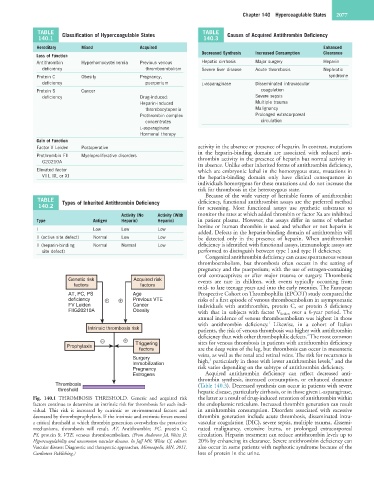
            Fig.  140.1  THROMBOSIS  THRESHOLD.  Genetic  and  acquired  risk   the latter as a result of drug-induced retention of antithrombin within
            factors continue to determine an intrinsic risk for thrombosis for each indi-  the endoplasmic reticulum. Increased thrombin generation can result
            vidual.  This  risk  is  increased  by  extrinsic  or  environmental  factors  and   in  antithrombin  consumption.  Disorders  associated  with  excessive
            decreased by thromboprophylaxis. If the intrinsic and extrinsic forces exceed   thrombin generation include acute thrombosis, disseminated intra-
            a critical threshold at which thrombin generation overwhelms the protective   vascular coagulation (DIC), severe sepsis, multiple trauma, dissemi-
            mechanisms,  thrombosis  will  result.  AT,  Antithrombin;  PC,  protein  C;   nated  malignancy,  extensive  burns,  or  prolonged  extracorporeal
            PS, protein S; VTE, venous thromboembolism. (From Anderson JA, Weitz JI:   circulation. Heparin treatment can reduce antithrombin levels up to
            Hypercoagulability and uncommon vascular diseases. In Jaff MR, White CJ, editors:   20% by enhancing its clearance. Severe antithrombin deficiency can
            Vascular disease: Diagnostic and therapeutic approaches, Minneapolis, MN, 2011,   also occur in some patients with nephrotic syndrome because of the
            Cardiotext Publishing.)                               loss of protein in the urine.

