


Page 2342 - Hematology_ Basic Principles and Practice ( PDFDrive )
P. 2342
2084   Part XII  Hemostasis and Thrombosis


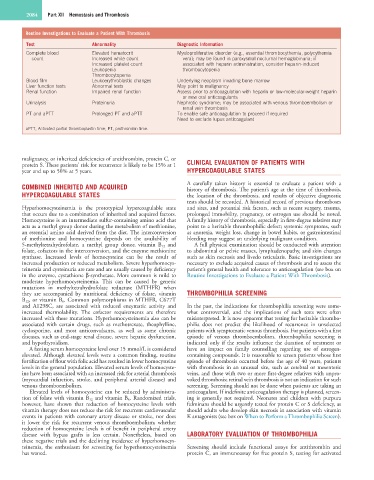
         Routine Investigations to Evaluate a Patient With Thrombosis
          Test                 Abnormality                 Diagnostic Information
          Complete blood       Elevated hematocrit         Myeloproliferative disorder (e.g., essential thrombocythemia, polycythemia
           count               Increased white count         vera); may be found in paroxysmal nocturnal hemoglobinuria; if
                               Increased platelet count      associated with heparin administration, consider heparin-induced
                               Leukopenia                    thrombocytopenia
                               Thrombocytopenia
          Blood film           Leukoerythroblastic changes  Underlying neoplasm invading bone marrow
          Liver function tests  Abnormal tests             May point to malignancy
          Renal function       Impaired renal function     Assess prior to anticoagulation with heparin or low-molecular-weight heparin
                                                             or new oral anticoagulants
          Urinalysis           Proteinuria                 Nephrotic syndrome; may be associated with venous thromboembolism or
                                                             renal vein thrombosis
          PT and aPTT          Prolonged PT and aPTT       To enable safe anticoagulation to proceed if required
                                                           Need to exclude lupus anticoagulant
         aPTT, Activated partial thromboplastin time; PT, prothrombin time.


        malignancy, or inherited deficiencies of antithrombin, protein C, or
        protein S. These patients’ risk for recurrence is likely to be 15% at 1   CLINICAL EVALUATION OF PATIENTS WITH
        year and up to 50% at 5 years.                        HYPERCOAGULABLE STATES

        COMBINED INHERITED AND ACQUIRED                       A  carefully  taken  history  is  essential  to  evaluate  a  patient  with  a
                                                              history of thrombosis. The patient’s age at the time of thrombosis,
        HYPERCOAGULABLE STATES                                the  location  of  the  thrombosis,  and  results  of  objective  diagnostic
                                                              tests should be recorded. A historical record of previous thromboses
        Hyperhomocysteinemia  is  the  prototypical  hypercoagulable  state   and sites, and potential risk factors, such as recent surgery, trauma,
        that occurs due to a combination of inherited and acquired factors.   prolonged immobility, pregnancy, or estrogen use should be noted.
        Homocysteine is an intermediate sulfur-containing amino acid that   A family history of thrombosis, especially in first-degree relatives may
        acts as a methyl group donor during the metabolism of methionine,   point to a heritable thrombophilic defect; systemic symptoms, such
        an essential amino acid derived from the diet. The interconversion   as anorexia, weight loss, change in bowel habits, or gastrointestinal
        of  methionine  and  homocysteine  depends  on  the  availability  of   bleeding may suggest an underlying malignant condition.
        5-methyltetrahydrofolate,  a  methyl  group  donor,  vitamin  B 12   and   A full physical examination should be conducted with attention
        folate, cofactors in the interconversion, and the enzyme methionine   to abdominal or pelvic masses, lymphadenopathy, and skin changes
        synthase.  Increased  levels  of  homocysteine  can  be  the  result  of   such as skin necrosis and livedo reticularis. Basic investigations are
        increased production or reduced metabolism. Severe hyperhomocys-  necessary to exclude acquired causes of thrombosis and to assess the
        teinemia and cysteinuria are rare and are usually caused by deficiency   patient’s general health and tolerance to anticoagulation (see box on
        in the enzyme, cystathione β-synthetase. More common is mild to   Routine Investigations to Evaluate a Patient With Thrombosis).
        moderate  hyperhomocysteinemia.  This  can  be  caused  by  genetic
        mutations  in  methyltetrahydrofolate  reductase  (MTHFR)  when
        they  are  accompanied  by  nutritional  deficiency  of  folate,  vitamin   THROMBOPHILIA SCREENING
        B 12 , or vitamin B 6 . Common polymorphisms in MTHFR, C677T
        and  A1298C,  are  associated  with  reduced  enzymatic  activity  and   In the past, the indications for thrombophilia screening were some-
        increased  thermolability.  The  cofactor  requirements  are  therefore   what  controversial,  and  the  implications  of  such  tests  were  often
        increased with these mutations. Hyperhomocysteinemia also can be   misinterpreted. It is now apparent that testing for heritable thrombo-
        associated  with  certain  drugs,  such  as  methotrexate,  theophylline,   philia  does  not  predict  the  likelihood  of  recurrence  in  unselected
        cyclosporine,  and  most  anticonvulsants,  as  well  as  some  chronic   patients with symptomatic venous thrombosis. For patients with a first
        diseases, such as end-stage renal disease, severe hepatic dysfunction,   episode  of  venous  thromboembolism,  thrombophilia  screening  is
        and hypothyroidism.                                   indicated only if the results influence the duration of treatment or
           A fasting serum homocysteine level over 15 mmol/L is considered   have  an  impact  on  family  counselling  regarding  use  of  estrogen-
        elevated. Although elevated levels were a common finding, routine   containing compounds. It is reasonable to screen patients whose first
        fortification of flour with folic acid has resulted in lower homocysteine   episode of thrombosis occurred before the age of 40 years, patients
        levels in the general population. Elevated serum levels of homocyste-  with  thrombosis  in  an  unusual  site,  such  as  cerebral  or  mesenteric
        ine have been associated with an increased risk for arterial thrombosis   veins, and those with two or more first-degree relatives with unpro-
        (myocardial  infarction,  stroke,  and  peripheral  arterial  disease)  and   voked thrombosis; retinal vein thrombosis is not an indication for such
        venous thromboembolism.                               screening. Screening should not be done when patients are taking an
           Elevated  levels  of  homocysteine  can  be  reduced  by  administra-  anticoagulant. If indefinite anticoagulation therapy is planned, screen-
        tion of folate with vitamin B 12  and vitamin B 6 . Randomized trials,   ing  is  generally  not  required.  Neonates  and  children  with  purpura
        however,  have  shown  that  reduction  of  homocysteine  levels  with   fulminans should be urgently tested for protein C or S deficiency, as
        vitamin therapy does not reduce the risk for recurrent cardiovascular   should adults who develop skin necrosis in association with vitamin
        events in patients with coronary artery disease or stroke, nor does   K antagonists (see box on When to Perform a Thrombophilia Screen).
        it  lower  the  risk  for  recurrent  venous  thromboembolism;  whether
        reduction  of  homocysteine  levels  is  of  benefit  in  peripheral  artery
        disease  with  bypass  grafts  is  less  certain.  Nonetheless,  based  on   LABORATORY EVALUATION OF THROMBOPHILIA
        these negative trials and the declining incidence of hyperhomocys-
        teinemia,  the  enthusiasm  for  screening  for  hyperhomocysteinemia     Screening  should  include  functional  assays  for  antithrombin  and
        has waned.                                            protein C, an immunoassay for free protein S, testing for activated

