


Page 2347 - Hematology_ Basic Principles and Practice ( PDFDrive )
P. 2347
Chapter 141  The Antiphospholipid Syndrome  2089


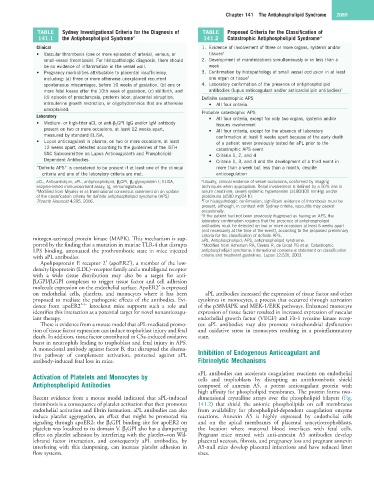
             TABLE   Sydney Investigational Criteria for the Diagnosis of   TABLE   Proposed Criteria for the Classification of
              141.1  the Antiphospholipid Syndrome a                141.2  Catastrophic Antiphospholipid Syndrome*
             Clinical                                              1.	 Evidence	of	involvement	of	three	or	more	organs,	systems	and/or
             •	 Vascular	thrombosis	(one	or	more	episodes	of	arterial,	venous,	or	  tissues a
               small-vessel	thrombosis).	For	histopathologic	diagnosis,	there	should	  2.	 Development	of	manifestations	simultaneously	or	in	less	than	a
               be	no	evidence	of	inflammation	in	the	vessel	wall.    week
             •	 Pregnancy	morbidities	attributable	to	placental	insufficiency,	  3.	 Confirmation	by	histopathology	of	small	vessel	occlusion	in	at	least
               including:	(a)	three	or	more	otherwise	unexplained	recurrent	  one	organ	or	tissue b
               spontaneous	miscarriages,	before	10	weeks	of	gestation,	(b)	one	or	  4.	 Laboratory	confirmation	of	the	presence	of	antiphospholipid
               more	fetal	losses	after	the	10th	week	of	gestation,	(c)	stillbirth,	and	  antibodies	(lupus	anticoagulant	and/or	anticardiolipin	antibodies) c
               (d)	episode	of	preeclampsia,	preterm	labor,	placental	abruption,	  Definite	catastrophic	APS
               intrauterine	growth	restriction,	or	oligohydramnios	that	are	otherwise	  •	 All	four	criteria
               unexplained.                                        Probable	catastrophic	APS
             Laboratory                                              •	 All	four	criteria,	except	for	only	two	organs,	systems	and/or
             •	 Medium-	or	high-titer	aCL	or	anti-β 2 GPI	IgG	and/or	IgM	antibody	  tissues	involvement
               present	on	two	or	more	occasions,	at	least	12	weeks	apart,	  •	 All	four	criteria,	except	for	the	absence	of	laboratory
               measured	by	standard	ELISA.                              confirmation	at	least	6	weeks	apart	because	of	the	early	death
             •	 Lupus	anticoagulant	in	plasma,	on	two	or	more	occasions,	at	least	  of	a	patient	never	previously	tested	for	aPL	prior	to	the
               12	weeks	apart,	detected	according	to	the	guidelines	of	the	ISTH	  catastrophic	APS	event
               SSC	Subcommittee	on	Lupus	Anticoagulants	and	Phospholipid-  •	 Criteria	1,	2,	and	4
               Dependent	Antibodies.                                 •	 Criteria	1,	3,	and	4	and	the	development	of	a	third	event	in
             “Definite	APS”	is	considered	to	be	present	if	at	least	one	of	the	clinical	  more	than	a	week	but	less	than	a	month,	despite
               criteria	and	one	of	the	laboratory	criteria	are	met.     anticoagulation
             aCL, Anticardiolipin; aPL, antiphospholipid; β 2 GPI, β 2 -glycoprotein I; ELISA,   a Usually, clinical evidence of vessel occlusions, confirmed by imaging
             enzyme-linked immunosorbent assay; Ig, immunoglobulin.  techniques when appropriate. Renal involvement is defined by a 50% rise in
             a Modified from Miyakis et al: International consensus statement on an update   serum creatinine, severe systemic hypertension (≥180/100 mmHg) and/or
             of the classification criteria for definite antiphospholipid syndrome (APS).   proteinuria (≥500 mg/24 h).
             Thromb Haemost 4:295, 2006.                           b For histopathologic confirmation, significant evidence of thrombosis must be
                                                                   present, although, in contrast with Sydney criteria, vasculitis may coexist
                                                                   occasionally.
                                                                   c If the patient had not been previously diagnosed as having an APS, the
                                                                   laboratory confirmation requires that the presence of antiphospholipid
                                                                   antibodies must be detected on two or more occasions at least 6 weeks apart
                                                                   (not necessarily at the time of the event), according to the proposed preliminary
                                                                   criteria for the classification of definite APS.
            mitogen-activated protein kinase (MAPK). This mechanism is sup-  aPL, Antiphospholipid; APS, antiphospholipid syndrome.
            ported by the finding that a mutation in murine TLR-4 that disrupts   *Modified from Asherson RA, Cevera R, de Groot PG et al. Catastrophic
            LPS  binding,  attenuated  the  prothrombotic  state  in  mice  injected   antiphospholipid syndrome: international consensus statement on classification
            with aPL antibodies.                                   criteria and treatment guidelines. Lupus 12:530, 2003.
              Apolipoprotein E receptor 2′ (apoER2′), a member of the low-
            density lipoprotein (LDL)–receptor family and a multiligand receptor
            with  a  wide  tissue  distribution  may  also  be  a  target  for  anti-
            β 2 GPI/β 2 GPI  complexes  to  trigger  tissue  factor  and  cell  adhesion
            molecule expression on the endothelial surface. ApoER2′ is expressed
            on  endothelial  cells,  platelets,  and  monocytes  where  it  has  been   aPL antibodies increased the expression of tissue factor and other
            proposed to mediate the pathogenic effects of the antibodies. Evi-  cytokines in monocytes, a process that occurred through activation
                            –/–
            dence  from  apoER2′   knockout  mice  supports  such  a  role  and   of the p38MAPK and MEK-1/ERK pathways. Enhanced monocyte
            identifies this interaction as a potential target for novel nonanticoagu-  expression of tissue factor resulted in increased expression of vascular
            lant therapy.                                         endothelial growth factor (VEGF) and Flt-1 tyrosine kinase recep-
              There is evidence from a mouse model that aPL-mediated promo-  tor.  aPL  antibodies  may  also  promote  mitochondrial  dysfunction
            tion of tissue factor expression can induce trophoblast injury and fetal   and  oxidative  stress  in  monocytes  resulting  in  a  proinflammatory
            death. In addition, tissue factor contributed to C5a-induced oxidative   state.
            burst in neutrophils leading to trophoblast and fetal injury in APS.
            A monoclonal antibody against factor B, that disrupted the alterna-
            tive  pathway  of  complement  activation,  protected  against  aPL   Inhibition of Endogenous Anticoagulant and
            antibody-induced fetal loss in mice.                  Fibrinolytic Mechanisms

            Activation of Platelets and Monocytes by              aPL  antibodies  can  accelerate  coagulation  reactions  on  endothelial
                                                                  cells  and  trophoblasts  by  disrupting  an  antithrombotic  shield
            Antiphospholipid Antibodies                           composed  of  annexin  A5,  a  potent  anticoagulant  protein  with
                                                                  high affinity for phospholipid membranes. The protein forms two-
            Recent  evidence  from  a  mouse  model  indicated  that  aPL-induced   dimensional  crystalline  arrays  over  the  phospholipid  bilayers  (Fig.
            thrombosis is a consequence of platelet activation that then promotes   141.2)  that  shield  the  anionic  phospholipids  on  cell  membranes
            endothelial activation and fibrin formation. aPL antibodies can also   from  availability  for  phospholipid-dependent  coagulation  enzyme
            induce  platelet  aggregation,  an  effect  that  might  be  promoted  via   reactions.  Annexin  A5  is  highly  expressed  by  endothelial  cells
            signaling through apoER2; the β 2GPI binding site for apoER2 on   and  on  the  apical  membranes  of  placental  syncytiotrophoblasts,
            platelets was localized to its domain V. β 2 GPI also has a dampening   the  location  where  maternal  blood  interfaces  with  fetal  cells.
            effect on platelet adhesion by interfering with the platelet–von Wil-  Pregnant  mice  treated  with  anti-annexin  A5  antibodies  develop
            lebrand  factor  interaction,  and  consequently  aPL  antibodies,  by   placental necrosis, fibrosis, and pregnancy loss and pregnant annexin
            interfering  with  this  dampening,  can  increase  platelet  adhesion  in   A5-null mice develop placental infarctions and have reduced litter
            flow systems.                                         sizes.

