


Page 2402 - Hematology_ Basic Principles and Practice ( PDFDrive )
P. 2402
2144   Part XII  Hemostasis and Thrombosis


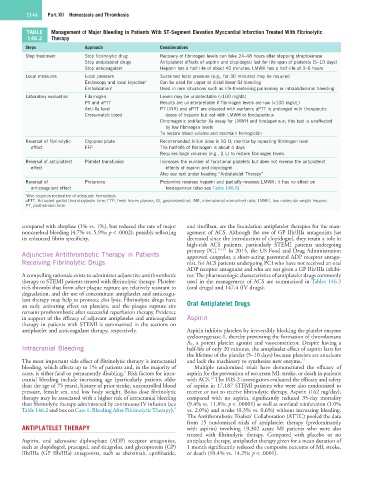
          TABLE   Management of Major Bleeding in Patients With ST-Segment Elevation Myocardial Infarction Treated With Fibrinolytic
          146.2   Therapy
         Steps               Approach                Considerations
         Stop treatment      Stop fibrinolytic drug  Recovery of fibrinogen levels can take 24–48 hours after stopping streptokinase
                             Stop antiplatelet drugs  Antiplatelet effects of aspirin and clopidogrel last for life span of platelets (5–10 days)
                             Stop anticoagulant      Heparin has a half-life of about 40 minutes; LMWH has a half-life of 3–6 hours
         Local measures      Local pressure          Sustained local pressure (e.g., for 30 minutes) may be required
                             Endoscopy and local injection a  Can be used for upper or distal lower GI bleeding
                             Embolization a          Used in rare situations such as life-threatening pulmonary or intraabdominal bleeding
         Laboratory evaluation  Fibrinogen           Levels may be undetectable (<100 mg/dL)
                             PT and aPTT             Results are uninterpretable if fibrinogen levels are low (<100 mg/dL)
                             Anti-Xa level           PT (INR) and aPTT are elevated with warfarin; aPTT is prolonged with therapeutic
                             Cross-match blood         doses of heparin but not with LMWH or fondaparinux
                                                     Chromogenic antifactor Xa assay for LMWH and fondaparinux; this test is unaffected
                                                       by low fibrinogen levels
                                                     To restore blood volume and maintain hemoglobin
         Reversal of fibrinolytic   Cryoprecipitate  Recommended initial dose is 10 U; monitor by repeating fibrinogen level
           effect            FFP                     The half-life of fibrinogen is about 4 days
                                                     Requires large volumes (e.g., 2 L) to restore fibrinogen levels
         Reversal of antiplatelet   Platelet transfusion  Increases the number of functional platelets but does not reverse the antiplatelet
           effect                                      effects of aspirin and clopidogrel
                                                     Also see text under heading “Antiplatelet Therapy”
         Reversal of         Protamine               Protamine reverses heparin and partially reverses LMWH; it has no effect on
           anticoagulant effect                        fondaparinux (also see Table 146.6)
         a Also requires restoration of adequate hemostasis.
         aPTT, Activated partial thromboplastin time; FFP, fresh frozen plasma; GI, gastrointestinal; INR, international normalized ratio; LMWH, low-molecular-weight heparin;
         PT, prothrombin time.


        compared with alteplase (1% vs. 1%), but reduced the rate of major   and tirofiban, are the foundation antiplatelet therapies for the man-
        noncerebral bleeding (4.7% vs. 5.9%; p < .0002), possibly reflecting   agement of ACS. Although the use of GP IIb/IIIa antagonists has
        its enhanced fibrin specificity.                      decreased since the introduction of clopidogrel, they retain a role in
                                                              high-risk  ACS  patients,  particularly  STEMI  patients  undergoing
                                                                        5,6,10
        Adjunctive Antithrombotic Therapy in Patients         primary PCI.   In 2015, the US Food and Drug Administration
                                                              approved cangrelor, a short-acting parenteral ADP receptor antago-
        Receiving Fibrinolytic Drugs                          nist, for ACS patients undergoing PCI who have not received an oral
                                                              ADP receptor antagonist and who are not given a GP IIb/IIIa inhibi-
        A compelling rationale exists to administer adjunctive antithrombotic   tor. The pharmacologic characteristics of antiplatelet drugs commonly
        therapy to STEMI patients treated with fibrinolytic therapy. Platelet-  used  in  the  management  of  ACS  are  summarized  in Tables  146.3
        rich thrombi that form after plaque rupture are relatively resistant to   (oral drugs) and 147.4 (IV drugs).
        degradation, and the use of concomitant antiplatelet and anticoagu-
        lant therapy may help to promote clot lysis. Fibrinolytic drugs have
        an  early  activating  effect  on  platelets,  and  the  plaque  rupture  site   Oral Antiplatelet Drugs
        remains prothrombotic after successful reperfusion therapy. Evidence
        in support of the efficacy of adjuvant antiplatelet and anticoagulant   Aspirin
        therapy in patients with STEMI is summarized in the sections on
        antiplatelet and anticoagulant therapy, respectively.  Aspirin inhibits platelets by irreversibly blocking the platelet enzyme
                                                              cyclooxygenase-1, thereby preventing the formation of thromboxane
                                                              A 2 , a potent platelet agonist and vasoconstrictor. Despite having a
        Intracranial Bleeding                                 half-life of only 20 minutes, the antiplatelet effect of aspirin lasts for
                                                              the lifetime of the platelet (5–10 days) because platelets are anucleate
        The most important side effect of fibrinolytic therapy is intracranial   and lack the machinery to synthesize new enzyme. 11
        bleeding, which affects up to 1% of patients and, in the majority of   Multiple  randomized  trials  have  demonstrated  the  efficacy  of
                                          8
        cases, is either fatal or permanently disabling.  Risk factors for intra-  aspirin for the prevention of recurrent MI, stroke, or death in patients
                                                                      12
        cranial  bleeding  include  increasing  age  (particularly  patients  older   with ACS.  The ISIS-2 investigators evaluated the efficacy and safety
        than the age of 75 years), history of prior stroke, uncontrolled blood   of aspirin in 17,187 STEMI patients who were also randomized to
        pressure, female sex, and low body weight. Bolus dose fibrinolytic   receive or not to receive fibrinolytic therapy. Aspirin (162 mg/day),
        therapy may be associated with a higher risk of intracranial bleeding   compared  with  no  aspirin,  significantly  reduced  35-day  mortality
        than fibrinolytic therapy administered by continuous IV infusion (see   (9.4% vs. 11.8%; p < .00001) as well as nonfatal reinfarction (1.0%
        Table 146.2 and box on Case 1: Bleeding After Fibrinolytic Therapy). 9  vs. 2.0%) and stroke (0.3% vs. 0.6%) without increasing bleeding.
                                                              The Antithrombotic Trialists’ Collaboration (ATTC) pooled the data
                                                              from  15  randomized  trials  of  antiplatelet  therapy  (predominantly
        ANTIPLATELET THERAPY                                  with  aspirin)  involving  19,302  acute  MI  patients  who  were  also
                                                              treated  with  fibrinolytic  therapy.  Compared  with  placebo  or  no
        Aspirin,  oral  adenosine  diphosphate  (ADP)  receptor  antagonists,   antiplatelet therapy, antiplatelet therapy given for a mean duration of
        such as clopidogrel, prasugrel, and ticagrelor, and glycoprotein (GP)   1 month significantly reduced the composite outcome of MI, stroke,
        IIb/IIIa  (GP  IIb/IIIa)  antagonists,  such  as  abciximab,  eptifibatide,   or death (10.4% vs. 14.2%; p < .0001).

