


Page 2406 - Hematology_ Basic Principles and Practice ( PDFDrive )
P. 2406
2148   Part XII  Hemostasis and Thrombosis


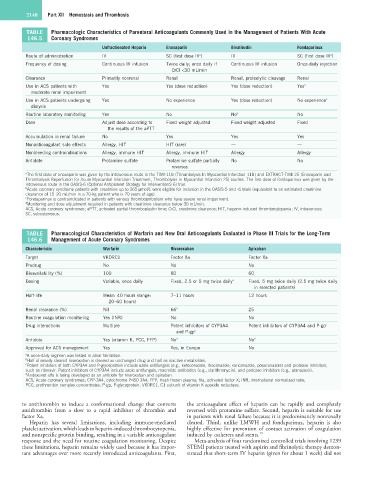
          TABLE   Pharmacologic Characteristics of Parenteral Anticoagulants Commonly Used in the Management of Patients With Acute
          146.5   Coronary Syndromes
                                  Unfractionated Heparin  Enoxaparin         Bivalirudin          Fondaparinux
         Route of administration  IV                   SC (first dose IV )   IV                   SC (first dose IV )
                                                                  a
                                                                                                             a
         Frequency of dosing      Continuous IV infusion  Twice daily; once daily if   Continuous IV infusion  Once-daily injection
                                                         CrCl <30 mL/min
         Clearance                Primarily nonrenal   Renal                 Renal, proteolytic cleavage  Renal
         Use in ACS patients with   Yes                Yes (dose reduction)  Yes (dose reduction)  Yes b
           moderate renal impairment
         Use in ACS patients undergoing   Yes          No experience         Yes (dose reduction)  No experience c
           dialysis
         Routine laboratory monitoring  Yes            No                    No d                 No
         Dose                     Adjust dose according to   Fixed weight adjusted  Fixed weight adjusted  Fixed
                                    the results of the aPTT
         Accumulation in renal failure  No             Yes                   Yes                  Yes
         Nonanticoagulant side effects  Allergy, HIT   HIT (rare)            —                    —
         Nonbleeding contraindications  Allergy, immune HIT  Allergy, immune HIT  Allergy         Allergy
         Antidote                 Protamine sulfate    Protamine sulfate partially   No           No
                                                         reverses
         a The first dose of enoxaparin was given by the intravenous route in the TIMI-11B (Thrombolysis In Myocardial Infarction 11B) and EXTRACT-TIMI 25 (Enoxaparin and
         Thrombolysis Reperfusion for Acute Myocardial Infarction Treatment, Thrombolysis in Myocardial Infarction 25) studies. The first dose of fondaparinux was given by the
         intravenous route in the OASIS-6 (Optimal Antiplatelet Strategy for InterventionS 6) trial.
         b Acute coronary syndrome patients with creatinine up to 265 µmol/L were eligible for inclusion in the OASIS-5 and -6 trials (equivalent to an estimated creatinine
         clearance of 15–20 mL/min in a 70-kg patient who is 70 years of age).
         c Fondaparinux is contraindicated in patients with venous thromboembolism who have severe renal impairment.
         d Monitoring and dose adjustment required in patients with creatinine clearance below 30 mL/min.
         ACS, Acute coronary syndromes; aPTT, activated partial thromboplastin time; CrCl, creatinine clearance; HIT, heparin-induced thrombocytopenia; IV, intravenous;
         SC, subcutaneous.


          TABLE   Pharmacological Characteristics of Warfarin and New Oral Anticoagulants Evaluated in Phase III Trials for the Long-Term
          146.6   Management of Acute Coronary Syndromes
         Characteristic            Warfarin              Rivaroxaban              Apixaban
         Target                    VKORC1                Factor Xa                Factor Xa
         Prodrug                   No                    No                       No
         Bioavailability (%)       100                   80                       60
         Dosing                    Variable, once daily  Fixed, 2.5 or 5 mg twice daily a  Fixed, 5 mg twice daily (2.5 mg twice daily
                                                                                    in selected patients)
         Half-life                 Mean: 40 hours (range:   7–11 hours            12 hours
                                     20–60 hours)
         Renal clearance (%)       Nil                   66 b                     25
         Routine coagulation monitoring  Yes (INR)       No                       No
         Drug interactions         Multiple              Potent inhibitors of CYP3A4   Potent inhibitors of CYP3A4 and P-gp c
                                                           and P-gp c
         Antidote                  Yes (vitamin K, PCC, FFP)  No d                No d
         Approved for ACS management  Yes                Yes, in Europe           No
         a A once-daily regimen was tested in atrial fibrillation.
         b Half of renally cleared rivaroxaban is cleared as unchanged drug and half as inactive metabolites.
         c Potent inhibitors of both CYP3A4 and P-glycoprotein include azole antifungals (e.g., ketoconazole, itraconazole, voriconazole, posaconazole) and protease inhibitors,
         such as ritonavir. Potent inhibitors of CYP3A4 include azole antifungals, macrolide antibiotics (e.g., clarithromycin), and protease inhibitors (e.g., atanazavir).
         d Andexanet alfa is being developed as an antidote for rivaroxaban and apixaban.
         ACS, Acute coronary syndromes; CYP-3A4, cytochrome P450 3A4; FFP, fresh frozen plasma; fXa, activated factor X; INR, international normalized ratio;
         PCC, prothrombin complex concentrates; P-gp, P-glycoprotein; VKORC1, C1 subunit of vitamin K epoxide reductase.


        to  antithrombin  to  induce  a  conformational  change  that  converts   the  anticoagulant  effect  of  heparin  can  be  rapidly  and  completely
        antithrombin  from  a  slow  to  a  rapid  inhibitor  of  thrombin  and    reversed with protamine sulfate. Second, heparin is suitable for use
        factor Xa.                                            in patients with renal failure because it is predominantly nonrenally
           Heparin  has  several  limitations,  including  immune-mediated   cleared.  Third,  unlike  LMWH  and  fondaparinux,  heparin  is  also
        platelet activation, which leads to heparin-induced thrombocytopenia,   highly effective for prevention of contact activation of coagulation
        and nonspecific protein binding, resulting in a variable anticoagulant   induced by catheters and stents. 28
        response and the need for routine coagulation monitoring. Despite   Meta-analysis of four randomized controlled trials involving 1239
        these limitations, heparin remains widely used because it has impor-  STEMI patients treated with aspirin and fibrinolytic therapy demon-
        tant advantages over more recently introduced anticoagulants. First,   strated that short-term IV heparin (given for about 1 week) did not

