


Page 2403 - Hematology_ Basic Principles and Practice ( PDFDrive )
P. 2403
Chapter 146  Acute Coronary Syndromes  2145


             Case 1: Bleeding After Fibrinolytic Therapy
             A  63-year-old  man  with  a  history  of  hypertension  presents  to  a  rural   bleeding; (3) draw blood to measure fibrinogen, prothrombin time (PT),
             hospital with sudden onset of severe retrosternal chest pain. An electro-  aPTT, and possibly anti-Xa levels (to measure the anticoagulant effect of
             cardiogram (ECG) performed in the emergency department demonstrates   low-molecular-weight heparin [LMWH]) and for blood typing and cross-
             4-mm ST segment elevation in the anterior leads. The nearest hospital   match; and (4) administer therapies to mitigate or reverse the effects of
             with  a  cardiac  catheterization  laboratory  is  more  than  6  hours  away.   fibrinolytic, antiplatelet, and anticoagulant drugs.
             After treatment with aspirin (300 mg loading dose), clopidogrel (300 mg   The extent and duration of the systemic lytic state induced by fibrinolytic
             loading dose), and an intravenous (IV) infusion of front-loaded alteplase,   drugs are determined by their fibrin specificity. Whereas streptokinase
             he has rapid resolution of his pain and the ECG reveals normalization   produces profound and sustained depletion of fibrinogen (<100 mg/dL)
             of the ST-segment elevation. Toward the end of the alteplase infusion,   that lasts for up to 24–48 hours, alteplase and other more fibrin-specific
             he  complains  of  abdominal  pain,  becomes  hypotensive,  and  develops   agents exert less pronounced and more short-lived effects on fibrinogen
             melena.  Hemoglobin  is  10.2 g/dL,  the  activated  partial  thromboplastin   levels.  The  aPTT  and  PT  can  be  markedly  prolonged  in  patients  with
             time  (aPTT)  is  89  seconds,  the  international  normalized  ratio  (INR)  is   hypofibrinogenemia. Normal coagulation can be restored by elevating the
             1.7, and the fibrinogen level is 80 mg/dL.           fibrinogen level to at least 100 mg/dL. This can readily be achieved by
              Aspirin and clopidogrel are held; the patient receives 10 units of cryo-  infusing cryoprecipitate (recommended dose: 10 units). Although fresh
             precipitate and is started on an IV infusion of a proton pump inhibitor. He   frozen plasma also contains fibrinogen, much larger volumes are needed
             undergoes urgent upper gastrointestinal tract endoscopy with injection   to increase the fibrinogen concentration to the desired range.
             of a bleeding ulcer. He does not receive platelets because of concerns   Platelet  dysfunction  caused  by  aspirin,  clopidogrel,  and  fibrinolytic
             about the risk of recurrent myocardial infarction (MI). No further bleeding   therapy cannot be specifically reversed, but infusion of donor platelets
             occurs, and after 48 hours he resumes aspirin. Clopidogrel is restarted   can  help  to  restore  platelet  function.  Platelet  transfusion  is  generally
             1 week later after repeat endoscopy demonstrates healing of the ulcer.  reserved for patients with life-threatening bleeding because of concerns
                                                                  about the risk of recurrent MI. A single unit of single donor platelets can
             Comment                                              be  expected  to  increase  the  platelet  count  by  50–60  ×  10 /L.  Even  a
                                                                                                           9
             Fibrinolytic trials in patients with acute MI report a 1%–6% incidence   small number (e.g., 10%–20%) of functional (nonaspirinated) platelets
             of  major  bleeding  and  a  10%  incidence  of  moderate  bleeding  during   is sufficient to generate sufficient thromboxane to sustain normal platelet
             the first 30 days. The most common sources of major bleeding are the   aggregation, but a much larger number of transfused platelets is needed
             gastrointestinal tract and procedure-related bleeding. The principles of   to overcome the antiplatelet effects of clopidogrel. In this case, bleeding
             management of major bleeding in STEMI patients treated with fibrinolytic   was  controlled  with  cryoprecipitate  and  local  measures,  and  platelet
             therapy  are  summarized  in  Table  146.2.  Steps  include  (1)  stop  anti-  transfusion was not required.
             thrombotic therapies; (2) use local measures when possible to control


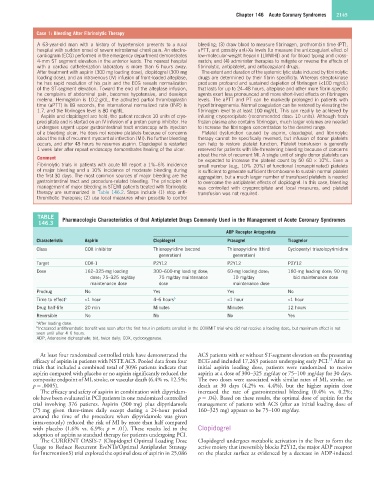
             TABLE   Pharmacologic Characteristics of Oral Antiplatelet Drugs Commonly Used in the Management of Acute Coronary Syndromes
              146.3
                                                                           ADP Receptor Antagonists
             Characteristic  Aspirin               Clopidogrel             Prasugrel           Ticagrelor
             Class           COX inhibitor         Thienopyridine (second   Thienopyridine (third   Cyclopentyl triazolopyrimidine
                                                     generation)             generation)
             Target          COX-1                 P2Y12                   P2Y12               P2Y12
             Dose            162–325-mg loading    300–600-mg loading dose;   60-mg loading dose;   180-mg loading dose; 90 mg
                               dose; 75–325 mg/day   75 mg/day maintenance   10 mg/day           bid maintenance dose
                               maintenance dose      dose                    maintenance dose
             Prodrug         No                    Yes                     Yes                 No
             Time to effect a  <1 hour             4–6 hours b             <1 hour             <1 hour
             Drug half-life  20 min                Minutes                 Minutes             12 hours
             Reversible      No                    No                      No                  Yes
             a After loading dose.
             b Increased antithrombotic benefit was seen after the first hour in patients enrolled in the COMMIT trial who did not receive a loading dose, but maximum effect is not
             seen until after 4–6 hours.
             ADP, Adenosine diphosphate; bid, twice daily; COX, cyclooxygenase.


              At least four randomized controlled trials have demonstrated the   ACS patients with or without ST-segment elevation on the presenting
                                                                                                             13
            efficacy of aspirin in patients with NSTE ACS. Pooled data from four   ECG and included 17,263 patients undergoing early PCI.  After an
            trials that included a combined total of 3096 patients indicate that   initial  aspirin  loading  dose,  patients  were  randomized  to  receive
            aspirin compared with placebo or no aspirin significantly reduced the   aspirin at a dose of 300–325 mg/day or 75–100 mg/day for 30 days.
            composite endpoint of MI, stroke, or vascular death (6.4% vs. 12.5%;   The two doses were associated with similar rates of MI, stroke, or
            p = .0005).                                           death  at  30  days  (4.2%  vs.  4.4%),  but  the  higher  aspirin  dose
              The efficacy and safety of aspirin in combination with dipyridam-  increased  the  rate  of  gastrointestinal  bleeding  (0.4%  vs.  0.2%;
            ole have been evaluated in PCI patients in one randomized controlled   p = .04). Based on these results, the optimal dose of aspirin for the
            trial  involving  376  patients.  Aspirin  (300 mg)  plus  dipyridamole   management of patients with ACS (after an initial loading dose of
            (75 mg  given  three-times  daily  except  during  a  24-hour  period   160–325 mg) appears to be 75–100 mg/day.
            around  the  time  of  the  procedure  when  dipyridamole  was  given
            intravenously) reduced the risk of MI by more than half compared
            with  placebo  (1.6%  vs.  6.9%;  p  =  .01).  These  results  led  to  the   Clopidogrel
            adoption of aspirin as standard therapy for patients undergoing PCI.
              The CURRENT OASIS-7 (Clopidogrel Optimal Loading Dose   Clopidogrel undergoes metabolic activation in the liver to form the
            Usage  to  Reduce  Recurrent  EveNTs/Optimal  Antiplatelet  Strategy   active moiety that irreversibly blocks P2Y12, the major ADP receptor
            for InterventionS) trial explored the optimal dose of aspirin in 25,086   on the platelet surface as evidenced by a decrease in ADP-induced

