


Page 2431 - Hematology_ Basic Principles and Practice ( PDFDrive )
P. 2431
Chapter 149  Antithrombotic Drugs  2169


                              Antithrombotic drugs                endothelial  cells,  COX-2  initiates  the  synthesis  of  prostacyclin,  a
                                                                  potent vasodilator and inhibitor of platelet aggregation.

             Antiplatelet drugs  Anticoagulants  Fibrinolytic agents  Indications
              Fig. 149.1  CLASSIFICATION OF ANTITHROMBOTIC DRUGS.
                                                                  Aspirin  is  widely  used  for  secondary  prevention  of  cardiovascular
                                                                  events  in  patients  with  coronary  artery  disease,  cerebrovascular
                                                                  disease,  or  peripheral  vascular  disease.  Compared  with  placebo,
                                                                  aspirin produces about a 25% reduction in the risk of cardiovascular


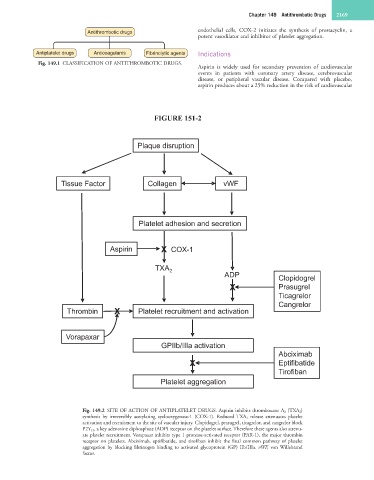
                            Fig. 149.2  SITE OF ACTION OF ANTIPLATELET DRUGS. Aspirin inhibits thromboxane A 2  (TXA 2 )
                            synthesis  by  irreversibly  acetylating  cyclooxygenase-1  (COX-1).  Reduced  TXA 2   release  attenuates  platelet
                            activation and recruitment to the site of vascular injury. Clopidogrel, prasugrel, ticagrelor, and cangrelor block
                            P2Y 12 , a key adenosine diphosphate (ADP) receptor on the platelet surface. Therefore these agents also attenu-
                            ate platelet recruitment. Vorapaxar inhibits type 1 protease-activated receptor (PAR-1), the major thrombin
                            receptor  on  platelets.  Abciximab,  eptifibatide,  and  tirofiban  inhibit  the  final  common  pathway  of  platelet
                            aggregation  by blocking  fibrinogen  binding to  activated  glycoprotein (GP) IIb/IIIa. vWF, von Willebrand
                            factor.

