


Page 2434 - Hematology_ Basic Principles and Practice ( PDFDrive )
P. 2434
2172   Part XII  Hemostasis and Thrombosis

        Indications                                           Dosing

        Dipyridamole  plus  aspirin  was  compared  with  aspirin  or  dipyri-  Aggrenox  is  given  twice  daily.  Each  capsule  contains  200 mg  of
        damole alone, or with placebo, in patients with an ischemic stroke   extended-release dipyridamole and 25 mg of aspirin.
        or  transient  ischemic  attack.  The  combination  reduced  the  risk
        of  stroke  by  22.1%  compared  with  aspirin  alone  and  by  24.4%
        compared  with  dipyridamole  alone.  In  a  second  trial,  researchers   Side Effects
        compared dipyridamole plus aspirin with aspirin alone for secondary
        prevention in patients with ischemic stroke. Vascular death, stroke,   Because dipyridamole has vasodilatory effects, it must be used with
        or myocardial infarction occurred in 13% of patients given combina-  caution  in  patients  with  coronary  artery  disease.  Gastrointestinal
        tion therapy and in 16% of those treated with aspirin alone. When   complaints, headache, facial flushing, dizziness, and hypotension also
        Aggrenox  was  compared  with  clopidogrel,  however,  there  was  no   can occur. These symptoms often subside with continued use of the
        difference in efficacy, and there was more intracranial bleeding with   drug.
                11
        Aggrenox.  Although Aggrenox is used for stroke prevention, because
        of  its  vasodilatory  effects  and  the  paucity  of  data  supporting  the
        use of dipyridamole in patients with symptomatic coronary artery   GPIIb/IIIa Receptor Antagonists
        disease, Aggrenox should not be used for stroke prevention in such
        patients.                                             As a class, parenteral GPIIb/IIIa receptor antagonists have an estab-
                                                              lished niche in patients with acute coronary syndromes. The three
                                                              agents in this class are abciximab, eptifibatide, and tirofiban.
                     Adenosine           Reuptake
                                                              Mechanism of Action
                                      X      Dipyridamole
                                                              A member of the integrin family of adhesion receptors, GPIIb/IIIa is
                      A receptor                              found on the surface of platelets and megakaryocytes. With about
                       2
                                                              40,000 to 80,000 copies per platelet, GPIIb/IIIa is the most abundant
                Platelet       Adenylate                      receptor. Consisting of a noncovalently linked heterodimer, GPIIb/
                                cyclase                       IIIa  is  inactive  on  resting  platelets.  When  platelets  are  activated,
                        ATP                                   inside–outside signal transduction pathways trigger a conformational
                                                              activation of the receptor. Once activated, GPIIb/IIIa binds adhesive
                                                              molecules, such as fibrinogen and, under high shear conditions, von
                                 cAMP        X        AMP     Willebrand  factor.  Binding  is  mediated  by  Arg-Gly-Asp  (RGD)
                                       Phosphodiesterase      sequences found on the fibrinogen and von Willebrand factor, as well

                                 Ca 2+                        as  by  the  Lys-Gly-Asp  (KGD)  sequence  located  within  a  unique
                                                              dodecapeptide domain on the γ-chains of fibrinogen. Once bound,
                                                              fibrinogen  and/or  von  Willebrand  factor  bridge  adjacent  platelets
                                                              together to induce platelet aggregation.
                          Activation and aggregation
                                inhibited                        Although  abciximab,  eptifibatide,  and  tirofiban  all  target  the
                                                              GPIIb/IIIa  receptor,  they  are  structurally  and  pharmacologically
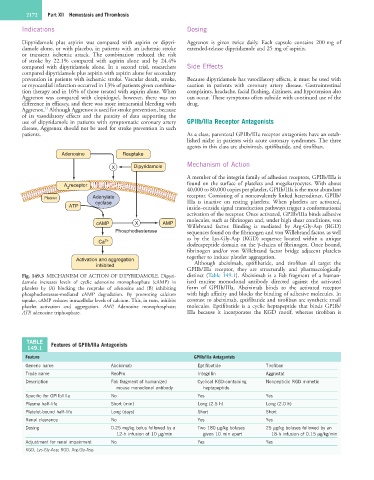
        Fig. 149.3  MECHANISM OF ACTION OF DIPYRIDAMOLE. Dipyri-  distinct  (Table  149.1).  Abciximab  is  a  Fab  fragment  of  a  human-
        damole  increases  levels  of  cyclic  adenosine  monophosphate  (cAMP)  in   ized  murine  monoclonal  antibody  directed  against  the  activated
        platelets  by  (A)  blocking  the  reuptake  of  adenosine  and  (B)  inhibiting   form  of  GPIIb/IIIa.  Abciximab  binds  to  the  activated  receptor
        phosphodiesterase-mediated  cAMP  degradation.  By  promoting  calcium   with high affinity and blocks the binding of adhesive molecules. In
        uptake, cAMP reduces intracellular levels of calcium. This, in turn, inhibits   contrast to abciximab, eptifibatide and tirofiban are synthetic small
        platelet  activation  and  aggregation.  AMP,  Adenosine  monophosphate;   molecules.  Eptifibatide  is  a  cyclic  heptapeptide  that  binds  GPIIb/
        ATP, adenosine triphosphate.                          IIIa  because  it  incorporates  the  KGD  motif,  whereas  tirofiban  is


          TABLE   Features of GPIIb/IIIa Antagonists
          149.1
         Feature                                                 GPIIb/IIIa Antagonists
         Generic name                Abciximab                    Eptifibatide          Tirofiban
         Trade name                  ReoPro                       Integrilin            Aggrastat
         Description                 Fab fragment of humanized    Cyclical KGD-containing   Nonpeptidic RGD mimetic
                                       mouse monoclonal antibody   heptapeptide
         Specific for GPIIb/IIIa     No                           Yes                   Yes
         Plasma half-life            Short (min)                  Long (2.5 h)          Long (2.0 h)
         Platelet-bound half-life    Long (days)                  Short                 Short
         Renal clearance             No                           Yes                   Yes
         Dosing                      0.25 mg/kg bolus followed by a   Two 180 µg/kg boluses   25 µg/kg boluses followed by an
                                       12-h infusion of 10 µg/min  given 10 min apart     18-h infusion of 0.15 µg/kg/min
         Adjustment for renal impairment  No                      Yes                   Yes
         KGD, Lys-Gly-Asp; RGD, Arg-Gly-Asp.

