


Page 2436 - Hematology_ Basic Principles and Practice ( PDFDrive )
P. 2436
2174   Part XII  Hemostasis and Thrombosis


         A                                                     10,000
         Unfractionated           Factor Xa
                                                                Fold increase over uncatalyzed rate  100
              heparin                                            1000


                     Pentasaccharide
                       sequence


           Antithrombin                                           10


                                   Thrombin

         B                                                         1        IIa           IXa           Xa
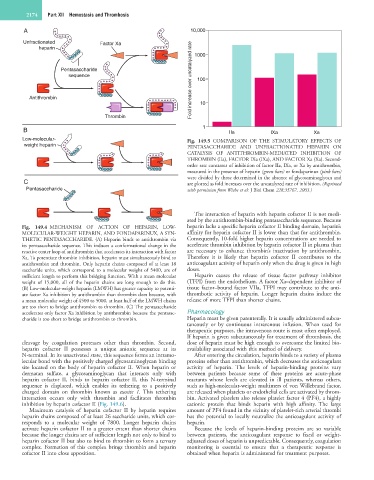
        Low-molecular-                                        Fig.  149.5  COMPARISON  OF  THE  STIMULATORY  EFFECTS  OF
         weight heparin                                       PENTASACCHARIDE  AND  UNFRACTIONATED  HEPARIN  ON
                                                              CATALYSIS  OF  ANTITHROMBIN-MEDIATED  INHIBITION  OF
                                                              THROMBIN (IIa), FACTOR IXa (IXa), AND FACTOR Xa (Xa). Second-
                                                              order rate constants of inhibition of factor IIa, IXa, or Xa by antithrombin,
                                                              measured in the presence of heparin (green bars) or fondaparinux (pink bars)
                                                              were divided by those determined in the absence of glycosaminoglycan and
         C                                                    are plotted as fold increases over the uncatalyzed rate of inhibition. (Reprinted
          Pentasaccharide                                     with permission from Wiebe et al: J Biol Chem 228:35767, 2003.)


                                                                 The interaction of heparin with heparin cofactor II is not medi-
                                                              ated by the antithrombin-binding pentasaccharide sequence. Because
        Fig.  149.4  MECHANISM  OF  ACTION  OF  HEPARIN,  LOW-  heparin lacks a specific heparin cofactor II binding domain, heparin’s
        MOLECULAR-WEIGHT HEPARIN, AND FONDAPARINUX, A SYN-    affinity for heparin cofactor II is lower than that for antithrombin.
        THETIC PENTASACCHARIDE. (A) Heparin binds to antithrombin via   Consequently, 10-fold higher heparin concentrations are needed to
        its pentasaccharide sequence. This induces a conformational change in the   accelerate thrombin inhibition by heparin cofactor II in plasma than
        reactive center loop of antithrombin that accelerates its interaction with factor   are  necessary  to  enhance  thrombin’s  inactivation  by  antithrombin.
        Xa. To potentiate thrombin inhibition, heparin must simultaneously bind to   Therefore  it  is  likely  that  heparin  cofactor  II  contributes  to  the
        antithrombin and thrombin. Only heparin chains composed of at least 18   anticoagulant activity of heparin only when the drug is given in high
        saccharide units, which correspond to a molecular weight of 5400, are of   doses.
        sufficient length to perform this bridging function. With a mean molecular   Heparin  causes  the  release  of  tissue  factor  pathway  inhibitor
        weight  of  15,000,  all  of  the  heparin  chains  are  long  enough  to  do  this.     (TFPI) from the endothelium. A factor Xa–dependent inhibitor of
        (B) Low-molecular-weight heparin (LMWH) has greater capacity to potenti-  tissue factor–bound factor VIIa, TFPI may contribute to the anti-
        ate factor Xa inhibition by antithrombin than thrombin does because, with   thrombotic  activity  of  heparin.  Longer  heparin  chains  induce  the
        a mean molecular weight of 4500 to 5000, at least half of the LMWH chains   release of more TFPI than shorter chains.
        are too short to bridge antithrombin to thrombin. (C) The pentasaccharide
        accelerates only factor Xa inhibition by antithrombin because the pentasac-  Pharmacology
        charide is too short to bridge antithrombin to thrombin.   Heparin must be given parenterally. It is usually administered subcu-
                                                              taneously  or  by  continuous  intravenous  infusion.  When  used  for
                                                              therapeutic purposes, the intravenous route is most often employed.
                                                              If heparin is given subcutaneously for treatment of thrombosis, the
        cleavage  by  coagulation  proteases  other  than  thrombin.  Second,   dose of heparin must be high enough to overcome the limited bio-
        heparin  cofactor  II  possesses  a  unique  anionic  sequence  at  its   availability associated with this method of delivery.
        N-terminal. In its unactivated state, this sequence forms an intramo-  After entering the circulation, heparin binds to a variety of plasma
        lecular bond with the positively charged glycosaminoglycan binding   proteins other than antithrombin, which decreases the anticoagulant
        site  located  on  the  body  of  heparin  cofactor  II. When  heparin  or   activity  of  heparin.  The  levels  of  heparin-binding  proteins  vary
        dermatan  sulfate,  a  glycosaminoglycan  that  interacts  only  with   between  patients  because  some  of  these  proteins  are  acute-phase
        heparin  cofactor  II,  binds  to  heparin  cofactor  II,  this  N-terminal   reactants  whose  levels  are  elevated  in  ill  patients,  whereas  others,
        sequence  is  displaced,  which  enables  its  tethering  to  a  positively   such as high-molecular-weight multimers of von Willebrand factor,
        charged  domain  on  thrombin  known  as  exosite  1.  This  tethering   are released when platelets or endothelial cells are activated by throm-
        interaction  occurs  only  with  thrombin  and  facilitates  thrombin   bin. Activated platelets also release platelet factor 4 (PF4), a highly
        inhibition by heparin cofactor II (Fig. 149.6).       cationic  protein  that  binds  heparin  with  high  affinity.  The  large
           Maximum  catalysis  of  heparin  cofactor  II  by  heparin  requires   amount of PF4 found in the vicinity of platelet-rich arterial thrombi
        heparin chains composed of at least 26 saccharide units, which cor-  has  the  potential to  locally neutralize  the  anticoagulant  activity of
        responds  to  a  molecular  weight  of  7800.  Longer  heparin  chains   heparin.
        activate heparin cofactor II to a greater extent than shorter chains   Because  the  levels  of  heparin-binding  proteins  are  so  variable
        because the longer chains are of sufficient length not only to bind to   between  patients,  the  anticoagulant  response  to  fixed  or  weight-
        heparin cofactor II but also to bind to thrombin to form a ternary   adjusted doses of heparin is unpredictable. Consequently, coagulation
        complex. Formation of this complex brings thrombin and heparin   monitoring  is  essential  to  ensure  that  a  therapeutic  response  is
        cofactor II into close apposition.                    obtained when heparin is administered for treatment purposes.

