


Page 2517 - Hematology_ Basic Principles and Practice ( PDFDrive )
P. 2517
2240   Part XIII  Consultative Hematology


        hypertension and vascular deformities. Over 80% of bleeding epi-  Being  an  acute  phase  reactant,  fibrinogen  synthesis  is  generally
        sodes in patients with cirrhosis are a result of variceal bleeding.  preserved unless liver disease is severe. Acquired dysfibrinogenemia,
           Hepatic dysfunction leads to reduced synthesis of most coagula-  however, has been described in approximately 75% of patients with
        tion factors. The number and degree of clotting factor deficiencies   chronic  liver  disease,  acute  liver  failure,  and  cirrhosis  but  is  not
        reflect  the  severity  of  liver  damage.  Factor  VII  levels,  having  the   thought to contribute significantly to bleeding. Aberrant polymeriza-
        shortest half-life (6 hours) of the coagulation factors, often decline   tion of fibrin monomers may be related to excess sialic acid residues
        early and are reflected by prolongation of the prothrombin time (PT)/  on fibrinogen, interfering with the activity of thrombin. Laboratory
        international  normalized  ratio  (INR).  Conversely,  factor  VIII  and   findings of dysfibrinogenemia include elevated PT, PTT, or thrombin
        vWF  levels  may  be  normal  or  elevated  in  liver  disease  because  of   time, low or normal fibrinogen by immunologic assay and reduced
        upregulated compensatory extrahepatic synthesis or impaired hepatic   fibrinogen by functional assay.
        clearance.                                               The presence of hyperfibrinolysis in liver disease and its contribu-
           Reductions  in  factors  II, VII,  IX,  and  X  in  patients  with  liver   tion to bleeding risk is controversial. Triggers of increased fibrinolysis
        disease may also result from vitamin K deficiency caused by malnutri-  may  involve  release  of  tissue  plasminogen  activator  (t-PA)  in  the
        tion, malabsorption, use of antibiotics, or biliary tract obstruction.   setting  of  infection  or  surgery,  reabsorption  of  ascitic  fluid  with
        For these coagulation factors, vitamin K is required as a cofactor in   fibrinolytic activity, and altered synthetic or metabolic functions of
        γ-carboxylation, a process that converts inactive precursors to biologi-  the  liver.  With  the  exception  of  t-PA  and  plasminogen  activator
        cally active factors.                                 inhibitor-1 (PAI-1), all fibrinolytic and antifibrinolytic proteins are
           Defects in coagulation factors are suggested by prolonged PT/INR   synthesized  in  the  liver.  Decreased  hepatic  clearance  of  t-PA  and
        and partial thromboplastin time (PTT) measurements and confirmed   reduced synthesis of α2 antiplasmin and thrombin-activatable fibri-
        by individual factor levels. However, these routine screening tests of   nolysis  inhibitor  favor  an  increase  in  circulating  plasmin  and  a
        coagulation do not identify patients at risk of bleeding. Both the PT   hyperfibrinolytic state in cirrhosis. Available laboratory tests cannot
        and INR have been incorporated into prognostic indices (Child-Pugh   adequately assess the overall activity of profibrinolytic and antifibri-
        and Model of End-stage Liver Disease scores) as markers of synthetic   nolytic  components.  Shortened  whole  blood  euglobulin  clot  lysis
        dysfunction  to  estimate  the  severity  of  liver  disease  and  stratify   time and elevated levels of D-dimer, fibrin, and fibrinogen degrada-
        patients for transplant, respectively. Factor V levels have been studied   tion products are suggestive of increased fibrinolysis. These abnormal
        as a prognostic indicator in acute fulminant hepatic failure. Acute   laboratory indices have been observed in nonbleeding patients but
        liver  failure  is  associated  with  more  pronounced  elevations  in  the   are seen more frequently in bleeding patients and have been reported
        INR, yet is associated with less spontaneous bleeding than chronic   to correlate with GI bleeding, severity of liver failure, and variceal
        liver  failure  reflecting  the  importance  of  hemodynamics  (portal   size. Hyperfibrinolysis may theoretically aggravate bleeding through
        hypertension) on the risk of bleeding.                consumption of coagulation factors, inhibition of fibrin polymeriza-
           Despite their routine use in clinical practice, several significant   tion, and reduced platelet aggregation via degradation of vWF and
        limitations exist in applying the PT/INR or PTT in the context of   glycoprotein  Ib  and  α IIb β 3 .  Hyperfibrinolysis  likely  plays  a  more
        liver disease. First, the INR has not been validated for patents with   important role in hemostasis during liver transplantation. Conversely,
        cirrhosis. Second, there is no evidence that demonstrates correcting   patients with acute hepatic failure show evidence of impaired fibri-
        these abnormal values with plasma or procoagulant agents prevents   nolysis with elevated PAI-1 levels and decreased plasminogen.
        bleeding or improves outcomes. Several reasons may account for the
        lack  of  correlation  between  PT/INR  or  PTT  with  bleeding.  Liver
        disease results in deficiencies of procoagulant proteins but also defi-  TREATMENT OF LIVER DISEASE–RELATED BLEEDING
        ciencies in the natural anticoagulant proteins, including antithrombin
        and proteins C and S. PT/INR and PTT assays reflect procoagulant   Treatment and correction of asymptomatic hemostatic abnormalities
        protein  levels  only  and  do  not  reflect  alterations  in  anticoagulant   in patients with liver disease is generally not indicated and potentially
        proteins, the role of the endothelium and platelet number or func-  harmful. Interventions may be indicated when there is active bleeding
        tion. Small studies have demonstrated normal thrombin generation   or before a planned invasive procedure. Most of the evidence for the
        in  cirrhotic  patients  and  patients  with  acute  liver  failure  and  pro-  prevention of bleeding in patients with chronic liver disease is based
        longed PT and PTTs. Tests of thrombin generation (e.g., thrombo-  on studies of the perioperative management of patients undergoing
        elastography,  rotational  thromboelastometry)  have  been  studied  in   liver transplantation.
        liver transplantation to assess hemostasis and guide transfusions but   RBC transfusions  should be  provided to  maintain an adequate
        not  to  predict  the  risk  of  bleeding  in  patients  with  liver  disease   hemoglobin  or  hematocrit  levels  and  for  symptomatic  anemia.  A
        undergoing other invasive procedures.                 randomized  controlled  trial  demonstrated  that  a  restrictive  RBC
                                                              transfusion threshold in patients with an acute upper GI bleed reduced
                                                              rebleeding and increased survival. In general, platelet transfusions are
                                                              not indicated for isolated thrombocytopenia in the absence of bleed-
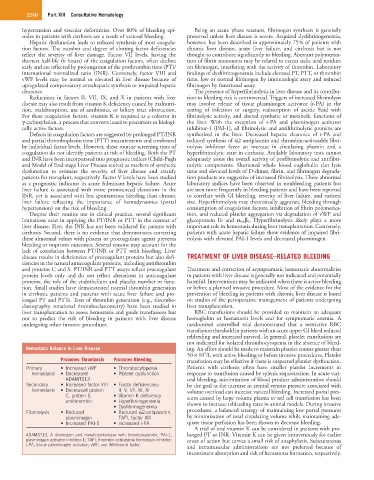
         Hemostatic Balance in Liver Disease                  ing. An effort should be made to maintain platelet counts greater than
                                                                    9
                                                              50 × 10 /L with active bleeding or before invasive procedures. Platelet
                     Promotes Thrombosis  Promotes Bleeding   transfusion may be effective if there is suspected platelet dysfunction.
          Primary    •  Increased vWF  •  Thrombocytopenia    Patients  with  cirrhosis  often  have  smaller  platelet  increments  in
           hemostasis  •  Decreased   •  Platelet dysfunction  response to transfusion caused by splenic sequestration. In acute vari-
                      ADAMTS13                                ceal bleeding, minimization of blood product administration should
          Secondary   •  Increased factor VIII  •  Factor deficiencies:    be the goal as the increase in central venous pressure associated with
           hemostasis  •  Decreased protein   II, V, VII, IX, XI  volume overload can increase variceal bleeding. Increased portal pres-
                      C, protein S,   •  Vitamin K deficiency  sures caused by large volume plasma or red cell transfusion has been
                      antithrombin    •  Hypofibrinogenemia   shown to increase rebleeding rates in animal models. During invasive
                                      •  Dysfibrinogenemia
          Fibrinolysis  •  Reduced    •  Reduced α2-antiplasmin,   procedures, a balanced strategy of maintaining low portal pressures
                      plasminogen       TAFI, factor XIII     by minimization of total circulating volume while maintaining ade-
                     •  Increased PAI-1  •  Increased t-PA    quate tissue perfusion has been shown to decrease bleeding.
                                                                 A trial of oral vitamin K can be considered in patients with pro-
         ADAMST13,  A  disintegrin  and  metalloproteinase  with  thrombospondin;  PAI-1,   longed PT or INR. Vitamin K can be given intravenously for earlier
         plasminogen activator inhibitor-1; TAFI, thrombin activatable fibrinolysis inhibitor;   onset of action but carries a small risk of anaphylaxis. Subcutaneous
         t-PA, tissue plasminogen activator; vWF, von Willebrand factor.  and  intramuscular  administrations  are  not  preferred  because  of
                                                              inconsistent absorption and risk of hematoma formation, respectively.

