


Page 2518 - Hematology_ Basic Principles and Practice ( PDFDrive )
P. 2518
Chapter 153  Hematologic Manifestations of Liver Disease  2241


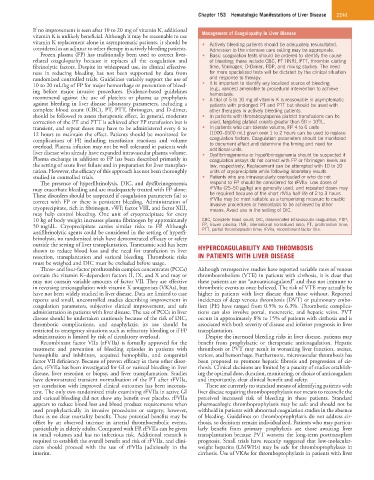
            If no improvement is seen after 10 to 20 mg of vitamin K, additional   Management of Coagulopathy in Liver Disease
            vitamin K is unlikely beneficial. Although it may be reasonable to use
            vitamin K replacement alone in asymptomatic patients, it should be   •  Actively bleeding patients should be adequately resuscitated.
            considered as an adjunct to other therapy in actively bleeding patients.  Admission to the intensive care setting may be appropriate.
              Frozen plasma (FP) has traditionally been used to correct liver-  •  Basic coagulation tests should be ordered to identify the cause
            related  coagulopathy  because  it  replaces  all  the  coagulation  and   of bleeding; these include CBC, PT (INR), PTT, thrombin clotting
            fibrinolytic factors. Despite its widespread use, its clinical effective-  time, fibrinogen, D-Dimer, FDP, and mixing studies. The need
            ness  in  reducing  bleeding  has  not  been  supported  by  data  from   for more specialized tests will be dictated by the clinical situation
            randomized controlled trials. Guidelines variably support the use of   and response to therapy.
            10 to 20 mL/kg of FP for major hemorrhage or prevention of bleed-  •  It is important to identify any localized source of bleeding
            ing  before  major  invasive  procedures.  Evidence-based  guidelines   (e.g., varices) amenable to procedural intervention to achieve
                                                                      hemostasis.
            recommend  against  the  use  of  platelets  or  plasma  as  prophylaxis   •  A trial of 5 to 10 mg of vitamin K is reasonable in asymptomatic
            against bleeding in liver disease laboratory parameters, including a   patients with prolonged PT and PTT but should be used with
            complete blood count (CBC), PT, PTT, fibrinogen, and D-dimer,   other therapies in actively bleeding patients.
            should be followed to assess therapeutic effect. In general, moderate   •  In patients with thrombocytopenia platelet transfusions can be
            correction of the PT and PTT is achieved after FP transfusion but is   used, targeting platelet counts greater than 50 × 10 /L.
                                                                                                         9
            transient, and repeat doses may have to be administered every 6 to   •  In patients who can tolerate volume, FP 4 to 6 units
            12 hours to maintain the effect. Patients should be monitored for   (1000–1500 mL) given over 1 to 2 hours can be used to replace
            complications  of  FP,  including  transfusion  reactions  and  volume   coagulation factors. Coagulation parameters should be monitored
            overload. Plasma infusion may not be well tolerated in patients with   to document effect and determine the timing and need for
                                                                      additional units.
            liver disease who already have expanded intravascular plasma volume.   •  Dysfibrinogenemia or hypofibrinogenemia should be suspected if
            Plasma exchange in addition to FP has been described primarily in   coagulation assays do not correct with FP or fibrinogen levels are
            the setting of acute liver failure and in preparation for liver transplan-  low, respectively. Replacement can be attempted with 10 to 20
            tation. However, the efficacy of this approach has not been thoroughly   units of cryoprecipitate while following laboratory results.
            studied in controlled trials.                          •  Patients who are intravascularly overloaded or who do not
              The  presence of hyperfibrinolysis,  DIC, and  dysfibrinogenemia   respond to FP should be considered for rFVIIa. Low doses of
            may exacerbate bleeding and are inadequately treated with FP alone.   rFVIIa (25–50 µg/kg) are generally used, and repeated doses may
            These disorders should be suspected if coagulation parameters fail to   be required because of the short rfVIIa half-life of 2 to 3 hours.
            correct  with  FP  or  there  is  persistent  bleeding.  Administration  of   rFVIIa may be most suitable as a temporizing measure to enable
                                                                      invasive procedures or hemostasis to be achieved by other
            cryoprecipitate, rich in fibrinogen, vWF, factor VIII, and factor XIII,   means. Avoid use in the setting of DIC.
            may  help  control  bleeding.  One  unit  of  cryoprecipitate  for  every
            10 kg of body weight increases plasma fibrinogen by approximately   CBC, Complete blood count; DIC, disseminated intravascular coagulation; FDP,
            50 mg/dL.  Cryoprecipitate  carries  similar  risks  to  FP.  Although   FP,  frozen  plasma;  INR,  international  normalized  ratio;  PT,  prothrombin  time;
            antifibrinolytic agents could be considered in the setting of hyperfi-  PTT, partial thromboplastin time; rFVIIa, recombinant factor VIIa.
            brinolysis, no randomized trials have demonstrated efficacy or safety
            outside the setting of liver transplantation. Tranexamic acid has been   HYPERCOAGULABILITY AND THROMBOSIS
            shown  to  reduce  blood  loss  and  the  need  for  transfusion  in  liver
            resection,  transplantation  and  variceal  bleeding.  Thrombotic  risks   IN PATIENTS WITH LIVER DISEASE
            must be weighed and DIC must be excluded before usage.
              Three- and four-factor prothrombin complex concentrates (PCCs)   Although retrospective studies have reported variable rates of venous
            contain the vitamin K–dependent factors II, IX, and X and may or   thromboembolism (VTE) in patients with cirrhosis, it is clear that
            may not contain variable amounts of factor VII. They are effective   these patients are not “autoanticoagulated” and thus not immune to
            in reversing anticoagulation with vitamin K antagonists (VKAs), but   thrombotic events as once believed. The risk of VTE may actually be
            have not been widely studied in liver disease. Data are limited to case   higher  in  patients  with  liver  disease  than  those  without.  Reported
            reports and small, uncontrolled studies describing improvement in   incidences of deep venous thrombosis (DVT) or pulmonary embo-
            coagulation  parameters,  subjective  clinical  improvement,  and  safe   lism (PE) have ranged from 0.5% to 6.3%. Thrombotic complica-
            administration in patients with liver disease. The use of PCCs in liver   tions  can  also  involve  portal,  mesenteric,  and  hepatic  veins.  PVT
            disease should be undertaken cautiously because of the risk of DIC,   occurs in approximately 8% to 15% of patients with cirrhosis and is
            thrombotic  complications,  and  anaphylaxis;  its  use  should  be   associated with both severity of disease and inferior prognosis in liver
            restricted to emergency situations such as refractory bleeding or if FP   transplantation.
            administration is limited by risk of circulatory overload.  Despite the increased bleeding risks in liver disease, patients may
              Recombinant factor VIIa (rFVIIa) is formally approved for the   benefit  from  prophylactic  or  therapeutic  anticoagulation.  Hepatic
            treatment  and  prevention  of  bleeding  episodes  in  patients  with   thrombosis or PVT may result in worsening liver function, ascites,
            hemophilia  and  inhibitors,  acquired  hemophilia,  and  congenital   varices, and hemorrhage. Furthermore, microvascular thrombosis has
            factor VII deficiency. Because of proven efficacy in these other disor-  been  proposed  to  promote  hepatic  fibrosis  and  progression  of  cir-
            ders, rFVIIa has been investigated for GI or variceal bleeding in liver   rhosis. Clinical decisions are limited by a paucity of studies establish-
            disease, liver resection or biopsy, and liver transplantation. Studies   ing the optimal dose, duration, monitoring, or choice of anticoagulant
            have demonstrated transient normalization of the PT after rFVIIa,   and importantly, clear clinical benefit and safety.
            yet correlation with improved clinical outcomes has been inconsis-  There are currently no standard means of identifying patients with
            tent. The only two randomized trials examining rFVIIa in active GI   liver disease requiring thromboprophylaxis nor means to reconcile the
            and variceal bleeding did not show any benefit over placebo. rFVIIa   perceived  increased  risk  of  bleeding  in  these  patients.  Standard
            appears to reduce blood loss and blood product requirements when   pharmacologic thromboprophylaxis may be safe and should not be
            used  prophylactically  in  invasive  procedures  or  surgery;  however,   withheld in patients with abnormal coagulation studies in the absence
            there is no clear mortality benefit. These potential benefits may be   of bleeding. Guidelines on thromboprophylaxis do not address cir-
            offset  by  an  observed  increase  in  arterial  thromboembolic  events,   rhosis, so decisions remain individualized. Patients who may particu-
            particularly in elderly adults. Compared with FP, rFVIIa can be given   larly  benefit  from  primary  prophylaxis  are  those  awaiting  liver
            in small volumes and has no infectious risk. Additional research is   transplantation because PVT worsens the long-term posttransplant
            required to establish the overall benefit and risk of rFVIIa, and clini-  prognosis. Small trials have recently suggested that low-molecular-
            cians  should  proceed  with  the  use  of  rFVIIa  judiciously  in  the     weight heparins (LMWHs) may be safe for thromboprophylaxis in
            interim.                                              cirrhosis. Use of VKAs for thromboprophylaxis in patients with liver

