


Page 2519 - Hematology_ Basic Principles and Practice ( PDFDrive )
P. 2519
2242   Part XIII  Consultative Hematology


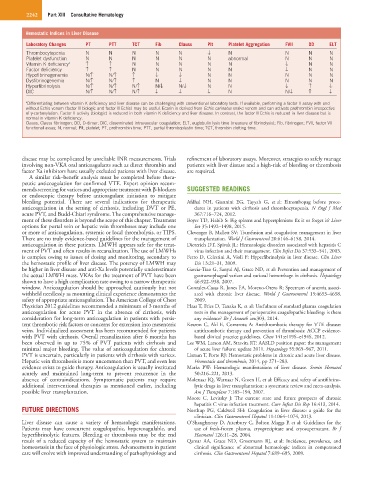
         Hemostatic Indices in Liver Disease
          Laboratory Changes  PT     PTT    TCT     Fib     Clauss   Plt    Platelet Aggregation  FVII  DD   ELT
          Thrombocytopenia   N       N      N       N      N         ↓      N                 N       N      N
          Platelet dysfunction  N    N      N       N      N         N      abnormal          N       N      N
          Vitamin K deficiency a  ↑  ↑      N       N       N        N      N                 ↓       N      N
          Factor deficiency  ↑       ↑      N       N      N         N      N                 ↓       N      N
          Hypofibrinogenemia  N/↑    N/↑    ↑       ↓      ↓         N      N                 N       N      N
          Dysfibrinogenemia  N/↑     N/↑    ↑       N      ↓         N      N                 N       N      N
          Hyperfibrinolysis  N/↑     N/↑    N/↑     N/↓    N/↓       N      N                 ↓       ↑      ↓
          DIC                N/↑     N/↑    N/↑     ↓      ↓         ↓      N                 N/↓     ↑      ↓
          a Differentiating between vitamin K deficiency and liver disease can be challenging with conventional laboratory tests. If available, performing a factor II assay with and
          without Echis venom (factor II biologic and factor II Echis) may be useful. Ecarin is derived from Echis carinatus snake venom and can activate prothrombin irrespective
          of γ-carboxylation. Factor II activity (biologic) is reduced in both vitamin K deficiency and liver disease. In contrast, the factor II Echis is reduced in liver disease but is
          normal in vitamin K deficiency.
          Clauss, Clauss fibrinogen; DD, D-dimer; DIC, disseminated intravascular coagulation; ELT, euglobulin lysis time (measure of fibrinolysis); Fib, fibrinogen; FVII, factor VII
          functional assay; N, normal; Plt, platelet; PT, prothrombin time; PTT, partial thromboplastin time; TCT, thrombin clotting time.


        disease may be complicated by unreliable INR measurements. Trials   refinement of laboratory assays. Moreover, strategies to safely manage
        involving non-VKA oral anticoagulants such as direct thrombin and   patients with liver disease and a high-risk of bleeding or thrombosis
        factor Xa inhibitors have usually excluded patients with liver disease.  are required.
           A similar risk–benefit analysis must be completed before thera-
        peutic anticoagulation for confirmed VTE. Expert opinion recom-
        mends screening for varices and appropriate treatment with β-blockers   SUGGESTED READINGS
        or  endoscopic  therapy  before  anticoagulant  initiation  to  mitigate
        bleeding  potential.  There  are  several  indications  for  therapeutic   Afdhal  NH,  Giannini  EG,  Tayyab  G,  et al:  Eltrombopag  before  proce-
        anticoagulation  in  the  setting  of  cirrhosis,  including  DVT  or  PE,   dures  in  patients  with  cirrhosis  and  thrombocytopenia.  N  Engl  J  Med
        acute PVT, and Budd-Chiari syndrome. The comprehensive manage-  367:716–724, 2012.
        ment of these disorders is beyond the scope of this chapter. Treatment   Boyer TD, Habib S: Big spleens and hypersplenism: fix it or forget it? Liver
        options for portal vein or hepatic vein thromboses may include one   Int 35:1492–1498, 2015.
        or more of anticoagulation, systemic or local thrombolysis, or TIPS.   Clevenger B, Mallett SV: Transfusion and coagulation management in liver
        There are no truly evidence-based guidelines for the management of   transplantation. World J Gastroenterol 20:6146–6158, 2014.
        anticoagulation in these patients. LMWH appears safe for the treat-  Dieterich DT, Spivak JL: Hematologic disorders associated with hepatitis C
        ment of PVT and often results in recanalization. The use of LMWHs   virus infection and their management. Clin Infect Dis 37:533–541, 2003.
        is complex owing to issues of dosing and monitoring, secondary to   Ferro D, Celestini A, Violi F: Hyperfibrinolysis in liver disease. Clin Liver
        the hemostatic profile of liver disease. The potency of LMWH may   Dis 13:21–31, 2009.
        be higher in liver disease and anti-Xa levels potentially underestimate   Garcia-Tsao G, Sanyal AJ, Grace ND, et al: Prevention and management of
        the actual LMWH mass. VKAs for the treatment of PVT have been   gastroesophageal varices and variceal hemorrhage in cirrhosis. Hepatology
        shown to have a high complication rate owing to a narrow therapeutic   46:922–938, 2007.
        window. Anticoagulation should be approached cautiously but not   Gonzalez-Casas R, Jones EA, Moreno-Otero R: Spectrum of anemia associ-
        withheld needlessly as mounting clinical experience demonstrates the   ated  with  chronic  liver  disease.  World  J  Gastroenterol  15:4653–4658,
        safety of appropriate anticoagulation. The American College of Chest   2009.
        Physician 2012 guidelines recommended a minimum of 3 months of   Haas T, Fries D, Tanaka K, et al: Usefulness of standard plasma coagulation
        anticoagulation  for  acute  PVT  in  the  absence  of  cirrhosis,  with   tests in the management of perioperative coagulopathic bleeding: is there
        consideration for long-term anticoagulation in patients with persis-  any evidence? Br J Anaesth aeu303, 2014.
        tent thrombotic risk factors or concerns for extension into mesenteric   Kearon  C,  Akl  E,  Comerota  A:  Antithrombotic  therapy  for VTE  disease:
        veins. Individualized assessment has been recommended for patients   antithrombotic therapy and prevention of thrombosis: ACCP evidence-
        with PVT with cirrhosis. Overall recanalization after 6 months has   based clinical practice guidelines. Chest 141:e419S–e494S, 2012.
        been  observed  in  up  to  75%  of  PVT  patients  with  cirrhosis  and   Lee WM, Larson AM, Stravitz RT: AASLD position paper: the management
        minimal major bleeding. The  value  of  anticoagulation  for chronic   of acute liver failure: update 2011. Hepatology 55:965–967, 2011.
        PVT is uncertain, particularly in patients with cirrhosis with varices.   Lisman T, Porte RJ: Hemostatic problems in chronic and acute liver disease.
        Hepatic vein thrombosis is more uncommon than PVT, and even less   Hemostasis and thrombosis, 2014, pp 271–283.
        evidence exists to guide therapy. Anticoagulation is usually instituted   Marks  PW:  Hematologic  manifestations  of  liver  disease.  Semin  Hematol
        acutely  and  maintained  long-term  to  prevent  recurrence  in  the   50:216–221, 2013.
        absence  of  contraindications.  Symptomatic  patients  may  require   Molenaar IQ, Warnaar N, Groen H, et al: Efficacy and safety of antifibrino-
        additional  interventional  therapies  as  mentioned  earlier,  including   lytic drugs in liver transplantation: a systematic review and meta-analysis.
        possible liver transplantation.                          Am J Transplant 7:185–194, 2007.
                                                              Moore  C,  Levitsky  J:  The  current  state  and  future  prospects  of  chronic
                                                                 hepatitis C virus infection treatment. Curr Infect Dis Rep 16:413, 2014.
        FUTURE DIRECTIONS                                     Northup  PG,  Caldwell  SH:  Coagulation  in  liver  disease:  a  guide  for  the
                                                                 clinician. Clin Gastroenterol Hepatol 11:1064–1074, 2013.
        Liver  disease  can  cause  a  variety  of  hematologic  manifestations.   O’Shaughnessy D, Atterbury C, Bolton Maggs P, et al: Guidelines for the
        Patients may have concurrent coagulopathic, hypercoagulable, and   use  of  fresh-frozen  plasma,  cryoprecipitate  and  cryosupernatant.  Br  J
        hyperfibrinolytic features.  Bleeding  or  thrombosis  may  be  the  end   Haematol 126:11–28, 2004.
        result  of  a  reduced  capacity  of  the  hemostatic  system  to  maintain   Qamar  AA,  Grace  ND,  Groszmann  RJ,  et al:  Incidence,  prevalence,  and
        homeostasis in the face of physiologic stress. Advancements in patient   clinical  significance  of  abnormal  hematologic  indices  in  compensated
        care will evolve with improved understanding of pathophysiology and   cirrhosis. Clin Gastroenterol Hepatol 7:689–695, 2009.

