


Page 2556 - Hematology_ Basic Principles and Practice ( PDFDrive )
P. 2556
Chapter 158  Hematologic Aspects of Parasitic Diseases  2279


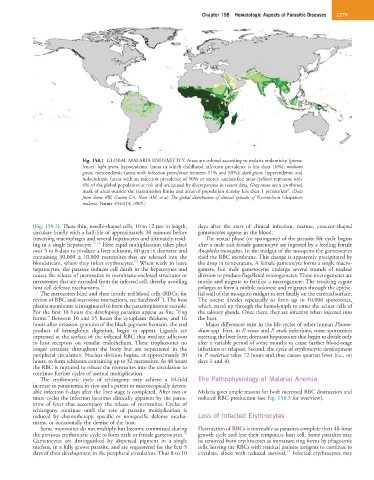
                            Fig. 158.1  GLOBAL MALARIA ENDEMICITY. Areas are colored according to malaria endemicity (preva-
                            lence): light green, hypoendemic (areas in which childhood infection prevalence is less than 10%); medium
                            green, mesoendemic (areas with infection prevalence between 11% and 50%); dark green, hyperendemic and
                            holoendemic (areas with an infection prevalence of 50% or more); unclassified areas (yellow) represent only
                            6% of the global population at risk and are caused by discrepancies in recent data. Gray areas are a combined
                                                                                               2
                            mask of areas outside the transmission limits and areas of population density less than 1 person/km . (Data
                            from Snow RW, Guerra CA, Noor AM, et al: The global distribution of clinical episodes of Plasmodium falciparum
                            malaria. Nature 434:214, 2005.)


            (Fig. 158.2). These thin, needle-shaped cells, 10 to 12 µm in length,   days  after  the  start  of  clinical  infection,  mature,  crescent-shaped
            circulate briefly with a half-life of approximately 30 minutes before   gametocytes appear in the blood.
            traversing macrophages and several hepatocytes and ultimately resid-  The sexual phase (or sporogony) of the parasite life cycle begins
            ing in a single hepatocyte. 11,12  Here rapid multiplication takes place   after a male and female gametocyte are ingested by a feeding female
            over 5 to 8 days to produce a liver schizont, 80 µm in diameter and   Anopheles mosquito. In the midgut of the mosquito the gametocytes
            containing  30,000  ±  10,000  merozoites  that  are  released  into  the   shed the RBC membrane. This change is apparently precipitated by
                                             13
            bloodstream, where they infect erythrocytes.  When ready to leave   the drop in temperature. A female gametocyte forms a single macro-
            hepatocytes, the parasite induces cell death in the hepatocytes and   gamete,  but  male  gametocytes  undergo  several  rounds  of  nuclear
            causes the release of merozoites in membrane-enclosed structures or   division to produce flagellated microgametes. These microgametes are
            merosomes that are extruded from the infected cell, thereby avoiding   motile and migrate to fertilize a macrogamete. The resulting zygote
            host cell defense mechanisms. 14                      enlarges to form a mobile ookinete and migrates through the epithe-
              The merozoites bind and then invade red blood cells (RBCs; for   lial wall of the mosquito midgut to rest finally on the external surface.
                                                     15
            review of RBC and merozoite interactions, see Satchwell ). The host   The  oocyst  divides  repeatedly  to  form  up  to  10,000  sporozoites,
            plasma membrane is invaginated to form the parasitophorous vacuole.   which travel up through the hemolymph to enter the acinar cells of
            For the first 10 hours the developing parasites appear as fine “ring   the salivary glands. Once there, they are infective when injected into
            forms.” Between 10 and 15 hours the cytoplasm thickens, and 16   the host.
            hours after invasion, granules of the black pigment hematin, the end   Major differences exist in the life cycles of other human Plasmo-
            product  of  hemoglobin  digestion,  begin  to  appear.  Ligands  are   dium spp. First, in P. vivax and P. ovale infections, some sporozoites
            expressed at the surface of the infected RBC that mediate adhesion   entering the liver form dormant hypnozoites that begin to divide only
            to  host  receptors  on  venular  endothelium.  These  trophozoites  no   after a variable period of some months to cause further blood-stage
            longer  circulate  throughout  the  body  but  are  sequestered  in  the   infections or relapses. Second, the cycle of erythrocytic development
            peripheral circulation. Nuclear division begins, at approximately 30   in P. malariae takes 72 hours and thus causes quartan fever (i.e., on
            hours, to form schizonts containing up to 32 merozoites. At 48 hours   days 1 and 4).
            the RBC is ruptured to release the merozoites into the circulation to
            continue further cycles of asexual multiplication.
              The  erythrocytic  cycle  of  schizogony  may  achieve  a  10-fold   The Pathophysiology of Malarial Anemia
            increase in parasitemia in vivo and a patent or microscopically detect-
            able infection 6 days after the liver stage is completed. After two or   Malaria gives ample reasons for both increased RBC destruction and
            more cycles the infection becomes clinically apparent by the parox-  reduced RBC production (see Fig. 158.3 for overview).
            ysms  of  fever  that  accompany  the  release  of  merozoites.  Cycles  of
            schizogony  continue  until  the  rate  of  parasite  multiplication  is
            reduced  by  chemotherapy,  specific  or  nonspecific  defense  mecha-  Loss of Infected Erythrocytes
            nisms, or occasionally the demise of the host.
              Some merozoites do not multiply but become committed during   Destruction of RBCs is inevitable as parasites complete their 48-hour
                                                             16
            the previous erythrocytic cycle to form male or female gametocytes.    growth cycle and lyse their temporary host cell. Some parasites may
            Gametocytes  are  distinguished  by  dispersed  pigment  in  a  single   be removed from erythrocytes as immature ring forms by phagocytic
            nucleus, in a fully grown parasite, and are sequestered for the first 5   cells, leaving the RBCs with residual parasite antigens to continue to
                                                                                               17
            days of their development in the peripheral circulation. Thus 8 to 10   circulate,  albeit  with  reduced  survival.   Infected  erythrocytes  may

