


Page 2558 - Hematology_ Basic Principles and Practice ( PDFDrive )
P. 2558
Chapter 158  Hematologic Aspects of Parasitic Diseases  2281


                                                               RSP2   Bone marrow sinusoid    Spleen
                                                                       Clearance of non-iRBC
                                                                                            MØ
                                                                      Clearance of iRBC
                                                                      RSP2 immune complexes
                                                                      Opsonization by specific Ab
                                                                                                  MØ
                                                                     Clearance of debris
                                                  iRBC and debris
                                                                                           Activation of MØ
                                                                          Pigment and GPI
                                                                          containing monocyte
                                                     Direct effect of                    Hz
                                                       parasite                       ++
                                                  –            Indirect effect by  ↑↑ TNF-α:IL-10
                                                               cytokines and  ↑ MIF
                                     +                   –   –  other mediators  ↓ IL-12
                                           +
                                +
                         Anemia    ↑↑ Epo
                         malaria infection
                                Erythropoiesis


                                KEY:    Reticulocyte  RBC   iRBC      iRBC
                                                                      Schizont stage
                                                            Ring stage
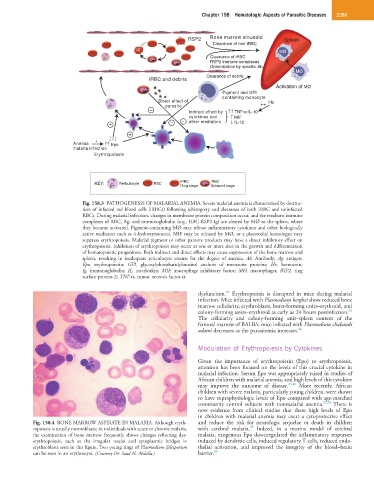
                            Fig. 158.3  PATHOGENESIS OF MALARIAL ANEMIA. Severe malarial anemia is characterized by destruc-
                            tion of infected red blood cells (iRBCs) following schizogony and clearance of both iRBC and uninfected
                            RBCs. During malarial infection, changes in membrane protein composition occur, and the resultant immune
                            complexes of RBC, Ag, and immunoglobulin (e.g., RBC-RSP2-Ig) are cleared by MØ to the spleen, where
                            they become activated. Pigment-containing MØ may release inflammatory cytokines and other biologically
                            active mediators such as 4-hydroxynonenal. MIF may be released by MØ, or a plasmodial homologue may
                            suppress erythropoiesis. Malarial pigment or other parasite products may have a direct inhibitory effect on
                            erythropoiesis. Inhibition of erythropoiesis may occur at one or more sites in the growth and differentiation
                            of hematopoietic progenitors. Both indirect and direct effects may cause suppression of the bone marrow and
                            spleen,  resulting  in  inadequate  reticulocyte  counts  for  the  degree  of  anemia.  Ab,  Antibody;  Ag,  antigen;
                            Epo,  erythropoietin;  GPI,  glycosylphosphatidylinositol  anchors  of  merozoite  proteins;  Hz,  hemozoin;
                            Ig,  immunoglobulin;  IL,  interleukin;  MIF,  macrophage  inhibitory  factor;  MØ,  macrophages;  RSP2,  ring
                            surface protein-2; TNF-α, tumor necrosis factor-α.

                                                                           42
                                                                  dysfunction.   Erythropoiesis  is  disrupted  in  mice  during  malarial
                                                                  infection. Mice infected with Plasmodium berghei show reduced bone
                                                                  marrow cellularity, erythroblasts, burst-forming units–erythroid, and
                                                                                                                   43
                                                                  colony-forming units–erythroid as early as 24 hours postinfection.
                                                                  The  cellularity  and  colony-forming  unit–spleen  content  of  the
                                                                  femoral marrow of BALB/c mice infected with Plasmodium chabaudi
                                                                  adami decreases as the parasitemia increases. 44

                                                                  Modulation of Erythropoiesis by Cytokines

                                                                  Given  the  importance  of  erythropoietin  (Epo)  to  erythropoiesis,
                                                                  attention has been focused on the levels of this crucial cytokine in
                                                                  malarial infection. Serum Epo was appropriately raised in studies of
                                                                  African children with malarial anemia, and high levels of this cytokine
                                                                  may  improve  the  outcome  of  disease. 45,46   More  recently,  African
                                                                  children with severe malaria, particularly young children, were shown
                                                                  to have supraphysiologic levels of Epo compared with age-matched
                                                                  community control subjects with nonmalarial anemia. 47,48  There is
                                                                  now  evidence  from  clinical  studies  that  these  high  levels  of  Epo
                                                                  in children with malarial anemia may exert a cytoprotective effect
            Fig. 158.4  BONE MARROW ASPIRATE IN MALARIA. Although eryth-  and  reduce  the  risk  for  neurologic  sequelae  or  death  in  children
                                                                                   49
            ropoiesis is usually normoblastic in individuals with acute or chronic malaria,   with  cerebral  malaria.   Indeed,  in  a  murine  model  of  cerebral
            the examination of bone marrow frequently shows changes reflecting dys-  malaria, exogenous Epo downregulated the inflammatory responses
            erythropoiesis,  such  as  the  irregular  nuclei  and  cytoplasmic  bridges  in   induced by dendritic cells, induced regulatory T cells, reduced endo-
            erythroblasts seen in this figure. Two young rings of Plasmodium falciparum   thelial  activation,  and  improved  the  integrity  of  the  blood–brain
            can be seen in an erythrocyte. (Courtesy Dr. Saad H. Abdalla.)  barrier. 50

