


Page 2557 - Hematology_ Basic Principles and Practice ( PDFDrive )
P. 2557
2280   Part XIII  Consultative Hematology

                                                              Role of the Spleen

               A                                    E         Some degree of splenomegaly is a normal feature of malarial infec-
                                                              tion,  and  the  prevalence  of  splenomegaly  in  regions  of  malarial
                                                              transmission  is  used  as  a  major  indicator  of  the  level  of  malarial
                                                              endemicity. The  importance  of  the  spleen  in  host  defense  against
                                                              malaria has been demonstrated in experimental systems, and indi-
               LIVER                                          viduals whose spleens have been surgically removed are thought to
                                                              be more susceptible to severe infection. Indeed, the phenomenon of
                                  B                D          parasitic  sequestration  is  thought  to  have  evolved  primarily  as  an
                                                              immune  evasion  strategy  so  the  mature  parasite  can  avoid  passing
                                                              through the spleen. 27
                                                                 Active  erythrophagocytosis  is  a  conspicuous  feature  within  the
                                                              bone marrow during P. vivax and P. falciparum malaria, 28,29  and it
                                  Asexual                     is highly probable that this also occurs within the spleen. Cytokines
                                  growth                      may  be  responsible  for  activating  macrophages  during  malarial
                                                              infection. Children with acute P. falciparum malaria have high cir-
                            C                                 culating levels of interferon-γ (IFN-γ) and tumor necrosis factor-α
                                                                     30
                                 Adhesion to                  (TNF-α),   a  synergistic  combination  of  cytokines  that  activates
                               endothelial and                macrophages.
                                other host cells                 Researchers in several studies have attempted to define the patho-
                                                              physiologic changes  in  the spleen  during  acute  malaria. In animal
                                                              models, malaria is accompanied by increased intravascular clearance
                                                                                                   31
                                                              of infected or rigid, heat-treated cells by the spleen,  as well as altera-
               KEY:                                                                      32
                                                              tions in the splenic microcirculation.  In studies of human malaria,
                    RBC  Merozoites  Ring  Trophozoites/      it has been found that increased splenic clearance of heated RBCs
                                           schizonts          occurs during acute attacks.  More recent, histologic studies and ex
                                                                                   33
                                                              vivo models of splenic function suggest that the spleen removes not
                                                              only  mature  infected  RBCs  but  also  uninfected  cells  marked  for
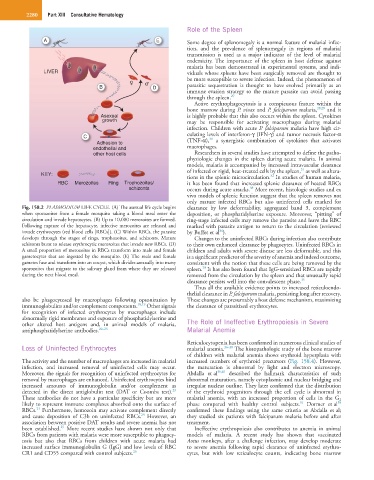
        Fig. 158.2  PLASMODIUM LIFE CYCLE. (A) The asexual life cycle begins   clearance  by  low  deformability,  aggregated  band  3,  complement
        when  sporozoites  from  a  female  mosquito  taking  a  blood  meal  enter  the   deposition,  or  phosphatidylserine  exposure.  Moreover,  “pitting”  of
        circulation and invade hepatocytes. (B) Up to 10,000 merozoites are formed.   ring-stage infected cells may remove the parasite and leave the RBC
        Following rupture of the hepatocyte, infective merozoites are released and   marked with parasite antigen to return to the circulation (reviewed
        invade erythrocytes (red blood cells [RBCs]). (C) Within RBCs, the parasite   by Buffet et al ).
                                                                         34
        develops  through  the  stages  of  rings,  trophozoites,  and  schizonts.  Mature   Changes to the uninfected RBCs during infection also contribute
        schizonts burst to release erythrocytic merozoites that invade new RBCs. (D)   to their own enhanced clearance by phagocytes. Uninfected RBCs in
        A small proportion of merozoites in RBCs transform into male and female   children and adults with severe disease are less deformable, and this
        gametocytes  that  are  ingested  by  the  mosquito.  (E) The  male  and  female   is a significant predictor of the severity of anemia and indeed outcome,
        gametes fuse and transform into an oocyst, which divides asexually into many   consistent with the notion that these cells are being removed by the
        sporozoites that migrate to the salivary gland from where they are released   spleen.  It has also been found that IgG-sensitized RBCs are rapidly
                                                                   20
        during the next blood meal.                           removed from the circulation by the spleen and that unusually rapid
                                                              clearance persists well into the convalescent phase. 35
                                                                 Thus all the available evidence points to increased reticuloendo-
                                                              thelial clearance in P. falciparum malaria, persisting long after recovery.
        also  be  phagocytosed  by  macrophages  following  opsonization  by   These changes are presumably a host defense mechanism, maximizing
        immunoglobulins and/or complement components. 18,19  Other signals   the clearance of parasitized erythrocytes.
        for  recognition  of  infected  erythrocytes  by  macrophages  include
        abnormally rigid membranes and exposure of phosphatidylserine and
        other  altered  host  antigens  and,  in  animal  models  of  malaria,   The Role of Ineffective Erythropoiesis in Severe
        antiphosphatidylserine antibodies. 20–23              Malarial Anemia
                                                              Reticulocytopenia has been confirmed in numerous clinical studies of
        Loss of Uninfected Erythrocytes                       malarial anemia. 36–38  The histopathologic study of the bone marrow
                                                              of children with malarial anemia shows erythroid hyperplasia with
        The activity and the number of macrophages are increased in malarial   increased  numbers  of  erythroid  precursors  (Fig.  158.4).  However,
        infection,  and  increased  removal  of  uninfected  cells  may  occur.   the  maturation  is  abnormal  by  light  and  electron  microscopy.
        Moreover, the signals for recognition of uninfected erythrocytes for   Abdalla  et al 39,40   described  the  hallmark  characteristics  of  such
        removal by macrophages are enhanced. Uninfected erythrocytes bind   abnormal maturation, namely cytoplasmic and nuclear bridging and
        increased  amounts  of  immunoglobulin  and/or  complement  as   irregular nuclear outline. They later confirmed that the distribution
                                                         23
        detected  in  the  direct  antiglobulin  test  (DAT  or  Coombs  test).    of  the  erythroid  progenitors  through  the  cell  cycle  is  abnormal  in
        These antibodies do not have a particular specificity but are more   malarial  anemia,  with  an  increased  proportion  of  cells  in  the  G 2
                                                                                                               38
                                                                                                   41
        likely to represent immune complexes absorbed onto the surface of   phase  compared  with  healthy  control  subjects.   Dormer  et al
             23
        RBCs.  Furthermore, hemozoin may activate complement directly   confirmed  these  findings  using  the  same  criteria  as  Abdalla  et al;
                                               24
        and  cause  deposition  of  C3b  on  uninfected  RBCs.   However,  an   they  studied  six  patients  with  falciparum  malaria  before  and  after
        association between positive DAT results and severe anemia has not   treatment.
                     25
        been  established.   More  recent  studies  have  shown  not  only  that   Ineffective  erythropoiesis  also  contributes  to  anemia  in  animal
        RBCs from patients with malaria were more susceptible to phagocy-  models  of  malaria.  A  recent  study  has  shown  that  vaccinated
        tosis  but  also  that  RBCs  from  children  with  acute  malaria  had   Aotus  monkeys,  after a  challenge  infection, may  develop  moderate
        increased surface immunoglobulin G (IgG) and low levels of RBC   to  severe  anemia  following  rapid  clearance  of  uninfected  erythro-
        CR1 and CD55 compared with control subjects. 26       cytes,  but  with  low  reticulocyte  counts,  indicating  bone  marrow

