


Page 2561 - Hematology_ Basic Principles and Practice ( PDFDrive )
P. 2561
2284   Part XIII  Consultative Hematology


        suggesting that the inhibition and abnormal maturation of erythroid   Treatment for HMS is lifelong antimalarial prophylaxis. Signs and
        precursors  may  have  somewhat  differing  etiologies  in  acute  and   symptoms usually subside over 1 to 2 years, but relapse may occur if
        chronic infection. 39                                 antimalarial therapy ceases. Splenectomy is contraindicated because
           The  role  of  hematinic  deficiency  in  children  presenting  with   it is technically difficult, with considerable intra-operative mortality,
        malaria and anemia may be difficult to assess. The relative importance   and it may predispose to severe infection.
        of absolute and functional iron deficiency have not been defined. Iron
        will not be absorbed during acute infection, because hepcidin levels
        are  raised. 54,55   Nevertheless,  many  hospitals  give  a  course  of  iron   Anemia and P. vivax, P. ovale, and
        supplementation  after  an  episode  of  acute  malaria,  although  no   P. malariae Infection
        general  guidelines  have  been  established.  Chronic  hemolysis  may
        increase folate requirements, but frank deficiency is uncommon in   In P. vivax and P. ovale malaria, high parasitemias are rare because
                                                     47
        children presenting with acute malaria, at least in East Africa.  Folate   invasion of erythrocytes is limited to reticulocytes. However, there is
        deficiency may be more common in West Africa, and protocols for   an emerging consensus that P. vivax monoinfection may cause severe
        folate supplementation after malaria must reflect local experience.  disease  with  cerebral  malaria  and/or  anemia  (for  review,  see  Price
                                                                 104
                                                              et al ). The vivax-infected RBC can adhere to host cells, but seques-
                                                              tration in the peripheral circulation and organ-specific syndromes of
        Malarial Anemia in Pregnancy                          disease are much less common than in falciparum malaria.
                                                                 P.  vivax  malaria  has  been  associated  with  anemia  during  preg-
        Pregnancy  is  accompanied  by  a  series  of  physiologic  changes  that   nancy  and  with  low  birth  weight  of  children  of  affected  mothers.
        predispose  not  only  to  anemia  but  also  to  malaria.  Hemodilution   Here  cytokines  or  other  inflammatory  mediators  appear  to  cause
                                                                              105
        causes a physiologic decrease in hemoglobin. Moreover, the demand   placental dysfunction.  P. malariae infection is also rarely fatal but
        for both iron and folate increases as the fetus grows and often pre-  is  distinguished  by  the  persistence  of  blood-stage  parasites  for  up
        cipitates frank folate or iron deficiency, particularly in multigravid   to 40 years. It can, however, cause a progressive and fatal nephrotic
        women.                                                syndrome. 106
           Occult malarial infection, often without fever, may cause anemia
        and placental dysfunction. This effect is greatest in primigravidas and
        has  been  attributed  to  the  adhesion  of  parasitized  erythrocytes  to   Malaria Diagnosis
        chondroitin  sulfate  A  and  hyaluronic  acid  in  the  placenta 97,98   (for
                            99
        review,  see  Rogerson  et al ).  Fetal  growth  is  impaired,  and  babies   The diagnosis of malaria is based on the identification of circulating
        born to women with placental malaria are, on average, 100 g lighter   blood-stage parasites. The standard methods of preparing thick and
        than those born to women without malaria. The subsequent contri-  thin films are straightforward and allow a simple method to diagnose
                                              100
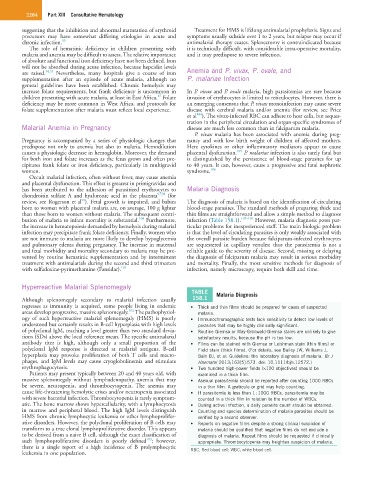
        bution of malaria to infant mortality is substantial.  Furthermore,   infection (Table 158.1). 107–109  However, malaria diagnosis poses par-
        the increase in hematopoiesis demanded by hemolysis during malarial   ticular problems for inexperienced staff. The main biologic problem
        infection may precipitate frank folate deficiency. Finally, women who   is that the level of circulating parasites is only weakly associated with
        are not immune to malaria are more likely to develop hypoglycemia   the overall parasite burden because falciparum-infected erythrocytes
        and pulmonary edema during pregnancy. The increase in maternal   are  sequestered  in  capillary  venules;  thus  the  parasitemia  is  not  a
        and fetal morbidity and mortality secondary to malaria may be pre-  reliable guide to the severity of disease. Second, missing or delaying
        vented  by  routine  hematinic  supplementation  and  by  intermittent   the diagnosis of falciparum malaria may result in serious morbidity
        treatment with antimalarials during the second and third trimesters   and mortality. Finally, the most sensitive methods for diagnosis of
        with sulfadoxine-pyrimethamine (Fansidar). 101        infection, namely microscopy, require both skill and time.


        Hyperreactive Malarial Splenomegaly
                                                                TABLE   Malaria Diagnosis
        Although  splenomegaly  secondary  to  malarial  infection  usually   158.1
        regresses  as  immunity  is  acquired,  some  people  living  in  endemic   •  Thick and thin films should be prepared for cases of suspected
                                           102
        areas develop progressive, massive splenomegaly.  The pathophysiol-  malaria.
        ogy  of  such  hyperreactive  malarial  splenomegaly  (HMS)  is  poorly   •  Immunochromographic tests lack sensitivity to detect low levels of
        understood but certainly results in B-cell hyperplasia with high levels   parasites that may be highly clinically significant.
        of polyclonal IgM, reaching a level greater than two standard devia-  •  Routine Giemsa or May-Grünwald-Giemsa stains are unlikely to give
        tions (SDs) above the local reference mean. The specific antimalarial   satisfactory results, because the pH is too low.
        antibody  titer  is  high,  although  only  a  small  proportion  of  the   •  Films can be stained with Giemsa or Leishman stain (thin films) or
        polyclonal  IgM  response  is  directed  at  malarial  antigens.  B-cell   Field stain (thick films). (For details, see Bailey JW, Williams J,
        hyperplasia  may  provoke  proliferation  of  both T  cells  and  macro-  Bain BJ, et al: Guideline: the laboratory diagnosis of malaria. Br J
        phages, and IgM levels may cause cryoglobulinemia and stimulate   Haematol 2013;163[5]:573. doi: 10.1111/bjh.12572.)
        erythrophagocytosis.                                   •  Two hundred high-power fields (×100 objectives) should be
           Patients may present typically between 20 and 40 years old, with   examined in a thick film.
        massive splenomegaly without lymphadenopathy, anemia that may   •  Asexual parasitemia should be reported after counting 1000 RBCs
        be  severe,  neutropenia,  and  thrombocytopenia.  The  anemia  may   in a thin film. A graticule or grid may help counting.
        cause life-threatening hemolytic crises and/or neutropenia associated   •  If parasitemia is less than 1 : 1000 RBCs, parasitemia may be
        with severe bacterial infection. Thrombocytopenia is rarely symptom-  counted in a thick film in relation to the number of WBCs.
        atic. The bone marrow shows hypercellularity, with a lymphocytosis   •  During active infection, a daily parasite count should be obtained.
        in  marrow  and  peripheral  blood. The  high  IgM  levels  distinguish   •  Counting and species determination of malaria parasites should be
        HMS from chronic lymphocytic leukemia or other lymphoprolifer-  verified by a second observer.
        ative disorders. However, the polyclonal proliferation of B cells may   •  Reports on negative films despite a strong clinical suspicion of
        transform to a true clonal lymphoproliferative disorder. This appears   malaria should be qualified that negative films do not exclude a
        to be derived from a naive B cell, although the exact classification of   diagnosis of malaria. Repeat films should be requested if clinically
                                                 103
        such  lymphoproliferative  disorders  is  poorly  defined ;  however,   appropriate. Thrombocytopenia may heighten suspicion of malaria.
        there  is  a  single  report  of  a  high  incidence  of  B  prolymphocytic   RBC, Red blood cell; WBC, white blood cell.
        leukemia in one population.

