


Page 2617 - Hematology_ Basic Principles and Practice ( PDFDrive )
P. 2617
2330   Part XIII  Consultative Hematology


        CLINICAL MANIFESTATIONS                               DIFFERENTIAL DIAGNOSIS

        In  the  industrialized  countries,  the  detection  of  cytopenias  is   It is important to distinguish true and clinically important findings
        often  encountered  after  routine  laboratory  testing  or  accompanies   from false or transiently low values by having serial blood counts and/
        minor  or  nonspecific  symptoms.  Especially  for  anemia,  one  may   or a review of the peripheral smear.
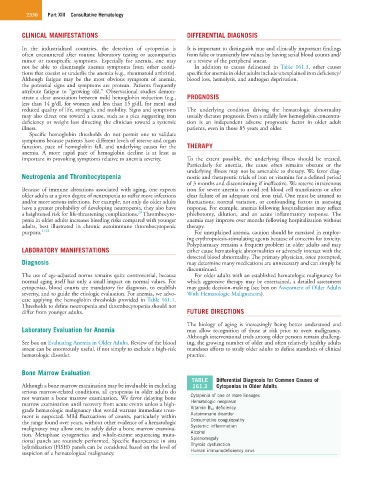
        not  be  able  to  disentangle  anemia  symptoms  from  other  condi-  In  addition  to  causes  delineated  in  Table  161.3,  other  causes
        tions that coexist or underlie the anemia (e.g., rheumatoid arthritis).   specific for anemia in older adults include unexplained iron deficiency/
        Although  fatigue  may  be  the  most  obvious  symptom  of  anemia,   blood loss, hemolysis, and androgen deprivation.
        the  potential  signs  and  symptoms  are  protean.  Patients  frequently
        attribute  fatigue  to  “growing  old.”  Observational  studies  demon-
        strate a clear association between mild hemoglobin reduction (e.g.,   PROGNOSIS
        less than 14 g/dL for women and less than 15 g/dL for men) and
        reduced quality of life, strength, and mobility. Signs and symptoms   The  underlying  condition  driving  the  hematologic  abnormality
        may also direct one toward a cause, such as a pica suggesting iron   usually dictates prognosis. Even a mildly low hemoglobin concentra-
        deficiency  or  weight  loss  directing  the  clinician  toward  a  systemic     tion  is  an  independent  adverse  prognostic  factor  in  older  adult
        illness.                                              patients, even in those 85 years and older.
           Specific  hemoglobin  thresholds  do  not  permit  one  to  validate
        symptoms because patients have different levels of reserve and organ
        function,  pace  of  hemoglobin  fall,  and  underlying  causes  for  the   THERAPY
        anemia.  A  more  rapid  pace  of  hemoglobin  decline  is  at  least  as
        important in provoking symptoms relative to anemia severity.  To  the  extent  possible,  the  underlying  illness  should  be  treated.
                                                              Particularly  for  anemia,  the  cause  often  remains  obscure  or  the
                                                              underlying illness may not be amenable to therapy. We favor diag-
        Neutropenia and Thrombocytopenia                      nostic and therapeutic trials of iron or vitamins for a defined period
                                                              of 3 months and discontinuing if ineffective. We reserve intravenous
        Because  of  immune  alterations  associated  with  aging,  one  expects   iron for severe anemia to avoid red blood cell transfusions or after
        older adults at a given degree of neutropenia to suffer more infections   clear failure of an adequate oral iron trial. One must be attuned to
        and/or more serious infections. For example, not only do older adults   fluctuations,  normal  variation,  or  confounding  factors  in  assessing
        have a greater probability of developing neutropenia, they also have   response. For example, anemia following hospitalization may reflect
                                              20
        a heightened risk for life-threatening complications.  Thrombocyto-  phlebotomy,  dilution,  and  an  acute  inflammatory  response.  The
        penia in older adults increases bleeding risks compared with younger   anemia may improve over months following hospitalization without
        adults,  best  illustrated  in  chronic  autoimmune  thrombocytopenic   therapy.
        purpura. 21,22                                           For unexplained anemia, caution should be exercised in employ-
                                                              ing erythropoiesis-stimulating agents because of concerns for toxicity.
                                                              Polypharmacy remains a frequent problem in older adults and may
        LABORATORY MANIFESTATIONS                             either cause hematologic abnormalities or adversely interact with the
                                                              detected blood abnormality. The primary physician, once prompted,
        Diagnosis                                             may determine many medications are unnecessary and can simply be
                                                              discontinued.
        The use of age-adjusted norms remains quite controversial, because   For older adults with an established hematologic malignancy for
        normal aging itself has only a small impact on normal values. For   which aggressive therapy may be entertained, a detailed assessment
        cytopenias, blood counts are mandatory for diagnosis, to establish   may guide decision-making (see box on Assessment of Older Adults
        severity, and to guide the etiologic evaluation. For anemia, we advo-  With Hematologic Malignancies).
        cate applying the hemoglobin thresholds provided in Table 161.1.
        Thresholds to define neutropenia and thrombocytopenia should not
        differ from younger adults.                           FUTURE DIRECTIONS

                                                              The  biology  of  aging  is  increasingly  being  better  understood  and
        Laboratory Evaluation for Anemia                      may  allow  recognition  of  those  at  risk  prior  to  overt  malignancy.
                                                              Although interventional trials among older persons remain challeng-
        See box on Evaluating Anemia in Older Adults. Review of the blood   ing, the growing number of older and often relatively healthy adults
        smear can be enormously useful, if not simply to exclude a high-risk   mandates efforts to study older adults to define standards of clinical
        hematologic disorder.                                 practice.

        Bone Marrow Evaluation
                                                                TABLE   Differential Diagnosis for Common Causes of
        Although a bone marrow examination may be invaluable in excluding   161.3  Cytopenias in Older Adults
        serious marrow-related conditions, all cytopenias in older adults do
        not warrant a bone marrow examination. We favor delaying bone   Cytopenia of one or more lineages
        marrow examination until recovery from acute events unless a high-  Hematologic neoplasm
        grade hematologic malignancy that would warrant immediate treat-  Vitamin B 12  deficiency
        ment is suspected. Mild fluctuations of counts, particularly within   Autoimmune disorder
        the range found over years, without other evidence of a hematologic   Consumptive coagulopathy
        malignancy may allow one to safely defer a bone marrow examina-  Systemic inflammation
        tion.  Metaphase  cytogenetics  and  whole-exome  sequencing  muta-  Alcohol
        tional panels are routinely performed. Specific fluorescence in situ   Splenomegaly
        hybridization (FISH) panels can be considered based on the level of   Thyroid dysfunction
        suspicion of a hematological malignancy.               Human immunodeficiency virus

