


Page 2622 - Hematology_ Basic Principles and Practice ( PDFDrive )
P. 2622
Chapter 162  Resources for the Hematologist  e3


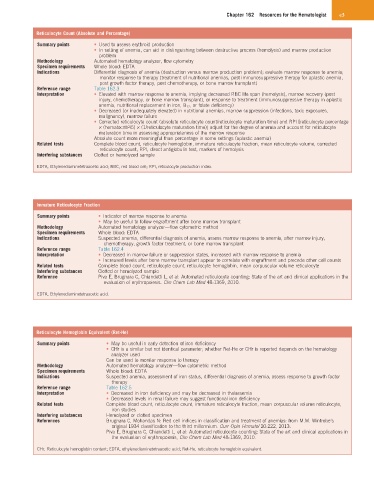
             Reticulocyte Count (Absolute and Percentage)
             Summary points     •  Used to assess erythroid production
                                •  In setting of anemia, can aid in distinguishing between destructive process (hemolysis) and marrow production
                                 problem
             Methodology        Automated hematology analyzer, flow cytometry
             Specimen requirements  Whole blood: EDTA
             Indications        Differential diagnosis of anemia (destruction versus marrow production problem); evaluate marrow response to anemia;
                                  monitor response to therapy (treatment of nutritional anemias, post immunosuppressive therapy for aplastic anemia,
                                  post growth factor therapy, post chemotherapy, or bone marrow transplant)
             Reference range    Table 162.3
             Interpretation     •  Elevated with marrow response to anemia, implying decreased RBC life span (hemolysis), marrow recovery (post
                                 injury, chemotherapy, or bone marrow transplant), or response to treatment (immunosuppressive therapy in aplastic
                                 anemia, nutritional replacement in iron, B 12 , or folate deficiency)
                                •  Decreased (or inadequately elevated) in nutritional anemias, marrow suppression (infections, toxic exposures,
                                 malignancy), marrow failure
                                •  Corrected reticulocyte count (absolute reticulocyte count/reticulocyte maturation time) and RPI [reticulocyte percentage
                                 × (hematocrit/45) × (1/reticulocyte maturation time)] adjust for the degree of anemia and account for reticulocyte
                                 maturation time in assessing appropriateness of the marrow response
                                Absolute count more meaningful than percentage in some settings (aplastic anemia)
             Related tests      Complete blood count, reticulocyte hemoglobin, immature reticulocyte fraction, mean reticulocyte volume, corrected
                                  reticulocyte count, RPI, direct antiglobulin test, markers of hemolysis
             Interfering substances  Clotted or hemolyzed sample
             EDTA, Ethylenediaminetetraacetic acid; RBC, red blood cell; RPI, reticulocyte production index.


             Immature Reticulocyte Fraction
             Summary points      •  Indicator of marrow response to anemia
                                 •  May be useful to follow engraftment after bone marrow transplant
             Methodology         Automated hematology analyzer—flow cytometric method
             Specimen requirements  Whole blood: EDTA
             Indications         Suspected anemia, differential diagnosis of anemia, assess marrow response to anemia, after marrow injury,
                                   chemotherapy, growth factor treatment, or bone marrow transplant
             Reference range     Table 162.4
             Interpretation      •  Decreased in marrow failure or suppression states, increased with marrow response to anemia
                                 •  Increased levels after bone marrow transplant appear to correlate with engraftment and precede other cell counts
             Related tests       Complete blood count, reticulocyte count, reticulocyte hemoglobin, mean corpuscular volume reticulocyte
             Interfering substances  Clotted or hemolyzed sample
             Reference           Piva E, Brugnara C, Chiandetti L, et al: Automated reticulocyte counting: State of the art and clinical applications in the
                                   evaluation of erythropoiesis. Clin Chem Lab Med 48:1369, 2010.
             EDTA, Ethylenediaminetetraacetic acid.


             Reticulocyte Hemoglobin Equivalent (Ret-He)
             Summary points         •  May be useful in early detection of iron deficiency
                                    •  CHr is a similar but not identical parameter; whether Ret-He or CHr is reported depends on the hematology
                                     analyzer used
                                    Can be used to monitor response to therapy
             Methodology            Automated hematology analyzer—flow cytometric method
             Specimen requirements  Whole blood: EDTA
             Indications            Suspected anemia, assessment of iron status, differential diagnosis of anemia, assess response to growth factor
                                      therapy
             Reference range        Table 162.5
             Interpretation         •  Decreased in iron deficiency and may be decreased in thalassemia
                                    •  Decreased levels in renal failure may suggest functional iron deficiency
             Related tests          Complete blood count, reticulocyte count, immature reticulocyte fraction, mean corpuscular volume reticulocyte,
                                      iron studies
             Interfering substances  Hemolyzed or clotted specimen
             References             Brugnara C, Mohandas N: Red cell indices in classification and treatment of anemias: from M.M. Wintrobe’s
                                      original 1934 classification to the third millennium. Curr Opin Hematol 20:222, 2013.
                                    Piva E, Brugnara C, Chiandetti L, et al: Automated reticulocyte counting: State of the art and clinical applications in
                                      the evaluation of erythropoiesis, Clin Chem Lab Med 48:1369, 2010.

             CHr, Reticulocyte hemoglobin content; EDTA, ethylenediaminetetraacetic acid; Ret-He, reticulocyte hemoglobin equivalent.

