


Page 2612 - Hematology_ Basic Principles and Practice ( PDFDrive )
P. 2612
Chapter 160  The Spleen and Its Disorders  2325


            enter the bloodstream and would ordinarily be removed by splenic   may be related to subsequent thrombocytosis that leads to enhance-
            macrophages are able to evade recognition by macrophages whose Fc   ment of plaque formation. Statistically, the increased risk for athero-
            and C3b receptors appear to be less avid than those of splenic mac-  sclerosis is not particularly high, but for individuals with other risk
            rophages. Circulation of the blood through the liver and lung is more   factors such as hypertension, diabetes, high levels of cholesterol or
            rapid  than  through  the  spleen,  and  there  is  little  opportunity  for   homocysteine, heterozygous protein C or S deficiency, or factor V
            macrophages to recognize organisms with surfaces containing little   Leiden, splenectomy may pose a more significant risk. Although no
            IgG and only small amounts of C3bi. The important filtration func-  human data are currently available in this area, some studies have
            tion of the venous sinus endothelial cells is absent following splenec-  suggested that the spleen might be involved in lipid metabolism in
            tomy. The generation of cytokines, including TNF-α and bacterial   both rats and rabbits.
            endotoxins, leads to cardiovascular collapse and shock. It is difficult
            to rescue an asplenic patient once shock develops, even with effective
            antibiotic  therapy.  The  risk  that  this  will  happen  varies  with  the   Prevention of Complications
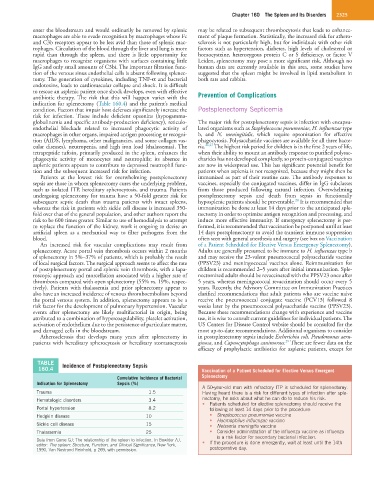
            indication for splenectomy (Table 160.4) and the patient’s medical
            condition. Factors that impair host defenses significantly increase the   Postsplenectomy Septicemia
            risk  for  infection. These  include  deficient  opsonins  (hypogamma-
            globulinemia and specific antibody-production deficiency), reticulo-  The major risk for postsplenectomy sepsis is infection with encapsu-
            endothelial  blockade  related  to  increased  phagocytic  activity  of   lated organisms such as Staphylococcus pneumoniae, H. influenzae type
            macrophages in other organs, impaired antigen processing or recogni-  b,  and  N.  meningitidis,  which  require  opsonization  for  effective
            tion (AIDS, lymphoma, other malignancies, and some collagen vas-  phagocytosis. Polysaccharide vaccines are available for all three bacte-
            cular diseases), neutropenia, and high iron load (thalassemia). The   ria. 26,27  The highest risk period for children is in the first 2 years of life,
            tetrapeptide tuftsin, primarily produced in the spleen, enhances the   when their ability to mount an antibody response to purified polysac-
            phagocytic  activity  of  monocytes  and  neutrophils;  its  absence  in   charides has not developed completely, so protein-conjugated vaccines
            asplenic patients appears to contribute to depressed neutrophil func-  are now in widespread use. This has significant potential benefit for
            tion and the subsequent increased risk for infection.  patients when asplenia is not recognized, because they might then be
              Patients  at  the  lowest  risk  for  overwhelming  postsplenectomy   immunized as part of their routine care. The antibody responses to
            sepsis are those in whom splenectomy cures the underlying problem,   vaccines, especially the conjugated vaccines, differ in IgG subclasses
            such as isolated ITP, hereditary spherocytosis, and trauma. Patients   from  those  produced  following  natural  infection.  Overwhelming
            undergoing splenectomy for trauma have a 50-fold greater risk for   postsplenectomy  sepsis  and  death  from  sepsis  in  functionally
                                                                                                  28
            subsequent  septic  death  than  trauma  patients  with  intact  spleens,   hyposplenic patients should be preventable.  It is recommended that
            whereas the risk in patients with sickle cell disease is increased 350-  immunization be done at least 14 days prior to the anticipated sple-
            fold over that of the general population, and other authors report the   nectomy in order to optimize antigen recognition and processing, and
            risk to be 600 times greater. Similar to use of hemodialysis to attempt   induce more effective immunity. If emergency splenectomy is per-
            to replace the function of the kidney, work is ongoing to devise an   formed, it is recommended that vaccination be postponed until at least
            artificial  spleen  as  a  mechanical  way  to  filter  pathogens  from  the   14 days postsplenectomy to avoid the transient immune suppression
            blood.                                                often seen with general anesthesia and surgery (see box on Vaccination
              An  increased  risk  for  vascular  complications  may  result  from   of a Patient Scheduled for Elective Versus Emergency Splenectomy).
            splenectomy. Acute portal vein thrombosis occurs within 2 months   Adults are generally presumed to be immune to H. influenzae type b
            of splenectomy in 5%–37% of patients, which is probably the result   and may receive the 23-valent pneumococcal polysaccharide vaccine
            of local surgical factors. The surgical approach seems to affect the rate   (PPSV23) and meningococcal vaccines alone. Reimmunization for
            of postsplenectomy portal and splenic vein thrombosis, with a lapa-  children is recommended 2–5 years after initial immunization. Sple-
            roscopic approach and morcellation associated with a higher rate of   nectomized adults should be revaccinated with the PPSV23 once after
            thrombosis compared with open splenectomy (55% vs. 19%, respec-  5 years, whereas meningococcal revaccination should occur every 5
            tively).  Patients  with  thalassemia  and  prior  splenectomy  appear  to   years. Recently, the Advisory Committee on Immunization Practices
            also have an increased incidence of venous thromboembolism beyond   clarified recommendations that adult patients who are vaccine naive
            the portal venous system. In addition, splenectomy appears to be a   receive  the  pneumococcal  conjugate  vaccine  (PCV13)  followed  8
            risk factor for the development of pulmonary hypertension. Vascular   weeks later by the pneumococcal polysaccharide vaccine (PPSV23).
            events  after  splenectomy  are  likely  multifactorial  in  origin,  being   Because these recommendations change with experience and vaccine
            attributed to a combination of hypercoagulability, platelet activation,   use, it is wise to consult current guidelines for individual patients. The
            activation of endothelium due to the persistence of particulate matter,   US Centers for Disease Control website should be consulted for the
            and damaged cells in the bloodstream.                 most up-to-date recommendations. Additional organisms to consider
              Atherosclerosis  that  develops  many  years  after  splenectomy  in   in postsplenectomy sepsis include Escherichia coli, Pseudomonas aeru-
                                                                                              29
            patients  with  hereditary  spherocytosis  or  hereditary  stomatocytosis   ginosa, and Capnocytophaga canimorsus.  There are fewer data on the
                                                                  efficacy of prophylactic antibiotics for asplenic patients, except for
             TABLE   Incidence of Postsplenectomy Sepsis
              160.4                                                Vaccination of a Patient Scheduled for Elective Versus Emergent
                                       Cumulative Incidence of Bacterial   Splenectomy
             Indication for Splenectomy  Sepsis (%)
                                                                   A 50-year-old man with refractory ITP is scheduled for splenectomy.
             Trauma                               1.5              Having heard there is a risk for different types of infection after sple-
             Hematologic disorders                3.4              nectomy, he asks about what he can do to reduce his risk.
                                                                   •  Patients scheduled for elective splenectomy should receive the
             Portal hypertension                  8.2                 following at least 14 days prior to the procedure:
             Hodgkin disease                     10                   •  Streptococcus pneumoniae vaccine
                                                                      •  Haemophilus influenzae vaccine
             Sickle cell disease                 15                   •  Neisseria meningitis vaccine
             Thalassemia                         25                   •  Consider administration of the influenza vaccine as influenza
                                                                        is a risk factor for secondary bacterial infection.
             Data from Gorse GJ: The relationship of the spleen to infection. In Bowlder AJ,   •  If the procedure is done emergently, wait at least until the 14th
             editor: The spleen: Structure, Function, and Clinical Significance, New York,
             1990, Van Nostrand Reinhold, p 269, with permission.     postoperative day.

