


Page 2623 - Hematology_ Basic Principles and Practice ( PDFDrive )
P. 2623
e4    Part XIII  Consultative Hematology


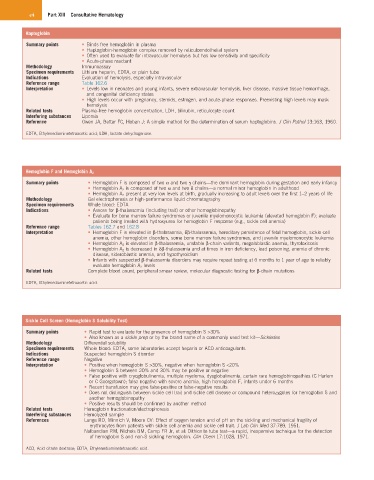
         Haptoglobin
          Summary points    •  Binds free hemoglobin in plasma
                            •  Haptoglobin-hemoglobin complex removed by reticuloendothelial system
                            •  Often used to evaluate for intravascular hemolysis but has low sensitivity and specificity
                            •  Acute-phase reactant
          Methodology       Immunoassay
          Specimen requirements  Lithium heparin, EDTA, or plain tube
          Indications       Evaluation of hemolysis, especially intravascular
          Reference range   Table 162.6
          Interpretation    •  Levels low in neonates and young infants, severe extravascular hemolysis, liver disease, massive tissue hemorrhage,
                             and congenital deficiency states
                            •  High levels occur with pregnancy, steroids, estrogen, and acute-phase responses. Preexisting high levels may mask
                             hemolysis
          Related tests     Plasma-free hemoglobin concentration, LDH, bilirubin, reticulocyte count
          Interfering substances  Lipemia
          Reference         Owen JA, Better FC, Hoban J: A simple method for the determination of serum haptoglobins. J Clin Pathol 13:163, 1960.

          EDTA, Ethylenediaminetetraacetic acid; LDH, lactate dehydrogenase.


         Hemoglobin F and Hemoglobin A 2
          Summary points      •  Hemoglobin F is composed of two α and two γ chains—the dominant hemoglobin during gestation and early infancy
                              •  Hemoglobin A 2 is composed of two α and two δ chains—a normal minor hemoglobin in adulthood
                              •  Hemoglobin A 2 present at very low levels at birth, gradually increasing to adult levels over the first 1–2 years of life
          Methodology         Gel electrophoresis or high-performance liquid chromatography
          Specimen requirements  Whole blood: EDTA
          Indications         •  Assess for β-thalassemia (including trait) or other hemoglobinopathy
                              •  Evaluate for bone marrow failure syndromes or juvenile myelomonocytic leukemia (elevated hemoglobin F); evaluate
                               patients being treated with hydroxyurea for hemoglobin F response (e.g., sickle cell anemia)
          Reference range     Tables 162.7 and 162.8
          Interpretation      •  Hemoglobin F is elevated in β-thalassemia, δβ-thalassemia, hereditary persistence of fetal hemoglobin, sickle cell
                               anemia, other hemoglobin disorders, some bone marrow failure syndromes, and juvenile myelomonocytic leukemia
                              •  Hemoglobin A 2 is elevated in β-thalassemia, unstable β-chain variants, megaloblastic anemia, thyrotoxicosis
                              •  Hemoglobin A 2 is decreased in δβ-thalassemia and at times in iron deficiency, lead poisoning, anemia of chronic
                               disease, sideroblastic anemia, and hypothyroidism
                              •  Infants with suspected β-thalassemia disorders may require repeat testing at 6 months to 1 year of age to reliably
                               evaluate hemoglobin A 2 levels
          Related tests       Complete blood count, peripheral smear review, molecular diagnostic testing for β-chain mutations
          EDTA, Ethylenediaminetetraacetic acid.


         Sickle Cell Screen (Hemoglobin S Solubility Test)
          Summary points     •  Rapid test to evaluate for the presence of hemoglobin S >30%
                             •  Also known as a sickle prep or by the brand name of a commonly used test kit—Sickledex
          Methodology        Differential solubility
          Specimen requirements  Whole blood: EDTA, some laboratories accept heparin or ACD anticoagulants
          Indications        Suspected hemoglobin S disorder
          Reference range    Negative
          Interpretation     •  Positive when hemoglobin S >30%, negative when hemoglobin S <20%
                             •  Hemoglobin S between 20% and 30% may be positive or negative
                             •  False positive with cryoglobulinemia, multiple myeloma, dysglobulinemia, certain rare hemoglobinopathies (C Harlem
                              or C Georgetown); false negative with severe anemia, high hemoglobin F, infants under 6 months
                             •  Recent transfusion may give false-positive or false-negative results
                             •  Does not distinguish between sickle cell trait and sickle cell disease or compound heterozygotes for hemoglobin S and
                              another hemoglobinopathy
                             •  Positive results should be confirmed by another method
          Related tests      Hemoglobin fractionation/electrophoresis
          Interfering substances  Hemolyzed sample
          References         Lange RD, Minnich V, Moore CV: Effect of oxygen tension and of pH on the sickling and mechanical fragility of
                              erythrocytes from patients with sickle cell anemia and sickle cell trait. J Lab Clin Med 37:789, 1951.
                             Nalbandian RM, Nichols BM, Camp FR Jr, et al: Dithionite tube test—a rapid, inexpensive technique for the detection
                              of hemoglobin S and non-S sickling hemoglobin. Clin Chem 17:1028, 1971.

          ACD, Acid citrate dextrose; EDTA, Ethylenediaminetetraacetic acid.

