


Page 2628 - Hematology_ Basic Principles and Practice ( PDFDrive )
P. 2628
Chapter 162  Resources for the Hematologist  e9


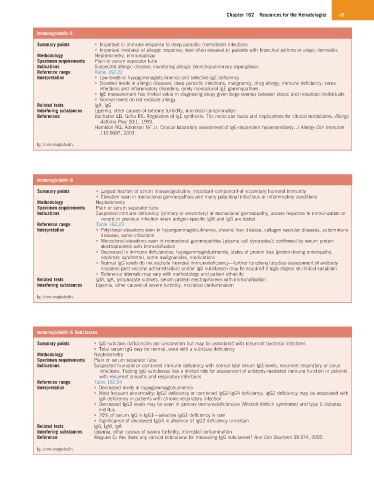
             Immunoglobulin E
             Summary points     •  Important in immune response to deep parasitic (nematode) infections
                                •  Important mediator of allergic response; level often elevated in patients with bronchial asthma or atopic dermatitis
             Methodology        Nephelometry, immunoassay
             Specimen requirements  Plain or serum separator tube
             Indications        Suspected allergic disease; monitoring allergic bronchopulmonary aspergillosis
             Reference range    Table 162.22
             Interpretation     •  Low levels in hypogammaglobulinemia and selective IgE deficiency
                                •  Elevated levels in allergic diseases, deep parasitic infections, malignancy, drug allergy, immune deficiency, some
                                  infections and inflammatory disorders; rarely monoclonal IgE gammopathies
                                •  IgE measurement has limited value in diagnosing atopy given large overlap between atopic and nonatopic individuals
                                •  Normal levels do not exclude allergy
             Related tests      IgA, IgG
             Interfering substances  Lipemia, other causes of extreme turbidity, microbial contamination
             References         Bacharier LB, Geha RS: Regulation of IgE synthesis: The molecular basis and implications for clinical modulation. Allergy
                                  Asthma Proc 20:1, 1999.
                                Hamilton RG, Adkinson NF Jr: Clinical laboratory assessment of IgE-dependent hypersensitivity. J Allergy Clin Immunol
                                  111:S687, 2003.

             Ig, Immunoglobulin.


             Immunoglobulin G
             Summary points     •  Largest fraction of serum immunoglobulins; important component of secondary humoral immunity
                                •  Elevation seen in monoclonal gammopathies and many polyclonal infectious or inflammatory conditions
             Methodology        Nephelometry
             Specimen requirements  Plain or serum separator tube
             Indications        Suspected immune deficiency (primary or secondary) or monoclonal gammopathy, assess response to immunization or
                                  recent or previous infection when antigen-specific IgM and IgG are tested
             Reference range    Table 162.23
             Interpretation     •  Polyclonal elevations seen in hypergammaglobulinemia, chronic liver disease, collagen vascular diseases, autoimmune
                                  diseases, some infections
                                •  Monoclonal elevations seen in monoclonal gammopathies (plasma cell dyscrasias); confirmed by serum protein
                                  electrophoresis with immunofixation
                                •  Decreased in immune deficiencies, hypogammaglobulinemia, states of protein loss (protein-losing enteropathy,
                                  nephrotic syndrome), some malignancies, medications
                                •  Normal IgG levels do not exclude humoral immunodeficiency—further functional studies (assessment of antibody
                                  response post vaccine administration) and/or IgG subclasses may be required if high degree of clinical suspicion
                                •  Reference intervals may vary with methodology and patient ethnicity
             Related tests      IgM, IgA, lymphocyte subsets, serum protein electrophoresis with immunofixation
             Interfering substances  Lipemia, other causes of severe turbidity, microbial contamination
             Ig, Immunoglobulin.


             Immunoglobulin G Subclasses
             Summary points     •  IgG subclass deficiencies are uncommon but may be associated with recurrent bacterial infections
                                •  Total serum IgG may be normal, even with a subclass deficiency
             Methodology        Nephelometry
             Specimen requirements  Plain or serum separator tube
             Indications        Suspected humoral or combined immune deficiency with normal total serum IgG levels, recurrent respiratory or sinus
                                  infections. Testing IgG subclasses has a limited role for assessment of antibody-mediated immune function in patients
                                  with recurrent sinusitis and respiratory infections
             Reference range    Table 162.24
             Interpretation     •  Decreased levels in hypogammaglobulinemia
                                •  Most frequent abnormality: IgG2 deficiency or combined IgG2-IgG4 deficiency. IgG2 deficiency may be associated with
                                 IgA deficiency in patients with chronic respiratory infection
                                •  Decreased IgG3 levels may be seen in primary immunodeficiencies (Wiskott-Aldrich syndrome) and type 1 diabetes
                                 mellitus
                                •  70% of serum IgG is IgG1—selective IgG1 deficiency is rare
                                •  Significance of decreased IgG4 in absence of IgG2 deficiency uncertain
             Related tests      IgG, IgM, IgA
             Interfering substances  Lipemia, other causes of severe turbidity, microbial contamination
             Reference          Maguire G: Are there any clinical indications for measuring IgG subclasses? Ann Clin Biochem 39:374, 2002.

             Ig, Immunoglobulin.

