


Page 281 - Hematology_ Basic Principles and Practice ( PDFDrive )
P. 281
232    Part III  Immunologic Basis of Hematology


                                    CTL                 CTL                CTL
                                            Perforin
                                           granzyme

                                                                 Perforin
                                                              Granzyme

                                                         Target cell          Target cell
                                     Target cell

                                                                               Apoptosis
                                   +
                                                                   +
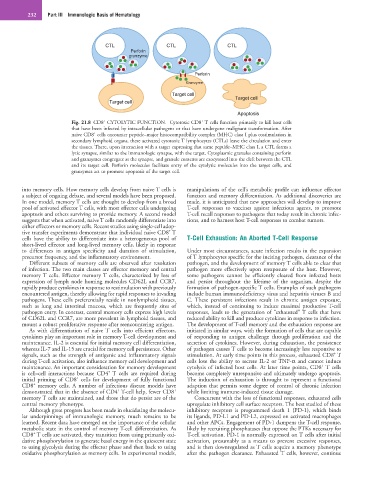
                        Fig. 21.8  CD8  CYTOLYTIC FUNCTION.  Cytotoxic CD8  T cells function primarily to kill host cells
                        that have been infected by intracellular pathogens or that have undergone malignant transformation. After
                                +
                        naive CD8  cells encounter peptide–major histocompatibility complex (MHC) class I plus costimulation in
                        secondary lymphoid organs, these activated cytotoxic T lymphocytes (CTLs) leave the circulation and enter
                        the tissues. There, upon interaction with a target expressing that same peptide–MHC class I, a CTL forms a
                        lytic synapse, similar to the immunologic synapse, with the target. Cytoplasmic granules containing perforin
                        and granzymes congregate at the synapse, and granule contents are exocytosed into the cleft between the CTL
                        and  its  target  cell.  Perforin  molecules  facilitate  entry  of  the  cytolytic  molecules  into  the  target  cells,  and
                        granzymes act to promote apoptosis of the target cell.

        into memory cells. How memory cells develop from naive T cells is   manipulations  of  the  cell’s  metabolic  profile  can  influence  effector
        a subject of ongoing debate, and several models have been proposed.   function and memory differentiation. As additional discoveries are
        In one model, memory T cells are thought to develop from a broad   made, it is anticipated that new approaches will develop to improve
        pool of activated effector T cells, with most effector cells undergoing   T-cell  responses  to  vaccines  against  infectious  agents,  to  promote
        apoptosis and others surviving to provide memory. A second model   T-cell recall responses to pathogens that today result in chronic infec-
        suggests that when activated, naive T cells randomly differentiate into   tions, and to harness host T-cell responses to combat tumors.
        either effectors or memory cells. Recent studies using single-cell adop-
                                                        +
        tive transfer experiments demonstrate that individual naive CD8  T
        cells  have  the  ability  to  differentiate  into  a  heterogeneous  pool  of   T-Cell Exhaustion: An Aborted T-Cell Response
        short-lived effector and long-lived memory cells, likely in response
        to  differences  in  antigen  specificity  and  duration  of  stimulation,   Under most circumstances, acute infection results in the expansion
        precursor frequency, and the inflammatory environment.  of T lymphocytes specific for the inciting pathogen, clearance of the
           Different  subsets  of  memory  cells  are  observed  after  resolution   pathogen, and the development of memory T cells able to clear that
        of infection. The two main classes are effector memory and central   pathogen  more  effectively  upon  reexposure  of  the  host.  However,
        memory T cells. Effector memory T cells, characterized by loss of   some  pathogens  cannot  be  efficiently  cleared  from  infected  hosts
        expression  of  lymph  node  homing  molecules  CD62L  and  CCR7,   and  persist  throughout  the  lifetime  of  the  organism,  despite  the
        rapidly produce cytokines in response to restimulation with previously   formation of pathogen-specific T cells. Examples of such pathogens
        encountered antigen, thereby allowing for rapid responses to invading   include human immunodeficiency virus and hepatitis viruses B and
        pathogens. These cells preferentially reside in nonlymphoid tissues,   C.  These  persistent  infections  result  in  chronic  antigen  exposure,
        such  as  lung  and  intestinal  mucosa,  which  are  frequently  sites  of   which,  instead  of  continuing  to  induce  maximal  productive T-cell
        pathogen entry. In contrast, central memory cells express high levels   responses, leads to the generation of “exhausted” T cells that have
        of CD62L and CCR7, are more prevalent in lymphoid tissues, and   reduced ability to kill and produce cytokines in response to infection.
        mount a robust proliferative response after reencountering antigen.  The development of T-cell memory and the exhaustion response are
           As  with  differentiation  of  naive T  cells  into  efficient  effectors,   initiated in similar ways, with the formation of cells that are capable
        cytokines play an important role in memory T-cell development and   of  responding  to  antigen  challenge  through  proliferation  and  the
        maintenance. IL-2 is essential for initial memory cell differentiation,   secretion of cytokines. However, during exhaustion, the persistence
        whereas IL-7 and IL-15 are crucial for memory cell persistence. Other   of pathogen causes T cells to become increasingly less responsive to
                                                                                                              +
        signals, such as the strength of antigenic and inflammatory signals   stimulation. At early time points in this process, exhausted CD8  T
        during T-cell activation, also influence memory cell development and   cells lose the  ability  to  secrete  IL-2  or TNF-α  and  cannot induce
                                                                                                          +
        maintenance. An important consideration for memory development   cytolysis  of  infected  host  cells.  At  later  time  points,  CD8  T  cells
                                    +
        is  cell–cell  interactions  because  CD4  T  cells  are  required  during   become completely unresponsive and ultimately undergo apoptosis.
                          +
        initial  priming  of  CD8   cells  for  development  of  fully  functional   The  induction  of  exhaustion  is  throught  to  represent  a  functional
            +
        CD8   memory  cells.  A  number  of  infectious  disease  models  have   adaption that permits some degree of control of chronic infection
                                        +
                                                          +
        demonstrated that in the absence of CD4  T-cell help, fewer CD8    while limiting immune-induced tissue damage.
        memory T cells are maintained, and those that do persist are of the   Concurrent with the loss of functional responses, exhausted cells
        central memory phenotype.                             upregulate inhibitory cell surface receptors. The best studied of these
           Although great progress has been made in elucidating the molecu-  inhibitory  receptors  is  programmed  death  1  (PD-1),  which  binds
        lar  underpinnings  of  immunologic  memory,  much  remains  to  be   its ligands, PD-L1 and PD-L2, expressed on activated macrophages
        learned. Recent data have emerged on the importance of the cellular   and other APCs. Engagement of PD-1 dampens the T-cell response,
        metabolic state in the control of memory T-cell differentiation. As   likely by recruiting phosphatases that oppose the PTKs necessary for
            +
        CD8  T cells are activated, they transition from using primarily oxi-  T-cell activation. PD-1 is normally expressed on T cells after initial
        dative phosphorylation to generate basal energy in the quiescent state   activation,  presumably  as  a  means  to  prevent  excessive  responses,
        to using glycolysis during the effector phase and then back to using   and is then downregulated as T cells acquire a memory phenotype
        oxidative phosphorylation as memory cells. In experimental models,   after the pathogen clearance. Exhausted T cells, however, continue

