


Page 276 - Hematology_ Basic Principles and Practice ( PDFDrive )
P. 276
Chapter 21  T-Cell Immunity  227


            killer (NK) T cells, a subtype of lymphocytes that has characteristics   interactions between Notch receptors on the developing T cells and
            of both T and NK cells (see Chapter 22), are also generated in the   specific Notch ligands collaborate with signaling through the IL-7
            thymus. It has become clear recently that additional small popula-  cytokine receptor to regulate lineage commitment and developmental
            tions of T cells possessing unique characteristics are also produced in   progression.
            the thymus. This chapter focuses primarily on αβ T cells and touches   During  the  DN3  stage,  rearrangement  of TCR-γ, TCR-δ,  and
            briefly on γδ T-cell development.                     TCR-β  loci  occurs  with  maximal  efficiency,  and  initial  expression
                                                                  of  the  TCR  proteins  these  genes  encode  occurs.  From  this  time
                                                                  onward in T-cell development, the proliferation and survival of the
            Early T-Cell Development                              developing thymocytes depend on TCR signals. Two key checkpoints
                                                                  must  be  passed  for  full  T-cell  development  to  occur.  First,  upon
            Identifying  T-cell  progenitors  is  an  area  of  intense  investigation   productive rearrangement of the TCR-β locus, the TCR-β protein
            because developing tools to manipulate these cells has great therapeu-  forms a “pre-TCR” complex with an invariant cytosolic protein des-
            tic potential for increasing the speed at which T-cell repopulation may   ignated pre-Tα. This complex engages the TCR signaling machinery,
            occur  following  hematopoietic  stem  cell  transplant.  A  population   including the PTKs Lck, Fyn, and Syk (a ZAP-70-related PTK) and
            of  bone  marrow–derived  thymic  settling  progenitors  (TSPs)  that   the adapters SLP-76 and LAT, to initiate the TCR signaling cascade.
            can  give  rise  to  mature T-cell  populations  has  been  identified.  As   The resultant biochemical second messengers suppress rearrangement
            these cells enter the thymus at the corticomedullary junction, they   of the other β allele resulting in “allelic exclusion,” or silencing of the
            develop into double-negative (DN) T cells, characterized by lack of   nonrearranged allele, to ensure each T cell expresses only one TCR
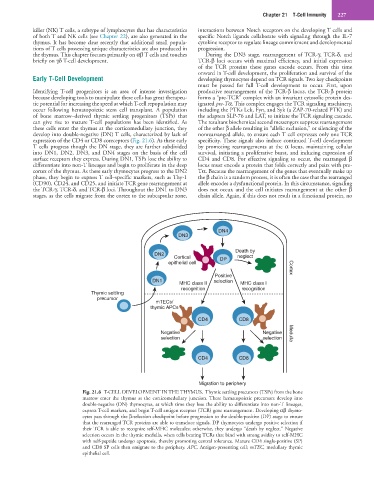
            expression of the CD4 or CD8 coreceptors (Fig. 21.6). As these early   specificity. These signals also induce continued T-cell development
            T cells progress though the DN stage, they are further subdivided   by  promoting  rearrangements  at  the  α  locus,  maintaining  cellular
            into  DN1,  DN2,  DN3,  and  DN4  stages  on  the  basis  of  the  cell   survival, initiating a proliferative burst, and inducing expression of
            surface receptors they express. During DN1, TSPs lose the ability to   CD4  and  CD8.  For  effective  signaling  to  occur,  the  rearranged  β
            differentiate into non-T lineages and begin to proliferate in the deep   locus must encode a protein that folds correctly and pairs with pre-
            cortex of the thymus. As these early thymocytes progress to the DN2   Tα. Because the rearrangement of the genes that eventually make up
            phase, they begin to express T cell–specific markers, such as Thy-1   the β chain is a random process, it is often the case that the rearranged
            (CD90), CD24, and CD25, and initiate TCR gene rearrangement at   allele encodes a dysfunctional protein. In this circumstance, signaling
            the TCR-γ, TCR-δ, and TCR-β loci. Throughout the DN1 to DN3   does not occur, and the cell initiates rearrangement at the other β
            stages, as the cells migrate from the cortex to the subcapsular zone,   chain allele. Again, if this does not result in a functional protein, no


                                                                        DN4
                                                           DN3

                                                                              Death by
                                                    DN2
                                                          Cortical       DP    neglect
                                                        epithelial cell                         Cortex

                                                                       Positive
                                                   DN1                 selection
                                                            MHC class II        MHC class I
                                                            recognition         recognition
                               Thymic settling
                                 precursor
                                                    mTECs/
                                                  thymic APCs
                                                                  CD4          CD8

                                                      Negative                         Negative  Medulla
                                                      selection                        selection


                                                                  CD4          CD8


                                                                  Migration to periphery
                            Fig. 21.6  T-CELL DEVELOPMENT IN THE THYMUS.  Thymic settling precursors (TSPs) from the bone
                            marrow  enter  the  thymus  at  the  corticomedullary  junction. These  hematopoietic  precursors  develop  into
                            double-negative (DN) thymocytes, at which time they lose the ability to differentiate into non-T lineages,
                            express T-cell markers, and begin T-cell antigen receptor (TCR) gene rearrangement. Developing αβ thymo-
                            cytes pass through the β-selection checkpoint before progression to the double-positive (DP) stage to ensure
                            that the rearranged TCR proteins are able to transduce signals. DP thymocytes undergo positive selection if
                            their TCR is able to recognize self-MHC molecules; otherwise, they undergo “death by neglect.” Negative
                            selection occurs in the thymic medulla, when cells bearing TCRs that bind with strong avidity to self-MHC
                            with self-peptide undergo apoptosis, thereby promoting central tolerance. Mature CD4 single-positive (SP)
                            and CD8 SP cells then emigrate to the periphery. APC, Antigen-presenting cell; mTEC, medullary thymic
                            epithelial cell.

