


Page 283 - Hematology_ Basic Principles and Practice ( PDFDrive )
P. 283
234    Part III  Immunologic Basis of Hematology


                                                 Cytokine
                                                deprivation
                                                                                CTLA4  CD28   TCR        PD1  TGF-R

                                    IL-2           Effector
                                                    cell

         Inhibitory cytokines                                                      Phosphorylation-dependent
                               CD25                                         Inhibitory  proximal signals  Inhibitory
                                                                             signals                     signals
                       IL-10
                       TGF-β                                          DGKs
                                                                                                       Shp-1
              Effector           Treg
                cell
                                                                                  PLCγ1
                                                                         DAG                          E3
                                                                PA                       PIP2
                                                                      Ras
                                      Apoptosis via                             IP3                 Ub
                                    cell-mediated contact                                             PI3K
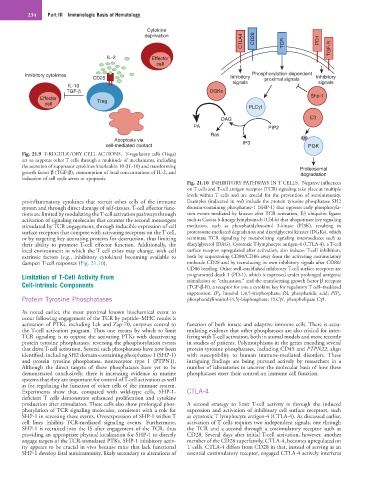
        Fig. 21.9  T-REGULATORY CELL ACTIONS.  T-regulatory cells (Tregs)
        act to suppress other T cells through a multitude of mechanisms, including
        the secretion of suppressor cytokines interleukin 10 (IL-10) and transforming              Proteosomal
        growth factor β (TGF-β), consumption of local concentrations of IL-2, and                  degradation
        induction of cell cycle arrest or apoptosis.
                                                              Fig. 21.10  INHIBITORY PATHWAYS IN T CELLS.  Negative influences
                                                              on T cells and T-cell antigen receptor (TCR) signaling take place at multiple
                                                              levels  within T  cells  and  are  crucial  for  the  prevention  of  autoimmunity.
        proinflammatory  cytokines  that  recruit  other  cells  of  the  immune   Examples (indicated in red) include the protein tyrosine phosphatase SH2
        system and through direct damage of self-tissues. T-cell effector func-  domain-containing phosphatase-1 (SHP-1) that opposes early phosphoryla-
        tions are limited by modulating the T-cell activation pathways through   tion events mediated by kinases after TCR activation, E3 ubiquitin ligases
        activation of signaling molecules that counter the second messengers   such as Casitas b-lineage lymphoma-b (Cbl-b) that ubiquitinate key signaling
        stimulated by TCR engagement, through inducible expression of cell   mediators,  such  as  phosphatidylinositol  3-kinase  (PI3K),  resulting  in
        surface receptors that compete with activating receptors on the T cell,   proteosome-mediated degradation and diacylglycerol kinases (DGKs), which
        or by targeting key activating proteins for destruction, thus limiting   terminate TCR  signaling  by  metabolizing  signaling  intermediates  such  as
        their  ability  to  promote T-cell  effector  function.  Additionally,  the   diacylglycerol (DAG). Cytotoxic T-lymphocyte antigen-4 (CTLA-4), a T-cell
        local environment in which the T cell exists may change, with cell   surface receptor upregulated after activation, also induces T-cell inhibition,
        extrinsic  factors  (e.g.,  inhibitory  cytokines)  becoming  available  to   both by sequestering CD80/CD86 away from the activating costimulatory
        dampen T-cell responses (Fig. 21.10).                 molecule CD28 and by transducing its own inhibitory signals after CD80/
                                                              CD86 binding. Other well-established inhibitory T-cell surface receptors are
        Limitation of T-Cell Activity From                    programmed death 1 (PD-1), which is expressed under prolonged antigenic
                                                              stimulation or “exhaustion,” and the transforming growth factor β receptor
        Cell-Intrinsic Components                             (TGF-β-R), a receptor for one a cytokine key for regulatory T cell–mediated
                                                              suppression. IP 3 , Inositol 1,4,5-trisphosphate; PA, phosphatidic acid; PIP 2 ,
        Protein Tyrosine Phosphatases                         phosphatidylinositol-(4,5)-bisphosphate; PLCγ1, phospholipase Cγ1.

        As  noted  earlier,  the  most  proximal  known  biochemical  event  to
        occur following engagement of the TCR by peptide–MHC results is
        activation of PTKs, including Lck and Zap-70, enzymes central to   function of both innate and adaptive immune cells. There is accu-
        the T-cell  activation  program. Thus  one  means  by  which  to  limit   mulating evidence that other phosphatases are also critical for inter-
        TCR signaling is to oppose the activating PTKs with deactivating   fering with T-cell activation, both in animal models and more recently
        protein tyrosine phosphatases, reversing the phosphorylation events   in studies of patients. Polymorphisms in the genes encoding several
        that drive T-cell activation. Several such phosphatases have now been   protein tyrosine phosphatases, including CD45 and PTPN22, align
        identified, including SH2 domain-containing phosphatase 1 (SHP-1)   with  susceptibility  to  human  immune-mediated  disorders.  These
        and  protein  tyrosine  phosphatase,  nonreceptor  type  1  (PTPN1).   intriguing  findings  are  being  pursued  actively  by  researchers  in  a
        Although  the  direct  targets  of  these  phosphatases  have  yet  to  be   number of laboratories to uncover the molecular basis of how these
        demonstrated  conclusively,  there  is  increasing  evidence  in  murine   phosphatases exert their control on immune cell function.
        systems that they are important for control of T-cell activation as well
        as for regulating the function of other cells of the immune system.
        Experiments  show  that,  compared  with  wild-type  cells,  SHP-1-   CTLA-4
        deficient T  cells  demonstrate  enhanced  proliferation  and  cytokine
        production after stimulation. These cells also show prolonged phos-  A  second  strategy  to  limit  T-cell  activity  is  through  the  induced
        phorylation of TCR signaling molecules, consistent with a role for   expression  and  activation  of  inhibitory  cell  surface  receptors,  such
        SHP-1 in reversing these events. Overexpression of SHP-1 within T   as cytotoxic T lymphocyte antigen-4 (CTLA-4). As discussed earlier,
        cell  lines  inhibits  TCR-mediated  signaling  events.  Furthermore,   activation of T cells requires two independent signals, one through
        SHP-1 is recruited into the IS after engagement of the TCR, thus   the  TCR  and  a  second  through  a  costimulatory  receptor  such  as
        providing an appropriate physical localization for SHP-1 to directly   CD28. Several days after initial T-cell activation, however, another
        engage targets of the TCR-stimulated PTKs. SHP-1 inhibitory activ-  member of the CD28 superfamily, CTLA-4, becomes upregulated on
        ity appears to be crucial in vivo because mice that lack functional   T cells. CTLA-4 differs from CD28 in that, instead of serving as an
        SHP-1 develop fatal autoimmunity, likely secondary to alterations of   essential costimulatory receptor, engaged CTLA-4 actively interferes

