


Page 278 - Hematology_ Basic Principles and Practice ( PDFDrive )
P. 278
Chapter 21  T-Cell Immunity  229


                                                                                 Consequences of
                                                                                uncontrolled activity
                                                      Th1
                                                                           IFN-γ  Inflammation
                                                          T-bet
                                            +IFN-γ,
                                             IL-12        Th2
                                                                            IL-4
                                                +IL-4, TSLP,  GATA3         IL-5    Allergy
                                                IL-25, IL-33               IL-13

                                         Naive      +IL-6,
                                         CD4 +   IL-21, TGF-β  Th17
                                                                           IL-17a
                                                                RORγt             Autoimmunity
                                                 +IL-21                    IL-17f
                                                        Tfh

                                                          Bcl-6            IL-21      ?

                                                        +
                                                                                        +
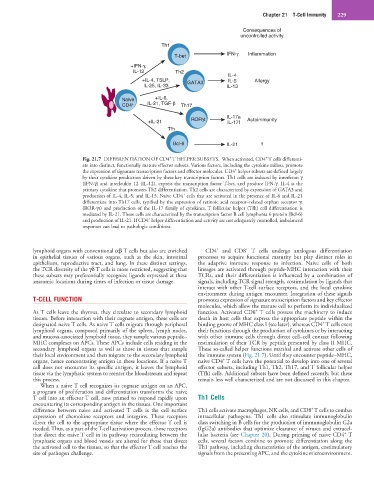
                            Fig. 21.7  DIFFERENTIATION OF CD4  T HELPER SUBSETS.  When activated, CD4  T cells differenti-
                            ate into distinct, functionally mature effector subsets. Various factors, including the cytokine milieu, promote
                                                                              +
                            the expression of signature transcription factors and effector molecules. CD4  helper subsets are defined largely
                            by their cytokine production driven by these key transcription factors. Th1 cells are induced by interferon γ
                            (IFN-γ) and interleukin 12 (IL-12), express the transcription factor T-bet, and produce IFN-γ. IL-4 is the
                            primary cytokine that promotes Th2 differentiation. Th2 cells are characterized by expression of GATA3 and
                                                             +
                            production of IL-4, IL-5, and IL-13. Naive CD4  cells that are activated in the presence of IL-6 and IL-21
                            differentiate into Th17 cells, typified by the expression of retinoic acid receptor–related orphan receptor γt
                            (ROR-γt) and production of the IL-17 family of cytokines. T follicular helper (Tfh) cell differentiation is
                            mediated by IL-21. These cells are characterized by the transcription factor B cell lymphoma 6 protein (Bcl-6)
                                                  +
                            and production of IL-21. If CD4  helper differentiation and activity are not adequately controlled, imbalanced
                            responses can lead to pathologic conditions.
                                                                                 +
                                                                        +
            lymphoid organs with conventional αβ T cells but also are enriched   CD4   and  CD8   T  cells  undergo  analogous  differentiation
            in  epithelial  tissues  of  various  organs,  such  as  the  skin,  intestinal   processes  to  acquire  functional  maturity  but  play  distinct  roles  in
            epithelium, reproductive tract, and lung. In these distinct settings,   the  adaptive  immune  response  to  infection.  Naive  cells  of  both
            the TCR diversity of the γδ T cells is more restricted, suggesting that   lineages are activated through peptide-MHC interaction with their
            these subsets may preferentially recognize ligands expressed at these   TCRs, and their differentiation is influenced by a combination of
            anatomic locations during times of infection or tissue damage.  signals, including TCR signal strength, costimulation by ligands that
                                                                  interact with other T-cell surface receptors, and the local cytokine
                                                                  environment during antigen encounter. Integration of these signals
            T-CELL FUNCTION                                       promotes expression of signature transcription factors and key effector
                                                                  molecules, which allow the mature cell to perform its individualized
                                                                                     +
            As T cells leave the thymus, they circulate to secondary lymphoid   function. Activated CD8  T cells possess the machinery to induce
            tissues. Before interaction with their cognate antigen, these cells are   death in host cells that express the appropriate peptide within the
                                                                                                           +
            designated naive T cells. As naive T cells migrate through peripheral   binding groove of MHC class I (see later), whereas CD4  T cells exert
            lymphoid organs, composed primarily of the spleen, lymph nodes,   their functions through the production of cytokines or by interacting
            and mucosa-associated lymphoid tissue, they sample various peptide–  with other immune cells through direct cell–cell contact following
            MHC complexes on APCs. These APCs include cells residing in the   restimulation of their TCR by peptide presented by class II MHC.
            secondary lymphoid organs as well as those in tissues that sample   These so-called helper functions marshal and activate other cells of
            their local environment and then migrate to the secondary lymphoid   the immune system (Fig. 21.7). Until they encounter peptide–MHC,
                                                                          +
            organs, hence concentrating antigen in these locations. If a naive T   naive CD4  T cells have the potential to develop into one of several
            cell does not encounter its specific antigen, it leaves the lymphoid   effector subsets, including Th1, Th2, Th17, and T follicular helper
            tissue via the lymphatic system to reenter the bloodstream and repeat   (Tfh) cells. Additional subsets have been defined recently, but these
            this process.                                         remain less well characterized and are not discussed in this chapter.
              When a naive T cell recognizes its cognate antigen on an APC,
            a program of proliferation and differentiation transforms the naive
            T cell into an effector T cell, now primed to respond rapidly upon   Th1 Cells
            encountering its corresponding antigen in the tissues. One important
                                                                                                       +
            difference  between  naive  and  activated  T  cells  is  the  cell  surface   Th1 cells activate macrophages, NK cells, and CD8  T cells to combat
            expression  of  chemokine  receptors  and  integrins.  These  receptors   intracellular  pathogens.  Th1  cells  also  stimulate  immunoglobulin
            direct the cell to the appropriate tissue where the effector T cell is   class switching in B cells for the production of immunoglobulin G2a
            needed. Thus, as a part of the T-cell activation process, those receptors   (IgG2a) antibodies that optimize clearance of viruses and extracel-
                                                                                                                  +
            that direct the naive T cell in its pathway recirculating between the   lular bacteria (see Chapter 20). During priming of naive CD4  T
            lymphatic organs and blood vessels are altered for those that direct   cells,  several  factors  combine  to  promote  differentiation  along  the
            the activated cell to the tissues, so that the effector T cell reaches the   Th1 pathway, including characteristics of the antigen, costimulatory
            site of pathogen challenge.                           signals from the presenting APC, and the cytokine microenvironment.

