


Page 311 - Hematology_ Basic Principles and Practice ( PDFDrive )
P. 311
Chapter 23  Dendritic Cell Biology  259


               A. Compromised immunity in advanced cancer  Tumor dLNs
                         Tumor bed                                                  Tumor bed
                                                                CD4 +
                                                                T cell        T reg       CD4 +
                                                                              cell        T cell
                                                                                              TGFβ
                                                                           IL-10
                                                                CD8 +
                                                                T cell          +             T reg
                                                                             CD8
                                                                             T cell           cell
                                                                 CD4 +            CD4 +
                                                                 T cell           T cell    CD8 +
                                                                                           T cell


                  Immunocompromised response   T-cell exhaustion               Immunosuppressive environment
                  - DC dysregulation           - Exhausted tumor-specific T cells  - IL-10/TGFβ
                                               - CTLA-4, PD-1, LAG3, and TIM3  - T regs  and MDSCs
                                                 inhibitory signals            - Cancer cell immune evasion (loss of MHCI,
                                                                                  antigen loss, PD-L1 upregulation)

               B. Cancer vaccines                       Tumor dLNs
                         Tumor bed                                                  Tumor bed
                                                               CD4 +
                                                               T cell                     CD4 +
                                                                                          T cell

                                                               CD8 +
                                                               T cell
                                                                             CD8 +
                                                                            T cell
                                                                CD4 +             CD4 +
                                                                T cell           T cell    CD8 +
                                                                                           T cell


                  Activating DCs               T-cell activation               Reverse inhibition in TME
                  - DC-based or targeted vaccines  - Cytokines - IL-2, IL-7 and IL-15  - Immunogenic cell death induction (XRT and
                    and adjuvants              - IDO inhibitors                  chemotherapy)
                  - DC mobilizing agents       - Anti-CD27, CD134, CD137       - Anti-VEGF mAbs
                  - Anti-CD40 mAbs                                             - Anti-tumor specific mAbs (Anti-CD20, Ab-drugs
                                               Checkpoint blockade               congugates, etc.)
                                               - Anti-CTLA-4, Anti-PD-1, Anti-PD-L1
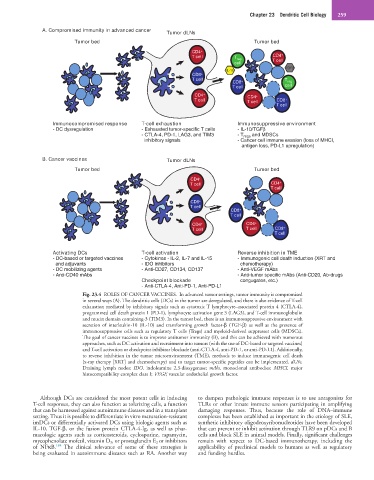
                            Fig. 23.4  ROLES OF CANCER VACCINES.  In advanced tumor settings, tumor immunity is compromised
                            in several ways (A). The dendritic cells (DCs) in the tumor are deregulated, and there is also evidence of T-cell
                            exhaustion mediated by inhibitory signals such as cytotoxic T lymphocyte–associated protein 4 (CTLA-4),
                            programmed cell death protein 1 (PD-1), lymphocyte activation gene 3 (LAG3), and T-cell immunoglobulin
                            and mucin domain containing-3 (TIM3). In the tumor bed, there is an immunosuppressive environment with
                            secretion  of  interleukin-10  (IL-10)  and  transforming  growth  factor-β  (TGF-β)  as  well  as  the  presence  of
                            immunosuppressive cells such as regulatory T cells (Tregs) and myeloid-derived suppressor cells (MDSCs).
                            The goal of cancer vaccines is to improve antitumor immunity (B), and this can be achieved with numerous
                            approaches, such as DC activation and recruitment into tumors (with the use of DC-based or targeted vaccines)
                            and T-cell activation or checkpoint inhibitor blockade (anti-CTLA-4, anti-PD-1, or anti-PD-L1). Additionally,
                            to reverse inhibition in the tumor microenvironment (TME), methods to induce immunogenic cell death
                            (x-ray therapy [XRT] and chemotherapy) and to target tumor-specific peptides can be implemented. dLNs,
                            Draining  lymph  nodes;  IDO,  indoleamine  2,3-dioxygenase;  mAbs,  monoclonal  antibodies;  MHCI,  major
                            histocompatibility complex class I; VEGF, vascular endothelial growth factor.


              Although DCs are considered the most potent cells in inducing   to  dampen  pathologic  immune  responses  is  to  use  antagonists  for
            T-cell responses, they can also function as tolerizing cells, a function   TLRs  or  other  innate  immune  sensors  participating  in  amplifying
            that can be harnessed against autoimmune diseases and in a transplant   damaging  responses.  Thus,  because  the  role  of  DNA–immune
            setting. Thus it is possible to differentiate in vitro maturation-resistant   complexes has been established as important in the etiology of SLE,
            imDCs or differentially activated DCs using biologic agents such as   synthetic inhibitory oligodeoxyribonucleotides have been developed
            IL-10, TGF-β,  or  the  fusion  protein  CTLA-4-Ig,  as  well  as  phar-  that can prevent or inhibit activation through TLR9 on pDCs and B
            macologic  agents  such  as  corticosteroids,  cyclosporine,  rapamycin,   cells and block SLE in animal models. Finally, significant challenges
            mycophenolate mofetil, vitamin D 3, or prostaglandin E 2 or inhibitors   remain  with  respect  to  DC-based  immunotherapy,  including  the
                   184
            of  NFκB.   The  clinical  relevance  of  some  of  these  strategies  is   applicability of preclinical models to humans as well as regulatory
            being evaluated in autoimmune diseases such as RA. Another way   and funding hurdles.

